
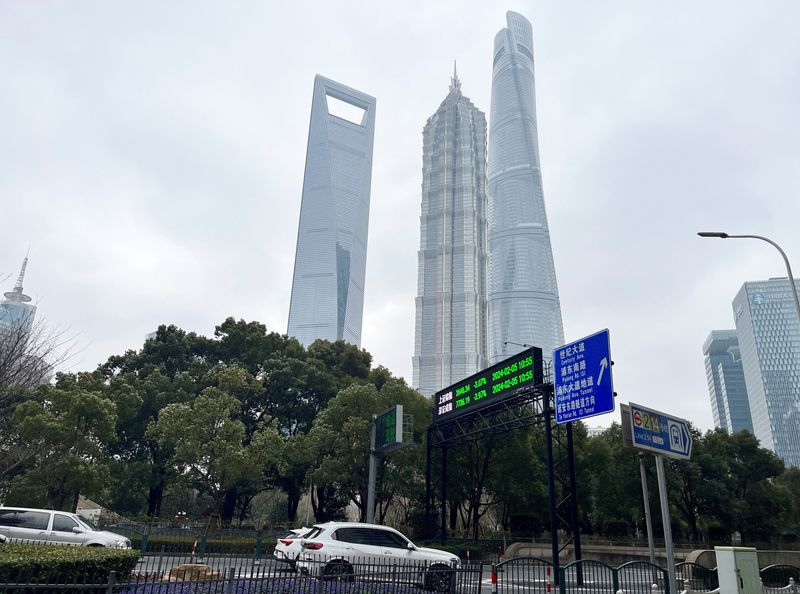
© Reuters. Cars travel past a display showing Shanghai and Shenzhen stock indexes near the Shanghai Tower and other skyscrapers at the Lujiazui financial district in Shanghai, China February 5, 2024. REUTERS/Xihao Jiang
By Tom Westbrook and Summer Zhen
SINGAPORE/HONG KONG (Reuters) – For a second day running state-backed buying likely scraped Chinese stocks from multi-year lows. Investors doubt the support will last and warn it leaves markets unbalanced and unstable.
Formed in response to a market crash in 2015, the so called “national team” of Chinese state-backed investors poured $17 billion into index-tracking funds last month and were piling in on Friday and Monday as markets fell, analysts say.
On both days, the index slid suddenly to five-year lows before recovering simultaneously with surges in turnover at blue-chip stock tracking index funds.[.SS]
But analysts and investors say propping up the market with cash can’t be sustained and won’t provide a lasting turnaround as long as the property sector remains weak and a weight on consumer and investor confidence. The task is also giant: mainland stocks are worth nearly $9 trillion.
“This effect may resemble the outcome observed during the 2015 boom-and-bust cycle,” said Dennis Yang, Professor of Business Administration at the University of Virginia Darden (NYSE:) School of Business.
“The short-term solution is unlikely to be sufficient for restoring long-term confidence among global investors without addressing the underlying issues in the Chinese economy.”
In 2015 with a vastly more favourable economic backdrop the effect of “national team” buying was debatable and in any case, it took months for markets to find a bottom and more than five years for the blue-chip CSI300 to regain its peak.
This time analysts say similar buying has been evident for months – with S&P Global Market Intelligence tracking more than $17 billion into blue-chip tracking funds last month – but there is no resolution in sight to the core growth problem.
“China’s economy is shifting away from infrastructure and property investment and towards higher value-added industries,” said Ben Bennett, Asia-Pacific investment strategist at Legal & General Investment Management.
“Recent stimulus is trying to ease the transition by focusing on the symptoms such as decelerating credit growth and volatile equity markets. But the transition is still taking place, so such policies can only have a limited impact.”
QUESTIONABLE
The underperformance of China’s markets is stark, as are signals that investor trust and patience are spent.
Numerous market-focused support measures such as restrictions on short-selling or reductions in trading duties have also failed to staunch the selloff, as have a number of government statements promising support but lacking details.
Most big investors say they are waiting for a spending package to help households. There has been no official confirmation of a Bloomberg News report of a mooted 2 trillion yuan stockmarket bailout fund.
“Consumers face multiple crises of confidence in debt, property, and employment, emphasising the multifaceted challenges confronting China’s economy,” said Michael Ashley Schulman, partner & CIO of Running Point Capital Advisors.
“The effectiveness of the market rescue … is questionable if it does not address weak aggregate demand or the deeper issues in the property market,” he said. “Beijing’s historical market interventions have shown short-lived impacts.”
Foreign investors sold a net 18.2 billion yuan ($2.5 billion) in Chinese equities last month to notch a sixth straight month of outflows.
The has fallen six months in a row, losing 20%, while world shares added 5%. Small domestic investors are scrambling to buy funds tracking foreign shares.
To be sure, there are speculators circling who think that Chinese stocks are so cheap as to be bargain value. And the entry of state-backed investors could bend markets and open opportunities to follow the “national team” into index funds.
“The rescue is unbalanced, they mainly save the central (state-owned enterprises) and the blue-chip CSI 300 stocks,” said Pang Xichun, research director at Nanjing RiskHunt Investment Management.
He recommends taking long positions in such state-owned companies and shorting small companies. While not exactly a bet on improvement, such a position – at least for now – may be profitable. The CSI 300 finished Monday up 0.7% and the small-cap index down 6.2%.
($1 = 7.1963 renminbi)
