

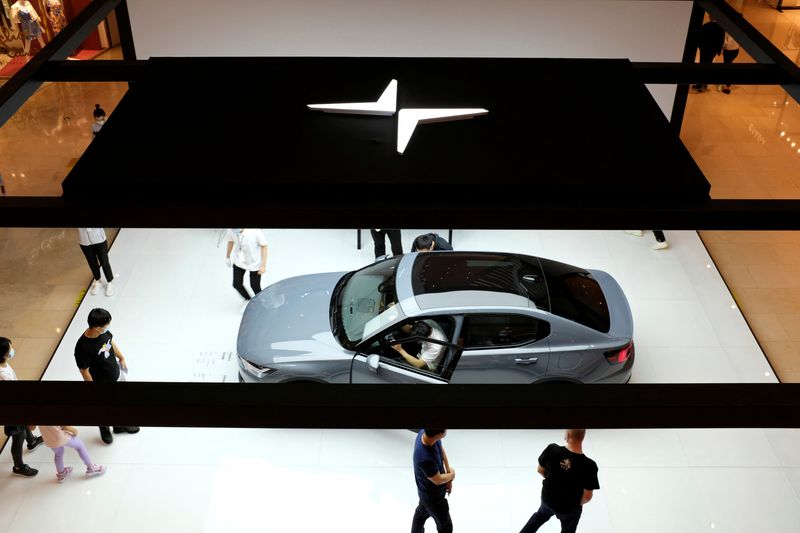
© Reuters. FILE PHOTO: People look at a Polestar 2 electric sedan displayed in a shopping mall in Shanghai, China May 5, 2020. Picture taken May 5, 2020. REUTERS/Yilei Sun/File Photo
2/5
By Marie Mannes, Nick Carey and Joseph White
STOCKHOLM (Reuters) – The shakeout in the global electric-vehicle industry is picking up speed.
Chinese automaker Geely’s move on Thursday to take over funding of struggling EV maker Polestar (NASDAQ:) from Volvo (OTC:) Cars is the latest consolidation among EV brands since Tesla (NASDAQ:) Inc’s historic financial surge in the early 2020s.
Tesla rode cheap capital, technological breakthroughs and Elon Musk’s outsized persona to a $1-trillion valuation – but only after years of heavy spending before turning a profit. Now legacy automakers, startups and investors that bet more than $1.2 trillion on EVs face increasingly tough decisions to cut losses.
Geely owns a majority stake in Volvo, which has operated Polestar as an offshoot luxury EV brand with similar styling.
The struggles of Polestar and other smaller players underscore the massive expense of developing EVs, which favor deep-pocketed companies willing and able withstand sustained financial bleeding. A global EV-demand slowdown could now weed out weaker players or force a consolidation wave.
“It’s certainly shakeout time,” said Andy Leyland, co-founder of supply chain specialist SC Insights. “EV startups need to start showing both how they will move to profitability, and how they will compete … with larger players and the Chinese.”
Volvo’s decision to halt Polestar investments came after the money-losing luxury EV offshoot brand missed a 2023 delivery target that had already been repeatedly revised downward.
Polestar needs another $1.3 billion in funding before it reaches the break-even point in 2025. Its stock has dropped 87% since it debuted in June 2022, limiting its ability to raise fresh capital.
Geely, among China’s largest automakers, sold nearly 2.8 million vehicles in 2023 – roughly four times the number of vehicles as Volvo.
Geely Chair Li Shufu aims to expand exports from China and gain economies of scale across brands including Western nameplates Volvo, Smart and Lotus. With full control of Polestar, Geely could streamline investment and technology sharing, analysts said.
Polestar welcomed Geely’s financial backing in a statement Tuesday. Geely said Thursday it will “continue to provide full operational and financial support” to Polestar going forward. That will not require a reduction of Geely Holding shareholding in Volvo Cars.
Other EV startups including Rivian (NASDAQ:), Fisker (NYSE:), Arrival, Xpeng (NYSE:) and Lucid (NASDAQ:) have all struggled with the cost of scaling up. Fisker, for example, last month renegotiated terms of a debt deal to allow it to take on a strategic partner.
Tesla also struggled with what Musk called “production hell” – but did so in 2018 when money was cheap, investors were more patient and future demand for EVs seemed limitless.
Capital-market enthusiasm for EVs has cooled as the growth of EV sales slowed and financial losses have piled up. That shortened runways for money-losing startups and pushed legacy automakers to seek more public subsidies.
EV PRICE WAR ESCALATES
Musk’s warning last week Tesla’s growth pace will slow this year led investors to slash $80 billion from the company’s market value in one day. Tesla has lost more than 40% of its value since it hit the $1 trillion market cap milestone in 2021.
The price war that Tesla and EV sales leader BYD (SZ:) escalated last year has forced weaker EV industry rivals to choose between wider losses or lower sales volumes.
Ford (NYSE:) last summer ramped up production of its Ford cut F-150 Lightning in anticipation on strong demand only to cut later cut 2024 production forecast by half in January.
In Europe, Stellantis (NYSE:) has said it needs more Italian-government subsidies to increase production of electric vehicles at Fiat factories. A senior Italian official said Thursday the government would consider taking a stake in Fiat to support more jobs.
As the EV industry has become more Darwinian, investors are rewarding companies that pull back on spending.
Volvo shares soared more than 30% Thursday after the company said it would no longer fund Polestar. Investors cheered when Renault (EPA:) said it would not go forward with a planned share offering for its Ampere EV unit.
General Motors (NYSE:) shares have risen nearly 50% since November as CEO Mary Barra has slowed spending on EVs and autonomous vehicles and launched a $10 billion share buyback.
GM has realized “spending $36mm per day trying to be the ‘next Tesla’ isn’t working,” Morgan Stanley analyst Adam Jonas said in a note Thursday.
Consolidation waves are not new for the capital-intensive auto industry.
In the early 20th century, scores of U.S. and European entrepreneurs tried to cash in on the promise of then-new combustion-engine technology. For every Henry Ford, dozens of other car-company founders failed or were swallowed by bigger, better-funded rivals. General Motors, Stellantis and Volkswagen (ETR:) are built on the skeletons of once-independent automakers.
Geely’s move to consolidate Polestar represents one pathway for struggling EV startups.
“Putting Polestar in the direct Geely orbit may help distribute the weight over a larger group’s balance sheet, giving them more time to scale up,” said Bill Russo, CEO of Shanghai-based advisory firm Automobility.
