
Key Takeaways:
- Perp DEXs are gaining momentum: platforms like Hyperliquid and Aster have pushed decentralized exchanges into trading volume levels once reserved for CEXs.
- CEX tokens rallied before the September market correction, signaling renewed institutional interest and regulatory clarity.
- Experts agree CEXs still lead on liquidity, fiat on- and off-ramps, and compliance, making them essential for institutions and new users.
- DEXs provide privacy, transparency, and access to small-cap tokens, advantages that centralized platforms cannot replicate.
- Hybrid models are emerging as the most likely path forward, combining the scale and usability of CEXs with the autonomy of DEXs.
The launch of Hyperliquid (HYPE) has shifted the direction of the crypto exchange market. Its hybrid model proved that a new platform could combine elements of centralized exchanges (CEXs) with features of decentralized exchanges (DEXs). That mix has been central to its success.
Throughout 2025, Hyperliquid held its lead among so-called perpetual decentralized exchanges, or perp DEXs. But in September, a new contender entered the stage: Aster with its native token. The project has backing from Changpeng Zhao (CZ), hinting at unofficial support from Binance.
Aster Shakes Up the Perp DEX Market
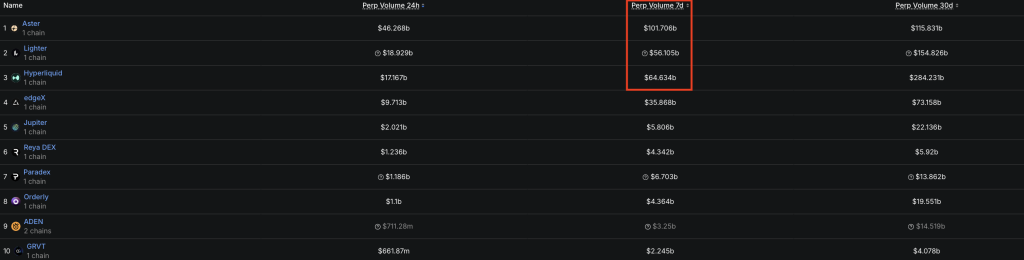
This could be the exchange’s way of stepping into the perp DEX market to prevent Hyperliquid from taking too much of its client base. And so far, the numbers suggest it is working. According to DeFiLlama, Aster’s trading volume over the past seven days topped $100 billion. Lighter followed with $56 billion, while Hyperliquid ranked third with $64.6 billion (note: it takes third place in the table due to lower daily volume).
It is still too early to judge how serious these competitors are, or whether this will mirror the story of Pump.Fun and other launchpads. At first, rival platforms surged on hype, but Pump.Fun eventually reclaimed its lead. With perp DEXs, the main question is not ranking but the sheer volume of money flowing through them. Just a year ago, such figures would have been unthinkable for decentralized exchanges.
This raises the key issue: can CEXs withstand the surge of perp DEXs and keep their place in a market that is increasingly moving toward decentralized alternatives? Experts share their views below.
Why Perp DEXs and CEXs Need Each Other
Frank Combay, COO of Next Generation NGPES, a platform connecting traditional financial infrastructure with digital assets, argues that the rally in exchange tokens, which began in late August before the recent market correction, reflects more than just short-term hype. He points to stronger institutional demand and regulatory clarity as the key drivers:
Institutional investors demonstrated a renewed interest in exchange-based crypto tokens, which significantly boosted their performance throughout August. This renewed confidence coincides with an increase in regulatory initiatives, creating a more predictable and secure investment environment.
He added that these conditions have fueled higher volumes on centralized exchanges and are likely to support demand for CEX tokens well into 2026. According to Combay, liquidity, tighter spreads, and fiat on- and off-ramps remain lasting advantages for centralized platforms.
Farzam Ehsani, co-founder and CEO of VALR, a centralized crypto trading platform, believes the future of exchanges is not about one model replacing the other but about how both can serve different needs:
While CEXs and DEXs certainly compete on some levels, it’s more helpful to see such venues as complementary in their service to humanity.
He noted that decentralized exchanges may provide anonymity and early access to small-cap tokens, while centralized platforms remain better positioned for newcomers thanks to usability, support, and liquidity.
In Ehsani’s view, institutional adoption will continue to lean toward CEXs, while DEXs will retain an edge in privacy and innovation:
The future of finance doesn’t need to be monolithic. CEXs and DEXs, and even TradFi institutions, can co-exist and collaborate in serving the diverse needs of humanity.
Lionel Iruk, senior advisor to Nav Markets and managing partner at Empire Legal, echoed the balance but cautioned against overinterpreting the rise of CEX tokens:
The recent uptick in exchange tokens like OKX, Cronos, and KuCoin reflects a growing investor interest in platforms that offer utility and governance within their ecosystems. However, it’s essential to differentiate between short-term market movements and long-term value propositions.
Iruk highlighted that centralized exchanges still hold the edge in liquidity management, compliance, and governance. At the same time, both CEXs and DEXs face persistent risks, from security breaches and regulatory scrutiny to thin liquidity pools and smart contract vulnerabilities.
The Role of Hybrid Models
Lionel Iruk sees hybrid models as a natural evolution for the market. By blending the liquidity and governance of CEXs with the transparency and autonomy of DEXs, exchanges can cover each other’s weaknesses:
Such models can offer enhanced liquidity, user control, and compliance. As the regulatory landscape evolves, exchanges will need to adapt and innovate to meet the demands of a diverse user base.
Farzam Ehsani underlines that CEXs still provide advantages that remain critical for institutions and newcomers alike:
CEXs have clear advantages in areas that include user experience, security, accountability, and regulatory compliance. This makes them particularly suitable for institutional investors as well as users who prioritize trust and reliability in their trading environment.
At the same time, he acknowledged the unique appeal of DEXs:
Privacy is often touted as an important part of the decentralized trading experience, with anonymity and access to small-cap tokens as core features. DEXs allow users to trade directly from their non-custodial wallets, giving them control over assets and early access to emerging, albeit volatile, digital assets.
Frank Combay called hybrids a logical step that directly addresses the biggest limitations of both models:
By combining CEX liquidity and performance with DEX transparency and self-custody, these hybrids mitigate scalability issues on one side and custodial risks on the other.
The DEX-to-CEX spot volume ratio shows how quickly perp DEXs have gained ground. From late 2023 through early 2025, their share of spot volumes rose gradually from below 10% to around 20–25%. In the spring of 2025, the pace accelerated, with the ratio briefly surpassing 60% before settling back near 30–35%.
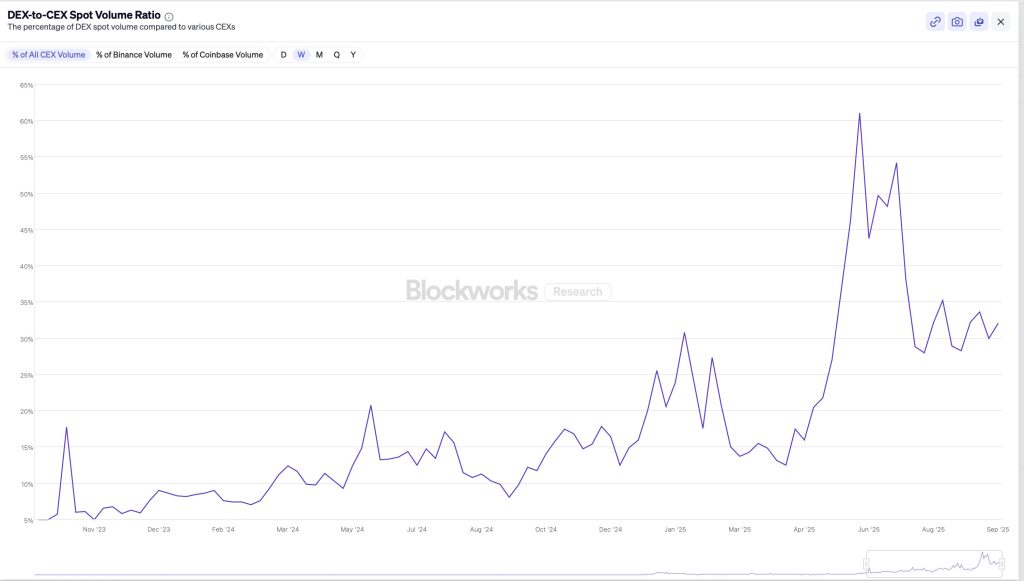
Even after the correction, the level remains several times higher than in previous years. This signals that the rise of perp DEXs is not just a short-term trend but a structural change in market behavior.
For CEXs, the message is clear: they no longer dominate liquidity in the way they once did. Whether through hybrid models or new competitive strategies, centralized platforms will need to adapt if they want to remain at the center of crypto trading.
Taken together, the experts agree that CEXs continue to dominate in areas like liquidity, accessibility, and regulatory compliance, which remain critical for institutions and new market entrants. DEXs, however, offer privacy, transparency, and access to emerging tokens that centralized platforms cannot match.
Rather than a winner-takes-all outcome, the future of trading may lie in hybrid models that combine the efficiency and scale of CEXs with the openness and self-custody of DEXs. Frank Combay underlines:
DEXs pose a spectrum of risks, primarily low liquidity and price slippage. Thin liquidity pools on smaller or newer platforms can lead to high slippage and unfavorable trade execution. Besides this, the users might face regulatory uncertainty, cyber threats and smart contract vulnerabilities.
The post CEXs vs Perp DEXs: Who Will Win? Experts Weigh In appeared first on Cryptonews.
