
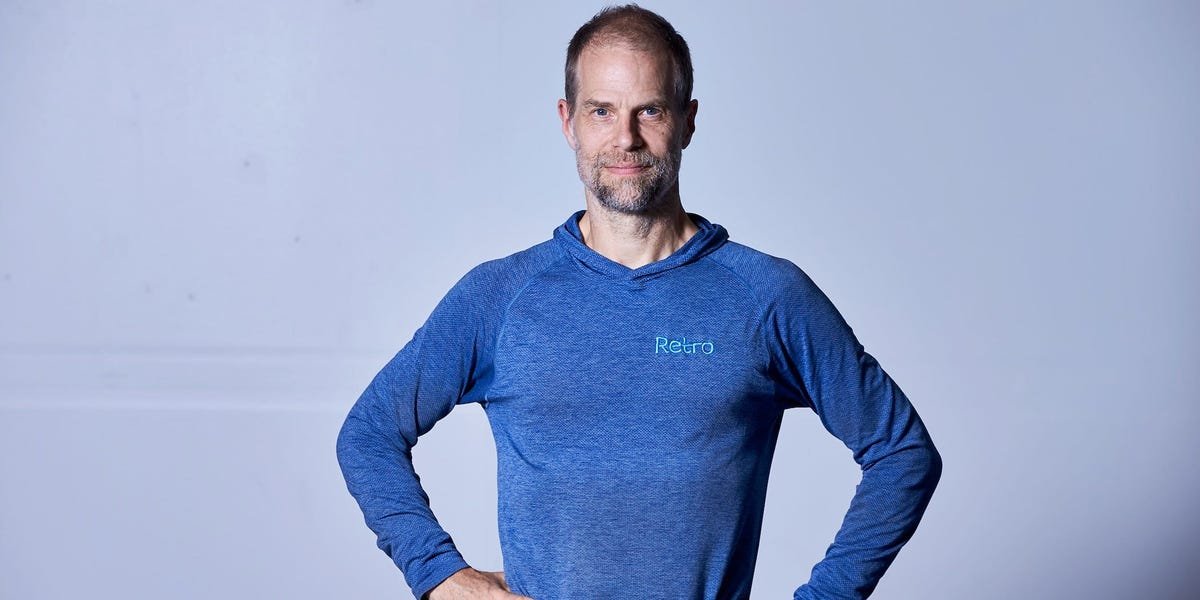
I’ve just hopped on a video call with the CEO of Retro Biosciences, the Sam Altman-backed longevity company, when I mention it’s quite hot.
Joe Betts-LaCroix takes my passing comment as a cue to muse on the wonders of air conditioning, and how energy and heat were once synonymous — until they weren’t.
As a multi-hyphenate scientist, entrepreneur, and once-inventor of the world’s smallest computer, Betts-LaCroix is excited by paradigm change.
At the helm of what is essentially Altman’s playground for experimenting with pushing the limits of the human lifespan, Betts-LaCroix is hoping to engineer the same shift that air conditioning brought to hot summer days for your brain and body. Ideally, one day, decouple aging from decline and disease.
Hoping is one thing, delivering is another.
Retro is set to start its first clinical trial since its launch in 2021, with an initial $180 million investment from Altman. Betts-LaCroix told Business Insider that by the end of 2025, Retro will have dosed its first trial patient with an experimental pill called RTR242.
It’s designed to help reverse Alzheimer’s by reviving autophagy. This cellular recycling process in our body — the same one that’s triggered by fasting — often goes haywire in old age, and is widely thought to have broad antiaging effects.
“There are old, misfolded, mutated, broken, undigestible proteins inside cells that build up over time,” Betts-LaCroix said. “The normal cellular recycling system gets messed up.”
In Australia, where it’s faster and easier to get Phase 1 safety trials off the ground, Retro has picked a clinical trial site, selected lab vendors, and expects its first participant to be enrolled toward the end of the year.
Meaningful results are needed to attract more investment for large-scale clinical trials. The company has been vocal about its goal to raise $1 billion in its Series A.
Related stories

Business Insider tells the innovative stories you want to know
Business Insider tells the innovative stories you want to know
If it’s successful, that cash would put Retro in the realm of longevity startups like the Jeff Bezos-backed Altos Labs, which is by far the most well-funded new name in Silicon Valley longevity biotech. Altos has raised more than $3 billion from big-name tech investors, including Yuri Milner, Palantir cofounder Joe Lonsdale (via his investment firm 8VC), and the Arch Venture founder Robert Nelson.
A pill for brain ‘gunk’
Justin Winokur
Betts-LaCroix assures me that Retro is in “hardcore preclinical mode.”
RTR242 is one of at least three big ideas the company is currently betting on to reverse aging. All of Retro’s big bets share the goal of taking some aspect of our biology “back to essentially a younger age,” Betts-LaCroix said.
Retro’s been vocal about its ultimate goal: to add 10 extra, healthy years to human lifespan. They’re not necessarily saying US life expectancy would ramp up to 88 from 78. Rather, they’re trying to create novel treatments that keep people feeling healthy, alert, and vibrant right until their very last days.
Aside from the Alzheimer’s drug, Retro is in the preclinical development stage for a treatment for blood diseases like leukemia, which involves making fresh blood stem cells for patients using their own cells as a starting point (RTR890), plus a stem cell-derived therapy for treating diseases of the central nervous system (RTR888).
The experimental memory pill works by clearing out “gunk in the cells” linked to Alzheimer’s and Parkinson’s, Betts-LaCroix said. If the pill works, it will restart stalled autophagy processes in the body, cleaning up damage, “especially in the brain cells,” he said.
In contrast, other new Alzheimer’s drugs, like Eisai’s Leqembi and Eli Lilly’s Kisunla, slow down cognitive decline by flushing out sticky amyloid plaques that are a hallmark of the disease.
“I tend to be more interested in therapeutics that reverse aging than ones that slow it down because the ‘slow it down’ thing just feels kind of like a weak sauce,” Betts-LaCroix said.
Old-school pharma approach vs. ChatGPT for aging
Justin Winokur Photography
There is serious tension in the longevity field: One strategy is to play it safe, going after one disease at a time and developing the kinds of drugs that pharmaceutical companies would consider acquiring, like RTR242.
Then, there’s the moonshot approach, aiming for a big paradigm shift. Betts-LaCroix hopes to straddle the divide.
“We have taste in the types of therapeutic programs that we find interesting,” he said, adding that they all aim to “reset some aspect of our biology back to essentially a younger age.”
The reset could be incremental, or it could be radical.
The physicist Peter Fedichev, who is not involved with Retro but founded a rival longevity biotech company called Gero, said he hopes that what Retro may be tackling in stealth mode is a bit more ambitious than its small molecule for autophagy.
“I think they pretend to be careful,” Fedichev told Business Insider. “With all my respect, I hope that they are more radical on the inside. 10 years? We can get with lifestyle.”
Betts-LaCroix disagrees. He said 10 extra years is nothing to sneeze at.
“Curing cancer would add about three years to life expectancy, and curing heart disease about four,” he said in response. “Adding 10 years of healthy lifespan to the adult population will be an even greater impact — one of the greatest achievements in the history of healthcare.”
There are hints that, at Retro, perhaps a radical streak is still simmering under the surface. In August, Altman’s OpenAI published a blog post touting a custom “GPT‑4b micro,” a protein-designing AI that they developed in partnership with Retro.
The company said GPT-4b micro improved the expression of stem cell reprogramming markers 50-fold, when compared to results from natural reprogramming factors.
Cellular reprogramming is arguably the trendiest, most far-out longevity bid in Silicon Valley right now. Basically, researchers are trying to find better ways to reverse the aging of our cells and engineer new parts for old bodies.
If that kind of improvement is able to, one day, fuel better aging treatments, the shift could be huge. But, like a lot of promises in AI land, it’s still a big if, for now.
In the meantime, Retro is playing a more cautious game with its clinical trial.
