
In The Sputnik vs. DeepSeek Moment I pointed out that the US response to Sputnik was fierce competition. Following Sputnik, we increased funding for education, especially math, science and foreign languages, organizations like ARPA were spun up, federal funding for R&D was increased, immigration rules were loosened, foreign talent was attracted and tariff barriers continued to fall. In contrast, the response to what I called the “DeepSeek” moment has been nearly the opposite. Why did Sputnik spark investment while DeepSeek sparks retrenchment? I examine four explanations from the comments and argue that the rise of zero-sum thinking best fits the data.
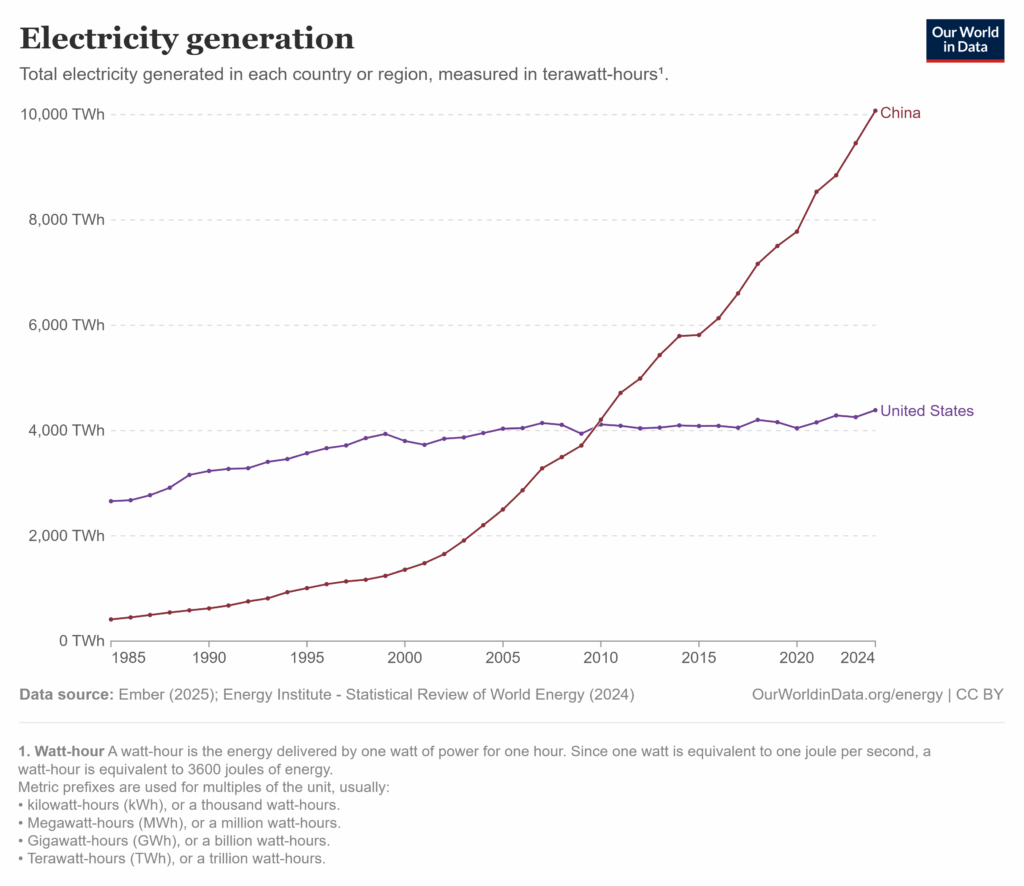
Several comments fixated on DeepSeek itself, dismissing it as neither impressive nor threatening. Perhaps but DeepSeek was merely a symbol for China’s broader rise: the world’s largest exporter, manufacturer, electricity producer, and military by headcount. These critiques missed the point.
Some commenters argued that Sputnik provoked a strong response because it was seen as an existential threat, while DeepSeek—and by extension China—is not. I certainly hope China’s rise isn’t existential, and I’m encouraged that China lacks the Soviet Union’s revolutionary zeal. As I’ve said, a richer China offers benefits to the United States.
But many influential voices do view China as a very serious, even existential, threat—and unlike the USSR, China is economically formidable.
More to the point, perceived existential stakes don’t answer my question. If the threat were greater, would we suddenly liberalize immigration, expand trade, and fund universities? Unlikely. A more plausible scenario is that if the threat were greater, we would restrict harder—more tariffs, less immigration, more internal conflict.
Several commenters, including my colleague Garett Jones, pointed to demographics—especially voter demographics. The median age has risen from 30 in 1950 to 39 in recent years; today’s older, wealthier, more diverse electorate may be more risk-averse and inward-looking. There’s something to this, but it’s not sufficient. Changes in the X variables haven’t been enough to explain the change in response given constant Betas so demography doesn’t push that far but does it even push in the right direction?
Age might correlate with risk-aversion, for example, but the Trump coalition isn’t risk-averse—it’s angry and disruptive, pushing through bold and often rash policy changes.
A related explanation is that the U.S. state has far less fiscal and political slack today than it did in 1957. As I argued in Launching, we’ve become a warfare–welfare state—possibly at the expense of being an innovation state. Fiscal constraints are real, but the deeper issue is changing preferences. It’s not that we want to return to the moon and can’t—it’s that we’ve stopped wanting to go.
In my view, the best explanation for the starkly different responses to the Sputnik and DeepSeek moments is the rise of zero-sum thinking—the belief that one group’s gain must come at another’s expense. Chinoy, Nunn, Sequiera and Stantcheva show that the zero sum mindset has grown markedly in the U.S. and maps directly onto key policy attitudes.
Zero sum thinking fuels support for trade protection: if other countries gain, we must be losing. It drives opposition to immigration: if immigrants benefit, natives must suffer. And it even helps explain hostility toward universities and the desire to cut science funding. For the zero-sum thinker, there’s no such thing as a public good or even a shared national interest—only “us” versus “them.” In this framework, funding top universities isn’t investing in cancer research; it’s enriching elites at everyone else’s expense. Any claim to broader benefit is seen as a smokescreen for redistributing status, power, and money to “them.”
Zero-sum thinking doesn’t just explain the response to China; it’s also amplified by the China threat. (hence in direct opposition to some of the above theories, the people who most push the idea that the China threat is existential are the ones who are most pushing the zero sum response). Davidai and Tepper summarize:
People often exhibit zero-sum beliefs when they feel threatened, such as when they think that their (or their group’s) resources are at risk…Similarly, working under assertive leaders (versus approachable and likeable leaders) causally increases domain-specific zero-sum beliefs about success….. General zero-sum beliefs are more prevalent among people who see social interactions as a competition and among people who possess personality traits associated with high threat susceptibility, such as low agreeableness and high psychopathy, narcissism and Machiavellianism.
Zero-sum thinking can also explain the anger we see in the United States:
At the intrapersonal level, greater endorsement of general zero-sum beliefs is associated with more negative (and less positive) affect, more greed and lower life satisfaction. In addition, people with general zero-sum beliefs tend to be overly cynical, see society as unjust, distrust their fellow citizens and societal institutions, espouse more populist attitudes, and disengage from potentially beneficial interactions.
…Together, these findings suggest a clear association between both types of zero-sum belief and well-being.
Focusing on zero-sum thinking gives us a different perspective on some of the demographic issues. In the United States, for example, the young are more zero-sum thinkers than the old and immigrants tend to be less zero-sum thinkers than natives. The likeliest reason: those who’ve experienced growth understand that everyone can get a larger slice from a growing pie while those who have experienced stagnation conclude that it’s us or them.
The looming danger is thus the zero-sum trap: the more people believe that wealth, status, and well-being are zero-sum, the more they back policies that make the world zero-sum. Restricting trade, blocking immigration, and slashing science funding don’t grow the pie. Zero-sum thinking leads to zero-sum policies, which produce zero-sum outcomes—making the zero sum worldview a self-fulfilling prophecy.
The post The Sputnik vs. Deep Seek Moment: The Answers appeared first on Marginal REVOLUTION.
