
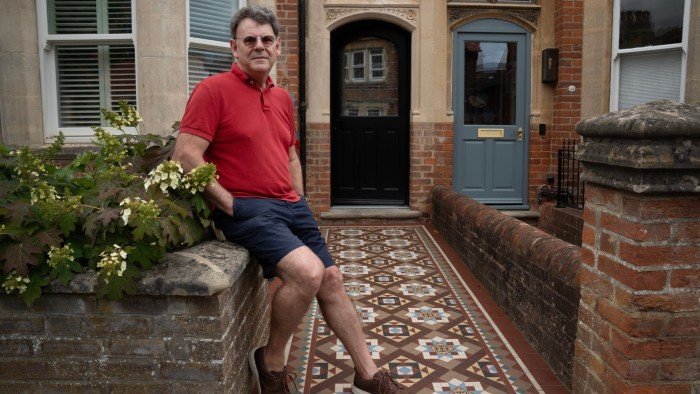
When Guy Hargreaves bought his mid-terrace house on the northern edge of Oxford in 2019, he knew he wanted to revamp it completely. The retired banker and engineer, originally from New Zealand, planned to extend the house and renovate it — but also transform its energy efficiency.
Six years on, the once rundown property has not only become, according to Hargreaves, “a joy to live in” but, for around six months of the year, a net exporter of electricity from its rooftop solar panels.
The project is a striking example of the potential for investment in a property to slash its energy bills. Cutting such bills has become an increasingly widespread concern after a surge in prices that has pushed up domestic energy costs, according to the Office for National Statistics, by 61 per cent over the five years to the first quarter this year. Ofgem, the UK’s energy price regulator, has set a cap on prices that it says limits the cost for electricity and gas to an average household to £1,720 per year.
Energy saving experts say there is a vast range of adjustments that can affect homes’ energy bills, from the wholly cost-free to wholesale rebuildings like Hargreaves’ project. However, Katy King, deputy director of the sustainable futures mission at Nesta, an innovation think-tank, says people are generally confused about which measures are most cost-effective.
“Many people don’t know which energy-saving actions save the most money,” she says.
In Hargreaves’ case, he spent a sum he describes as between 50 and 75 per cent of the property’s roughly £1mn purchase price on all aspects of the renovation, including the extension and turning the basement into a separate, lettable flat. Much of the spending was either on elements not related to the house’s energy use or on elements affecting both energy consumption and other aspects.
Nevertheless, Hargreaves says modelling by the installers suggests the last bit of spending on his property — £12,500 spent on rooftop solar panels and an attached battery — could pay for itself within seven years. He estimates that year-round the solar panels should provide around 95 per cent of the electricity used in the main house, excluding the flat. The house’s energy use is modest mainly because the renovation insulated the building to the demanding EnerPHIt standard. That means, among other things, that there is little air leakage.
“I have the flexibility now, for example, to be able to charge my battery at off-peak [rates] and charge it back into the grid at peak times at a higher export rate,” Hargreaves says. “That’s generating income.”
Potential energy-saving measures for a house fit into three broad categories — those that stop energy from leaking out, those that boost the efficiency of appliances in the home and those that generate power.
Alan Budden, director of Eco Design Consultants, who oversaw the transformation of Hargreaves’ property, stresses the potential for even small changes to cut bills. He suggests householders go into their lofts to check whether the roof insulation has not been disturbed or moved in a way that makes it ineffective.
He also suggests putting simple insulation around hot-water pipes and stopping up draughts.
“Draught-proofing is one of the biggest areas of heat loss that you find you can do something with,” Budden says.
King says a typical householder can also save around £65 annually by turning down the thermostat that controls the internal heat of the house’s boiler to the more efficient working temperature of 60C.
“We often encourage people to do the cheap and free things,” King says. “Some things are lower cost and excellent value for money.”
Like Budden, King is enthusiastic about loft insulation. She says it costs about £1,000 to fit 300mm-thick loft insulation in a typical house that currently has none. The measure will save up to £470 annually on a typical bill.
“If you’re going from nothing to a substantial amount, in two years you’ve got almost nothing to pay back,” King says of loft insulation. “So it’s really well worth considering.”
Yet the issues quickly become complex, beyond the most basic and effective measures.
King points out, for example, that it is far more expensive to insulate a building’s external walls than it is to do the same for a loft. In a typical detached house, solid wall insulation will cost £11,000. But the work will generally generate annual energy bill savings of up to £550.
She acknowledges that people will have differing views on whether that 20-year payback period is worthwhile.
There are similarly complex questions about whether it is worth paying the extra cost for the highest standards of insulation, draught-proofing and glazing when a cheaper, lower-performance product will produce energy savings only a little lower.
“Everyone has their appetite for what kind of payback period they’re interested in,” King says.
Anastasiya Ostrovnaya, a senior research fellow at London’s Imperial College Business School, says that in the UK the calculations become absurd when it comes to installing heat pumps in place of traditional gas central heating boilers.
While grants can cut the costs for many homeowners, an electric, air-source heat pump costs about £10,000 for a typical house — far more than the typical £4,000 cost of installing a new gas central heating boiler. Yet, while a heat pump generally uses around a third as much energy as a gas boiler, high electricity costs mean it can cost more than the gas boiler to operate.
“The most ridiculous fact . . . is that it costs more to run because England has the highest electricity prices,” Ostrovnaya says.
There are some electricity providers, including Octopus, that offer cheap, off-peak rates for customers with heat pumps. That can change the cost calculations. Heat pump users are incentivised under such tariffs to switch the devices off at peak times.

King says that the high costs of running heat pumps with electricity from the grid make the combination of solar panel, battery and heat pump that Hargreaves chose especially attractive.
“If you’re taking the solar panel energy and using it for heating, it will be so much better,” King says. “The solar panel and battery combination is a really great idea.”
Yet Hargreaves’ project also highlights how adjustments to a house are seldom solely a financial question.
He says the transformation of his property was a “passion project”.
“The truth is that it was a challenge and it really aligned with both my and my wife’s values,” Hargreaves says.
Budden says homes and people’s feelings about them go far beyond questions about their running costs. He says it can help homeowners’ mental and physical health to live in comfortable homes with few draughts that they know are inflicting the minimum damage on the environment.
“It’s difficult to put a number on that in terms of what you’d pay for it,” he says.
He recommends that homeowners draw up long-term energy-saving plans and renovate aspects of their property as the need arises.
“You work out, ‘This is what I can do with my house eventually — maybe reduce its usage by 80 per cent’,” he says. “That’s the cheapest way of doing it because you’re doing it within the maintenance schedules.”
For Hargreaves, the pleasure of living in his house is that the tightly insulated property now feels supremely comfortable, free of the draughts that plague most older English properties.
“I never feel I’m in the game of chasing heat around the house,” he says.
He also expresses deep satisfaction that the property’s energy use now imposes almost no burden on the environment.
“I’ve not regretted it for a moment,” he says.
