
Unlock the Editor’s Digest for free
Roula Khalaf, Editor of the FT, selects her favourite stories in this weekly newsletter.
Being 13 is tough. Your mum doesn’t get you. Your body is changing in strange ways that you don’t understand. School means running a gauntlet between cruel bullies and baffling maths classes. And to cap it all off, you don’t have any elbows.
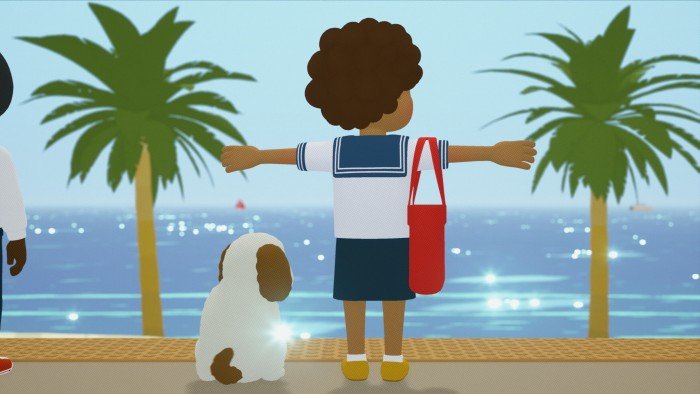
That last part may not be quite as relatable for the general readership, but it’s the precise predicament of Teen, the protagonist of the charming, oddball new indie game To a T. Teen’s arms stick out perpendicular to his body, as if frozen in a perpetual aeroplane impression. This makes even the simplest daily task a convoluted affair.
While his life in a seaside town is flecked with surreality, like the sandwich shop run by a giraffe with her own theme song, or the fact that Teen can fly if he spins around fast enough, these novelties remain in the background. At its heart, the game is about performing Teen’s daily activities with surprising mechanical granularity: pick up the toothbrush; turn on the tap; squeeze the toothpaste; brush left; brush right. One button to gargle, another to spit.

It is a deeply eccentric concept for a video game, which would probably never have been greenlit if its creator, Keita Takahashi, were not one of gaming’s best-loved auteurs. Since modern video games are often made by teams numbering more than a thousand, it’s rare to see a single creator’s fingerprints in a release. This is why gamers are so attached to the few distinctive auteurs they do have.
Takahashi’s credentials were established with the 2004 game Katamari Damacy, in which you play a diminutive prince whose father destroys the galaxy on a drunken bender and then asks his son to rebuild it. Your tool to do this is an incredibly sticky ball that you roll around, picking up objects so that it grows ever larger. First you’re collecting ants and drawing pins, later cows, buildings and mountains. When big enough, your ball becomes a new star in the sky.
At a time when the most popular games were macho shooters, Katamari Damacy was refreshing, showing that games did not have to be about violence and resource extraction, but could be gentle, toylike and creative. Its absurd story of infinite accumulation offered a sly critique of consumerism, while its superb electro-jazz-funk soundtrack remains a touchstone of gaming music two decades on. The game was one of the first selected by MoMA in New York for its game collection in 2012. Takahashi’s next games may not have been as successful, but they built on his unique vision: worlds of colourful, absurd characters whose systems resolutely defied the conventions of game design.
Such auteurs were more common in the days when games were made by smaller teams. Shigeru Miyamoto created series such as Super Mario, Donkey Kong and Zelda for Nintendo in the 1980s, pioneering character-driven, narrative gameplay with an emphasis on exploration. Sid Meier became synonymous with complex strategy systems with games such as Pirates! and Railroad Tycoon, and his name still adorns the box of his flagship Civilisation series (though he long ago stepped away from active development). Will Wright was enormously influential with simulations such as SimCity, The Sims and Spore, championing games that were less about winning and more about experimentation and sandbox gameplay.
These developers are elder statesmen now — venerated, but no longer central to the medium’s evolution. Meanwhile, most of today’s blockbusters lack the stamp of a distinctive creative voice. Call of Duty and Assassin’s Creed give the impression of having been designed by committee, possibly because these series are too lucrative to allow risks. There are studios whose games have distinctive identities — Remedy and Naughty Dog make high-concept action games with strong narratives, BioWare and CD Projekt Red excel at role-playing titles, while Paradox Interactive and Creative Assembly are known for strategy. But while these companies might have figureheads, they don’t have auteurs.

In Japan, there is a different paradigm that still gives space to visionary developers. The most notable is Hideo Kojima of Metal Gear Solid fame, who brings cinematic ambition to his explorations of surveillance, war and alienation. The second instalment in his wildly strange Death Stranding series is due out later in June. Another major player is Hidetaka Miyazaki, whose studio FromSoftware has built its name on games with complex bosses, sophisticated systems and little hand-holding, releasing hits such as Dark Souls and Elden Ring — whose spin-off Nightreign was released last month. An arthouse choice would be Fumito Ueda, whose profound games Ico and Shadow of the Colossus trade in mute characters, minimalist plots and spare, haunted landscapes.
While the big Japanese auteurs manage to put their signature on games made by large teams, their closest equivalents in the west are found in the indie scene, where many developers make their games almost single-handed. These include puzzle master Jonathan Blow, who created Braid and The Witness; Lucas Pope, whose brilliant games Papers, Please and Return of the Obra Dinn tackle politics and murder through paperwork; and Davey Wreden, who brings a personal and postmodern narrative sensibility to The Stanley Parable, The Beginner’s Guide and Wanderstop.
Auteurs can also serve as mouthpieces for an industry that often remains tight-lipped, but there is often tension between such creators and the commercial imperatives of large studios. After working with Konami for nearly 30 years, Kojima left under acrimonious circumstances to start his own studio. To a T’s Takahashi left Katamari Damacy publisher Namco when he was disappointed by its commercialisation of his concept. He has struggled for funding ever since.

It took Takahashi six years to make To a T with a team of 12. His personality is everywhere in it, from the catchy theme tunes that bookend play to the game mechanics that exist just to be toyed with: you can spill your milk on the floor while making cereal if you like, or play director and switch camera angles during dialogue scenes. Yet beneath the surface whimsy lies something more profound. To a T is about self-acceptance. You stay with Teen as he uses a specially adapted long spoon to eat. You feel for him when his outstretched arms inadvertently shove people as he walks down the street. The clumsiness of the gameplay forces you to share Teen’s limitations, creating a rare, tactile kind of empathy.
Whether it’s a metaphor for disability, mental illness, puberty or just being different, it’s undeniably wholesome and inventive. Like its quirky protagonist, To a T is unique. Works by auteurs such as Takahashi remind us that games can be more than system and spectacle — they can be deeply personal expressions that push the medium to strange new places, elbows or not.
