
Welcome to FT Asset Management, our weekly newsletter on the movers and shakers behind a multitrillion-dollar global industry. This article is an on-site version of the newsletter. Subscribers can sign up here to get it delivered every Monday. Explore all of our newsletters here.
Does the format, content and tone work for you? Let me know: harriet.agnew@ft.com
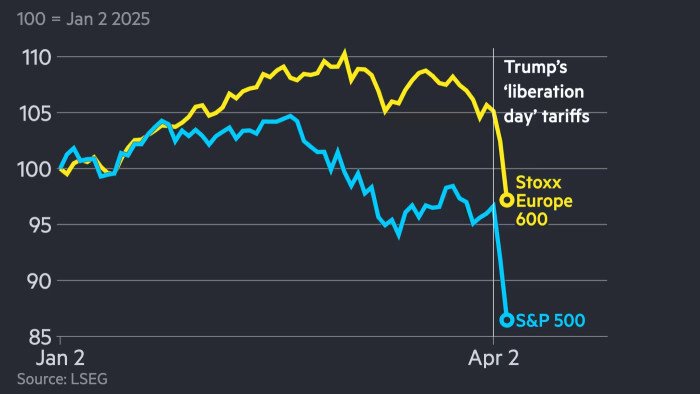
In today’s newsletter we explore the market fallout from so-called “liberation day”, when Donald Trump’s bid to upend the international trading order with huge tariffs was followed by retaliatory duties by China, and other countries readied their own responses.
-
Hedge funds hit with steepest margin calls since 2020 Covid crisis
-
Larry Fink warns ‘protectionism has returned with force’
-
Tariffs spark US junk bond sell-off as recession risk mounts
Banks ask clients to stump up additional money
Hedge funds have been hit with the biggest margin calls since Covid shut down huge parts of the global economy in 2020, after Donald Trump’s tariffs triggered a rout in global financial markets.
Wall Street banks have asked their hedge fund clients to stump up more money as security for their loans because the value of their holdings had tumbled. Several big banks have issued the largest margin calls to their clients since the beginning of the pandemic in early 2020.
The margin calls underscore the intense turbulence in global markets at the end of last week. Trump’s announcement of huge tariffs wiped $5.4tn from US stocks in two days, as China hit back with its own levies, deepening fears of recession in the global economy.
The S&P 500 index’s 9.1 per cent fall for the week was the biggest since the onset of the pandemic five years ago.
“Rates, equities and oil were down significantly . . . it was the breadth of moves across the board [which caused the scale of the margin calls],” said one prime brokerage executive, adding that it was reminiscent of the sharp and broad market moves in the early months of the Covid pandemic.
Thursday was the worst day of performance for US-based long/short equity funds since it began tracking the data in 2016, with the average fund down 2.6 per cent, according to a new weekly report by Morgan Stanley’s prime brokerage division.
The report said that the magnitude of hedge fund selling across equities on Thursday was in line with the largest seen on record, as they dumped equity positions at a level in line with the US regional bank crisis in 2023 and the Covid sell-off in 2020.
The pain so far would have been greater had many hedge funds not been scaling back their stock positions and cutting their leverage with banks in recent weeks in response to the trade war Trump had been threatening. In a further sign of the tumult across the hedge fund sector, gold — a traditional haven for investors — dropped 2.9 per cent on Friday, despite the deep gloom among global investors.
Suki Cooper, a precious metals analyst at Standard Chartered, suggested gold was being used to “meet margin calls.”
Larry Fink: ‘protectionism has returned with force’
Just days before US President Donald Trump escalated a tariffs war with America’s trading partners, BlackRock chief executive Larry Fink told shareholders in the world’s largest asset manager that “protectionism has returned with force”.
Fink, whose annual letter is pored over by investors and executives across the corporate world, said his conversations with “nearly every client, nearly every leader” underscored the pervasive unease over the state of the global economy.
He said people were “more anxious about the economy than any time in recent memory”. Despite rising participation in the US stock market by everyday investors, “not everyone has shared in this wealth”, he added.
“This extraordinary era of market expansion has coincided with — and was largely fuelled by — globalisation,” he wrote. “And while a flatter world lifted 1bn people out of $1-a-day poverty, it also held back millions in wealthier nations striving for a better life.
“The unspoken assumption is that capitalism didn’t work and it’s time to try something new. But there’s another way to look at it: Capitalism did work — just for too few people.”
Last year marked a paradigm shift for BlackRock as it evolved beyond its core business in public markets, agreeing to spend roughly $30bn on two of the biggest private investment firms — infrastructure investor Global Infrastructure Partners and private credit firm HPS Investment Partners — and data provider Preqin.
Somewhat unsurprisingly then, Fink used much of his letter as a pitch to expand access to private investments to everyday investors, which he claimed would help “further democratise investing”.
He told BlackRock shareholders that the “solution isn’t to abandon markets; it’s to expand them . . . and let more people own a meaningful stake in the growth happening around them”.
Chart of the week

Donald Trump’s “liberation day” tariff blitz has sparked the biggest sell-off in the US junk bond market since 2020, write Harriet Clarfelt and Will Schmitt in New York, signalling growing angst among investors that an economic slowdown will hit corporate America.
The premium investors demand to hold speculative-rated corporate debt compared to that offered by US government bonds — a proxy for default risk — has shot up by 1 percentage point to 4.45 percentage points since Wednesday, ICE BofA data shows. That is the biggest rise since coronavirus triggered widespread lockdowns in 2020.
The sell-off in corporate bonds since Wednesday, when Trump took US tariffs to their highest level in over a century, highlights investors’ worries that the move will hit economic output and raise unemployment, leaving weaker companies struggling to repay their debts, analysts said.
“Credit is obviously a canary in the coal mine,” said Brian Levitt, global market strategist at Invesco. “Credit tends to go first . . . if the economy’s going to roll over, the odds of a recession pick up and then you’re going to see spreads blow out.”
On Friday, JPMorgan slashed its US economic forecasts, predicting a contraction of 0.3 per cent in 2025 — down from an earlier growth estimate of 1.3 per cent. It also said the jobless rate would rise to 5.3 per cent, from 4.2 per cent in March.
Companies in the household goods, retail and automobile parts sectors are among those hardest hit by the rout in lower-rated debt.
The pain was most acute in the weakest pockets of the high-yield market; the average spread on debt rated triple-C and below topped 10 percentage points for the first time in roughly eight months.
“The junkiest of the junk stuff [is] underperforming,” said Eric Winograd, chief economist at AllianceBernstein.
Five unmissable stories this week
Large institutional investors are studying options to shed stakes in illiquid private equity funds after the rout in global financial markets pummelled their portfolios, according to top private capital advisers.
Endowments and their racier asset mix must have outperformed a balanced portfolio of equities and bonds in the long run, right? Nope. Inside the inevitable decline of the alternatives-heavy “Yale Model” of institutional investing pioneered by the late David Swensen.
Deutsche Bank’s asset manager DWS has been fined €25mn by German prosecutors over a greenwashing scandal following long-running investigations by authorities in the US and Germany.
UK wealth managers, including Rathbones, RBC Brewin Dolphin, Evelyn Partners and Schroders Cazenove, say enquiries from US-based investors worried by the actions of Donald Trump and his administration and seeking to move money from the country have risen markedly.
Investors are pouring cash into gold funds at the fastest pace since the Covid-19 pandemic, part of a broader flight to haven assets such as US Treasuries and cash, amid mounting concerns over the economic impact of a US tariff war.
And finally

Is there anything more romantic than the Orient Express? Maria Shollenbarger is the lucky one who boards the Dolce Vita Orient Express — from Rome to Venice, via Siena — for an exclusive preview of the first new iteration of the world’s most famous train in more than 40 years.
Thanks for reading. If you have friends or colleagues who might enjoy this newsletter, please forward it to them. Sign up here
We would love to hear your feedback and comments about this newsletter. Email me at harriet.agnew@ft.com
Recommended newsletters for you
Due Diligence — Top stories from the world of corporate finance. Sign up here
Working It — Everything you need to get ahead at work, in your inbox every Wednesday. Sign up here
