
The recent announced tariffs were computed using a formula that is almost universally viewed by economists as making no sense:

Now we discover that even if you think this formula does make sense, the specific calculations were based on the wrong elasticity estimate. The following is from an AEI report by Kevin Corinth and Stan Veuger:
The idea is that as tariffs rise, the change in the trade deficit will depend on the responsiveness of import demand to tariffs, which depends on how import demand responds to import prices and how import prices respond to tariffs. The Trump Administration assumes an elasticity of import demand with respect to import prices of four, and an elasticity of import prices with respect to tariffs of 0.25, the product of which is one and is the reason they cancel out in the Administration’s formula.
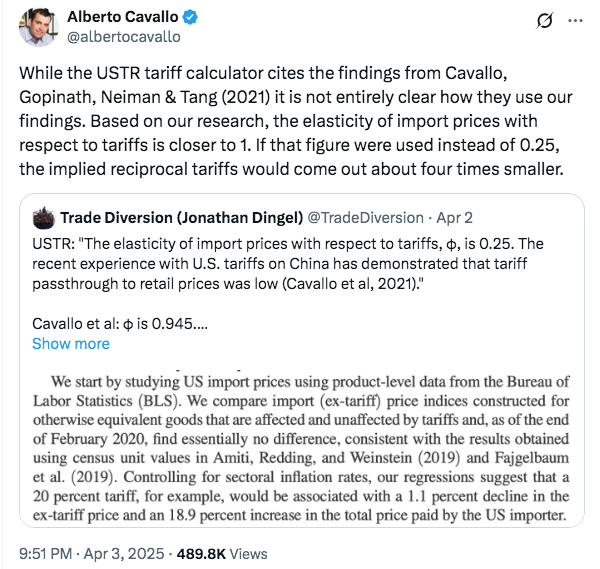
However, the elasticity of import prices with respect to tariffs should be about one (actually 0.945), not 0.25 as the Trump Administration states. Their mistake is that they base the elasticity on the response of retail prices to tariffs, as opposed to import prices as they should have done. The article they cite by Alberto Cavallo and his coauthors makes this distinction clear. The authors state that “tariffs [are] passed through almost fully to US import prices,” while finding “more mixed evidence regarding retail price increases.” It is inconsistent to multiply the elasticity of import demand with respect to import prices by the elasticity of retail prices with respect to tariffs.
Correcting the Trump Administration’s error would reduce the tariffs assumed to be applied by each country to the United States to about a fourth of their stated level, and as a result, cut the tariffs announced by President Trump on Wednesday by the same fraction, subject to the 10 percent tariff floor. As shown in Table 1, the tariff rate would not exceed 14 percent for any country. For all but a few countries, the tariff would be exactly 10 percent, the floor imposed by the Trump Administration.
The Cavallo study was gated, but a tweet by Cavallo seems to confirm their interpretation:
Unless I’m mistaken, the stock market briefly rose at the beginning of the tariff announcement, as it looked at first like there’d be a uniform 10% tariff on all countries (which would have been a relief to the markets). Stocks then crashed when it became clear that our major trading partners would face far higher rates. Thus it looks like $5.4 trillion in wealth was destroyed by a math error by a low-level government official. (To be clear, there are many other problems with the formula, but this mistake is especially significant.)
Of course it is likely that the administration had already decided on high tariffs, and this equation was reverse engineered to provide cover. Nonetheless, this equation was used to compute the specific rates for each country, and thus probably explains why the EU was hit with a 20% tariff, China with a 34% tariff, and Vietnam with a 46% tariff. Mistakes do have consequences!
All this reminds me a bit of the Chinese Cultural Revolution of 1966-76, when grown-up experts were banished to the countryside and important parts of the economy were turned over to students.
You might argue that anyone can make a math error, and that’s true. But in an administration that includes skilled economists, it is more likely that someone will catch the error, especially when the final results look “fishy”. To be fair, even the previous administration fell short in this area. Larry Summers warned the Biden people that excessive fiscal and monetary expansion could lead to high inflation. The current administration seems even more anti-elite than the Biden administration, and is especially hostile to the views of economists. Most talented people have either left the government or are laying low to avoid involvement in the current mess.
The administration now has three options:
- They can admit that the wrong figure was used, and correct the tariffs.
- They can admit that the wrong figure was used, and also admit that the formula was not the actual justification for the tariffs. In other words, they can admit that they lied.
- They can deny that the wrong figure was used in the formula.
In the old days, choice #3 would have been unthinkable. But we are in a new world. Just a few weeks ago, the administration responded to the Signal chat scandal by claiming that the highly specific battle plans leaked to a reporter at The Atlantic did not constitute “classified information.” Yes, and the sky is green.
My wife lived through the Cultural Revolution. She hoped that she was leaving all that behind when she moved to America.
PS. When I think of the Chinese Cultural Revolution, I often recall this scene from the 1994 Chinese film To Live:
Months later, during Fengxia’s childbirth, her parents and husband accompany her to the county hospital. All doctors have been sent to do hard labor for being over educated, and the students are left as the only ones in charge. Wan Erxi manages to find a doctor to oversee the birth, removing him from confinement, but he is very weak from starvation. Fugui purchases seven steamed buns (mantou) for him and the family decides to name the son Mantou, after the buns. However, Fengxia begins to hemorrhage, and the nurses panic, admitting that they do not know what to do. The family and nurses seek the advice of the doctor, but find that he has overeaten and is semiconscious. The family is helpless, and Fengxia dies from postpartum hemorrhage (severe blood loss).
