
If you thought the cost of groceries was high before, economists and supply chain experts have some bad news.
President Donald Trump on Wednesday announced sweeping 10% tariffs on goods from any country imported into the United States, and even higher tariffs for 60 trading partners with a persistent trade deficit with the US.
The wide-reaching “Liberation Day” tariffs impact countries including China and Japan, as well as the European Union, and territories near Antarctica inhabited only by penguins. They come in addition to existing tariffs against the United States’ top trade partners, Canada and Mexico.
For consumers, the increased import costs caused by Trump’s aggressive tariff plan are expected to result in higher prices for everything from pantry staples like coffee and sugar to apparel and larger purchases like cars and appliances.
Ernie Tedeschi, the director of economics at the Budget Lab at Yale, said the price hikes are expected to increase the overall price level of goods in the United States by 2.3%, costing the average consumer household about $3,800 this year.
Tedeschi told Business Insider that the existing tariffs against Mexico and Canada alone account for an expected 1% price increase of about $1,700 per household. The “Liberation Day” tariffs announced Wednesday are expected to result in a further 1.3% hike, or $2,100 per household.
“So 1.3% may not sound like a lot to the normal person, but $2,100 is a meaningful amount,” Tedeschi said. “Now, of course, that’s an average, so if you open up the hood to that number, there’s a distribution beneath that number.”
Price hikes on pantry staples and produce
The exact intention behind Trump’s tariff plan remains unclear — the president says his main goal is to bring manufacturing jobs back to the United States, but some analysts suspect he may be trying to trigger a recession to reduce interest rates purposely — and the stock market has tanked in response to the uncertainty.
Imports from some countries will be hit with higher tariffs than others, driving uneven price hikes across industries. For example, China — which largely imports machinery and appliances, furniture, toys, and electronics to the US — will be subject to a 54% tariff when combining the new tariffs (34%) with ones that have been previously announced. Goods from the European Union, which primarily imports medical and pharmaceutical products and motor vehicles, will be subject to a new 20% tariff.
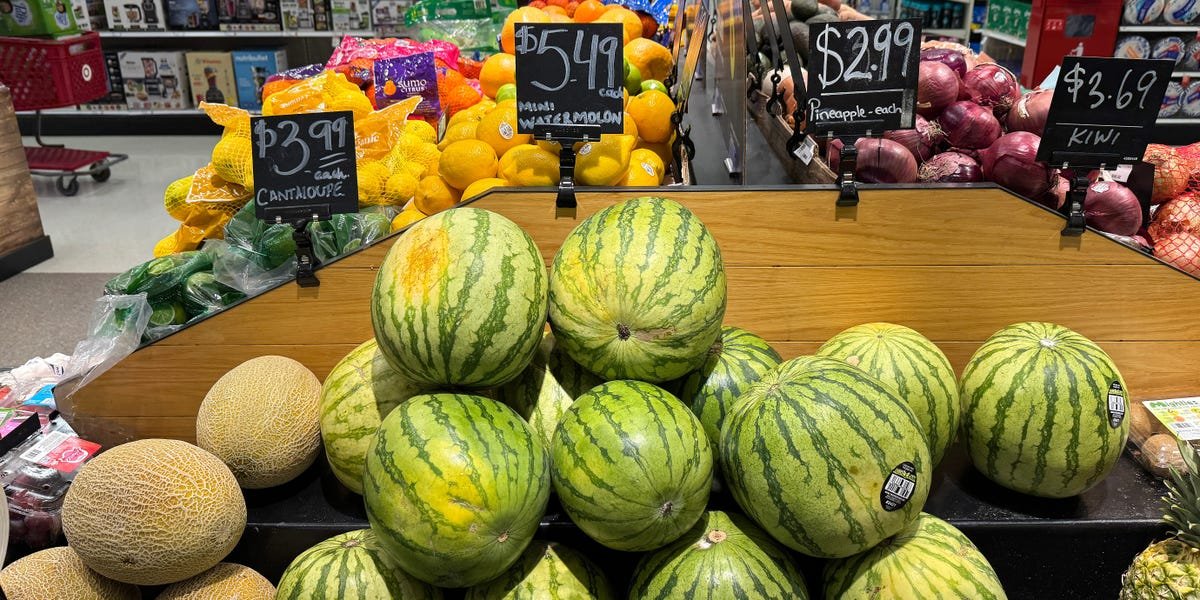
Tedeschi said the cost of clothing items is expected to increase by about 8%. He added that pantry staples like sugar and coffee are expected to increase in price by about 1.3%, while fresh produce is likely to increase by about 2.2%.
“The luxury of eating our favorite fruits and vegetables regardless of the season is based on global imports with much coming from Central and South America,” Margaret Kidd, an instructional associate professor of supply chain and logistics technology at the University of Houston, told BI. “Tariffs will make many of these staples unaffordable.”
The United States-Mexico-Canada Agreement, which replaced the North American Free Trade Agreement in 2020, maintains NAFTA’s zero-tariff treatment for most agricultural products, textiles, apparel, and other goods that meet the trade agreement’s rules of origin. But while the United States gets much of its produce from neighboring Mexico tariff-free, including tomatoes, avocados, and strawberries, other imports will face new price hikes — like grapes from Peru or bananas and mangoes from the Philippines.
“The USMCA is still in effect, so there are fruits and vegetables still covered under the deal and are tariff-free, but then some of them, they are not covered,” Chris Tang, a UCLA professor who’s an expert in global supply chain management and the impact of regulatory policies, told Business Insider.
Stockpiling and substitutions
Of course, consumers and businesses alike will try to find substitutions. Still, Tedeschi said it takes time to carve out new supply chain routes, for stores to expand their offerings, and for customers to find suitable alternatives to their typical favorites.
“So you may, literally and figuratively, eat the price increase in the short run, as you’re figuring out what a proper substitute is, but there are areas where there will be substitutions available,” Tedeschi said. “Let’s say coffee, for example, imported from Colombia. If Starbucks has a supply chain agreement with Colombia, over time, they’ll be able to shift that to another country or another supplier to mitigate the cost of the tariff, perhaps. Whereas, in the short run, like, in a month, Starbucks is not going to be able to do that, so if you want your latte, you’re going to have to pay extra.”
Some, like “Shark Tank” star Mark Cuban, have suggested Americans start stockpiling goods now to avoid price hikes. They say retailers may raise prices and “blame it on tariffs,” even if their goods are US-made. While the experts who spoke to Business Insider say that may be true, panic buying might further hurt supply chains and cause prices to go up, too.
“This kind of shift in demand would actually exacerbate this price increase,” Tang said. “If the demand is more stable, then the price is more stable. If everyone starts stocking up on toothpaste and toilet paper, the prices go higher.”
Related stories

Business Insider tells the innovative stories you want to know
Business Insider tells the innovative stories you want to know
Low-income households will bear the brunt
And that’s just the immediate impact on everyday consumable items.
The Consumer Technology Association estimated in a January report that Trump’s tariffs could increase the price of laptops and tablets by 46-68%, video game consoles by 40-58%, and smartphones by 26-37%.
Car imports will see tariffs of upward of 25%, which could translate to $12,000 or more based on an average car price of $48,000. Some automakers have responded to the tariffs by offering employee pricing deals, while others paused work at their factories and started cutting staff, Business Insider previously reported.
Not every household will be affected by the tariffs similarly, either. In response to Trump’s trade plan, Tedeschi said, lower-income households will spend about two and a half times more of their share of income than the highest-earning households will.
Kidd said pharmaceuticals, which represent $251 billion of imports, will face tariffs from 20% to more than 50%, which will disproportionately burden Americans without insurance and may set the path toward an increased deductible for those covered under an employer health plan.
“Lower income households are more likely to purchase imports. They spend a larger share of their income than higher income households do, and so they are more vulnerable to tariffs than higher income households are,” Tedeschi said. “And obviously people care about food for food’s sake, but that also has distributional implications as well. The more the price of food goes up, the more that disproportionately affects lower-income families as well.”
