
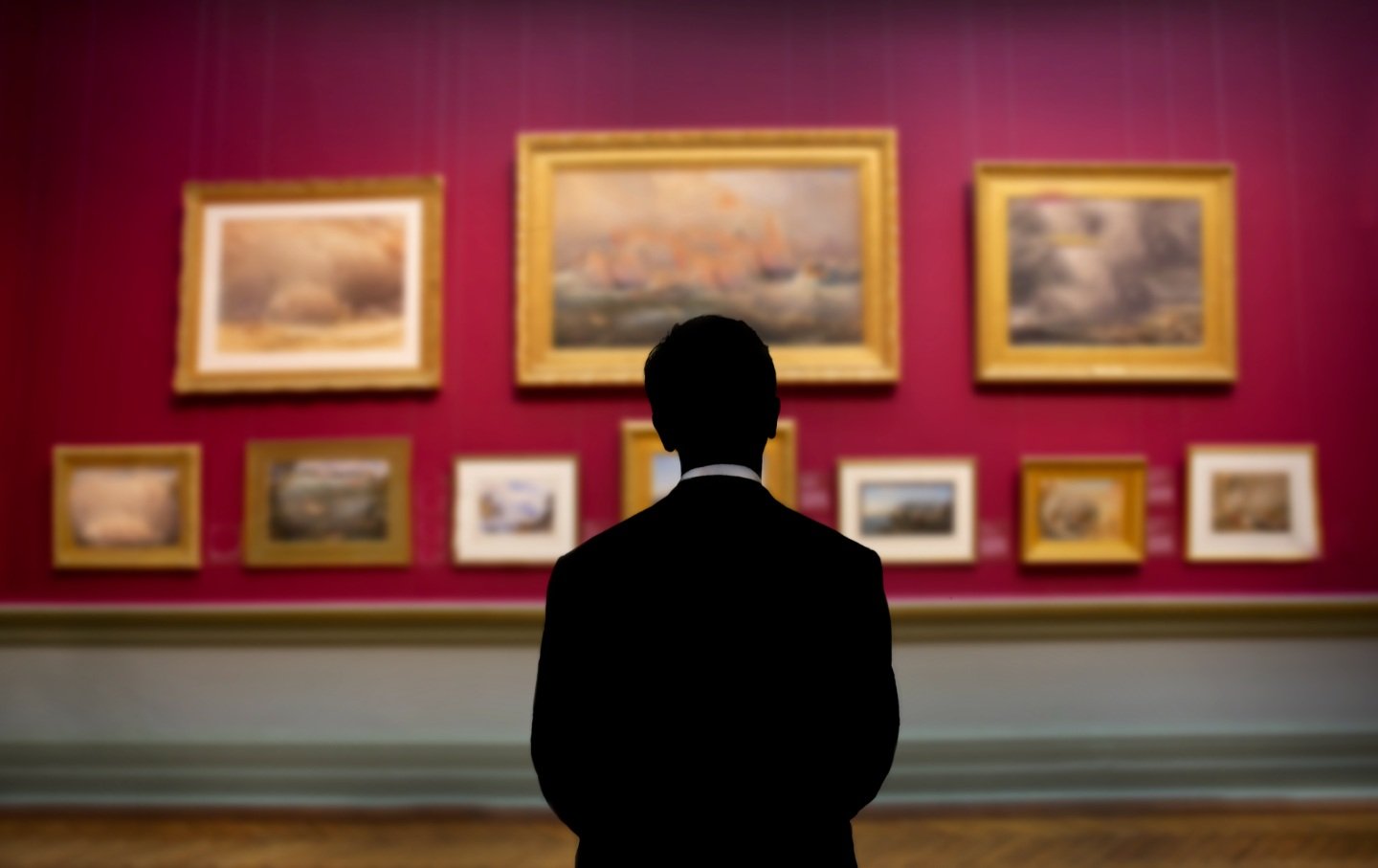
Art history, once a staple in every college humanities curriculum, is now seen as elitist and futile. With Donald Trump back in the White House, the arts are more at risk than ever.
For many, the words “art history” conjure images of ornate canvases, endless lectures on Rome and the Renaissance, and lists of long-dead painters. Or perhaps, more frequently, the two words elicit no response at all.
Across undergraduate institutions in the United States, art history has seen a startling loss in popularity over the last decade. While 5,300 art history degrees were awarded in 2012, the number fell to just 3,500 in 2022—a 34 percent decline.
This trend isn’t limited to public institutions like UCLA and CU Boulder, which experienced 35 percent and 78 percent declines in art history majors respectively. Ivy League colleges like Princeton also saw a 27 percent decline, and smaller institutions such as Williams College—where art history has long been one of the most popular offerings—saw the number of art history majors drop by half from 2008 to 2022.
My first formal art education came from my sophomore AP art history class, but the seeds were planted long before. My parents had taken me and my younger sister to museums throughout my childhood, always armed with drawing materials and questions to engage our connection to the art. But in school, I saw a wider array of artists and artistic mediums that redefined my outdated perspective of art history. Over the course of the year, I became truly passionate about the discipline.
After mentioning an upcoming visit to an exhibit on Johannes Vermeer to my high school journalism adviser, he suggested that I review it for The Science Survey, the school newspaper. The retrospective was an unexpectedly emotional experience, inspiring me to write a deeply personal review. One article led to another, and before I knew it, I had transformed into The Science Survey’s art critic, with plans to study art history after graduation.
Unfortunately, similar opportunities to engage in art education are increasingly few and far between. In recent years, amid large-scale cuts to arts departments nationwide, secondary school art history classes—which are often students’ first introduction to the discipline—have sharply decreased. “It was only after taking an AP art history [course] in high school that I realized I wanted to pursue art history in college,” said Northwestern student and former president of the Northwestern Art Review, Aimee Resnick.
Current Issue
Now, with Donald Trump back in the White House, the arts are more at risk than ever. The president has moved to dismantle the Department of Education, and in November, Senator Mike Rounds introduced a bill to eliminate the agency, remove the arts as a requirement for a well-rounded education, and cut the Assistance in Arts program that provides grants to encourage innovative approaches to arts education. While the bill is unlikely to pass with the required 60 votes, it does signify the administration’s and Republican Party’s view of the arts—as an insignificant, unimportant field of study.
It would be easy to dismiss the discipline as elitist and dated. But as the art critic for my high school newspaper, a former AP art history student, and a prospective art history major in college, I’m a living example that young people can still be excited by art history.
But two key factors are responsible for its decline: a lack of early arts education for most students, and the perception of art history as an exclusive, and potentially fruitless, discipline.
According to data from the National Endowment for the Arts, only 14 percent of high schools in the United States now offer art history classes. This included my high school, The Bronx High School of Science, until the AP art history course was cut ahead of the 2023–24 school year. Frances Auth, then an incoming sophomore who wanted to take the class, was dismayed. “When I was a freshmen, I heard upperclassmen talking about this AP art history class and I thought it would be a perfect way to fulfill my art credit while taking a genuinely interesting class,” said Auth. “When I signed up however, I found the class unexpectedly canceled because of a lack of demand.”
Compared to traditional STEM fields, many still believe that an art history degree isn’t “serious” or won’t lead to future job prospects. This can often dissuade those with higher student loans, or those who are financially independent, from going into what they see as a riskier, less lucrative industry. “Students are feeling pressure to take classes and to major in fields that directly lead to a career,” said professor Laura Weigert, chair of the Art History Department at Rutgers–New Brunswick, “and there’s a perception that art history is not in that category.”
But even a career in STEM is no longer guaranteed. Over the past two years, more than a quarter of computer programming jobs have been eliminated. “Learning to code was supposed to save millions of would-have-been liberal arts majors,” wrote The Washington Post in March. “But today there are fewer programmers in the United States than at any point since 1980.”
Popular
“swipe left below to view more authors”Swipe →
Faculty like Barry Bergdoll, a professor of art history and archaeology at Columbia and the director of undergraduate studies, are hoping to show students that art history isn’t a dead end for their careers. “I frequently stage events where people come and speak about what they do, having studied art history at Columbia,” said Bergdoll. “Not only people who are professors or in the museum world. They might be in publishing. They might be in the real estate world. We’ve had people who were in design professions. We let students see that studying art history doesn’t have to lead to the most predictable professions.”
And despite the decline in art history majors, the field has more relevance than many understand. “Art history is about the only discipline in which students are taught how to engage with the visual experience,” said Bergdoll. “So much of most subject matters are based on being able to either understand texts or understand numbers, but not understand the world around us.”
This cross-disciplinary relevance is often ignored by those who believe it to be out of touch with the needs of STEM students. “A lot of students don’t realize that the skills that you learn in this discipline are really transferable,” said Daniella Sanchez, a double major in history of art and comparative literature at Yale, and former editor in chief of Asterisk*, the undergraduate art journal.
A 2022 study published in the Journal of the Learning Sciences showed the symbiotic relationship between arts subjects like art history and STEM fields. Researchers found that when artistic practice and analysis was integrated into STEM classes, there was an enhancement in creativity, student engagement, and problem solving ability. “All the skills we teach in terms of visual analysis are the basic unit of method for the disciplines of history, culture, materiality, engineering, technical skill, and more,” said Tiffany Barber, an assistant professor of African American art at UCLA. “There’s a misconception about the level of difficulty that the practice of Art History requires. But I think once students are in the classes, they’re like ‘Oh, wow, this is actually much more complex and much more relevant than I previously thought.’”
When art history is a standard course offered in high schools to fulfill an arts credit, interest increases—as was true for Resnick and myself. And when that’s not possible, integrating the content into other classes such as history and literature can still make a difference. Partnerships between schools and museums help supplement a robust arts education, translating the images seen on a projector screen into the real world. Prominent museums like the National Gallery of Art in DC, the MET Museum in New York, and the Art Institute of Chicago all have child and teen programming and outreach. “Standing in front of a work of art and being able to appreciate both the intellectual, mythological story, and the way the tactility of the work of art integrates with what the artist is trying to do is just not as easily available in digital form,” said Norman Kleblatt, former chief curator for the Jewish Museum and former president of AICA-USA. “You have such a different experience that you almost lose your groundedness.”
Yet, without the financial means to afford a museum ticket, or parents who are able to or interested in spending hours looking at artwork, many children lose the chance to nurture an interest early on. “It is pretty rare to have successful art history majors come from backgrounds that are not infused with art history in their families,” said Resnick, once a double major in art history and social policy. She dropped the major after feeling pressured to keep up with peers from more traditional “art-historical” backgrounds. “It’s just not a very diverse field.”
Art history has allowed me to better understand the world—and my place in it. I’m able to see my life in art made hundreds of years ago; despite the fluidity of time, cultures, and countries, we are connected. The discipline made me a better thinker, with works prompting me to consider details and hidden meanings in the absence of written words. But future students will only experience these revelations if they’re able to receive the same education.
Donald Trump’s cruel and chaotic second term is just getting started. In his first month back in office, Trump and his lackey Elon Musk (or is it the other way around?) have proven that nothing is safe from sacrifice at the altar of unchecked power and riches.
Only robust independent journalism can cut through the noise and offer clear-eyed reporting and analysis based on principle and conscience. That’s what The Nation has done for 160 years and that’s what we’re doing now.
Our independent journalism doesn’t allow injustice to go unnoticed or unchallenged—nor will we abandon hope for a better world. Our writers, editors, and fact-checkers are working relentlessly to keep you informed and empowered when so much of the media fails to do so out of credulity, fear, or fealty.
The Nation has seen unprecedented times before. We draw strength and guidance from our history of principled progressive journalism in times of crisis, and we are committed to continuing this legacy today.
We’re aiming to raise $25,000 during our Spring Fundraising Campaign to ensure that we have the resources to expose the oligarchs and profiteers attempting to loot our republic. Stand for bold independent journalism and donate to support The Nation today.
Onward,
Katrina vanden Heuvel
Editorial Director and Publisher, The Nation
More from The Nation
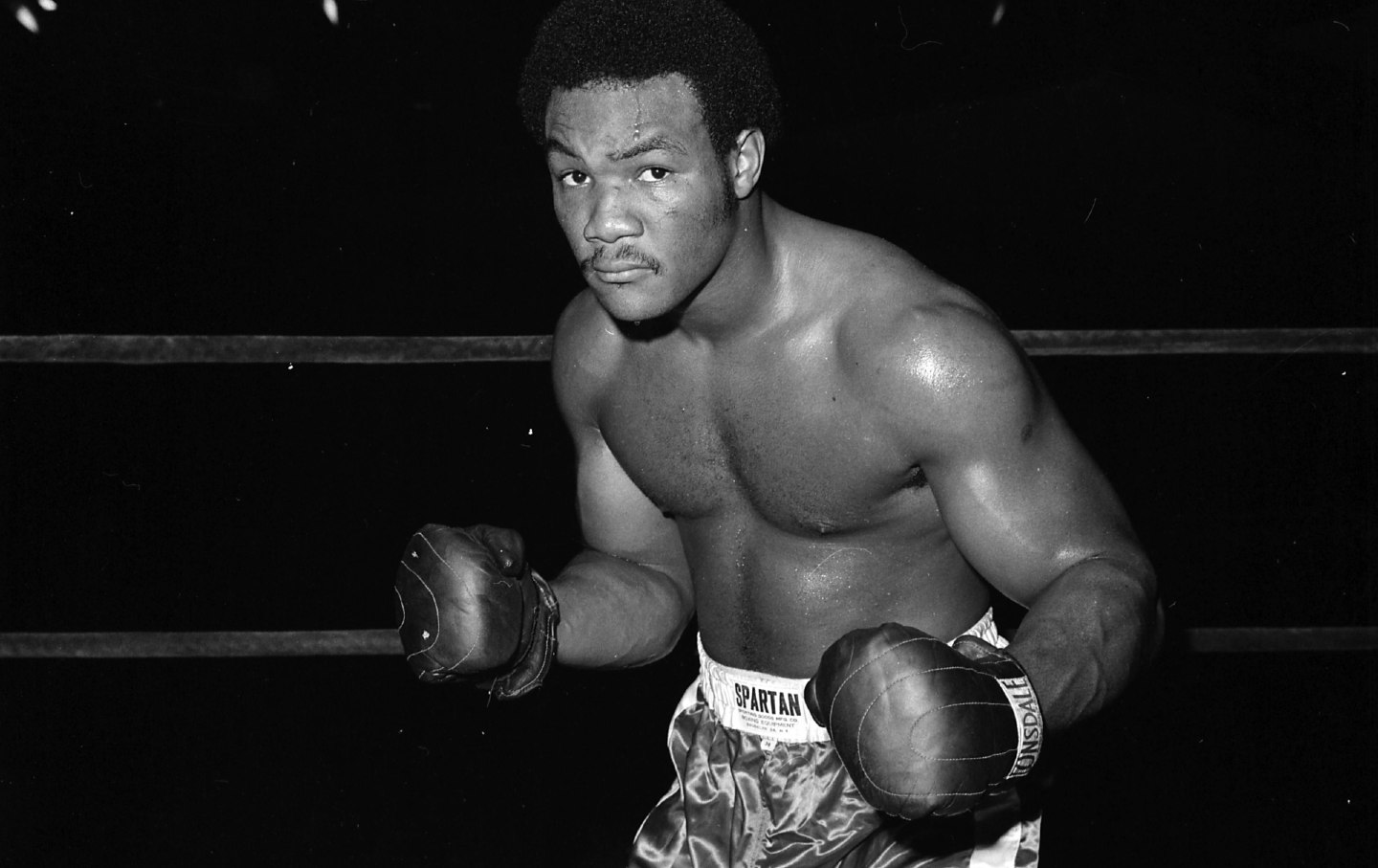
With the passing of the boxing legend, I want to recall an interview I never expected and will never forget
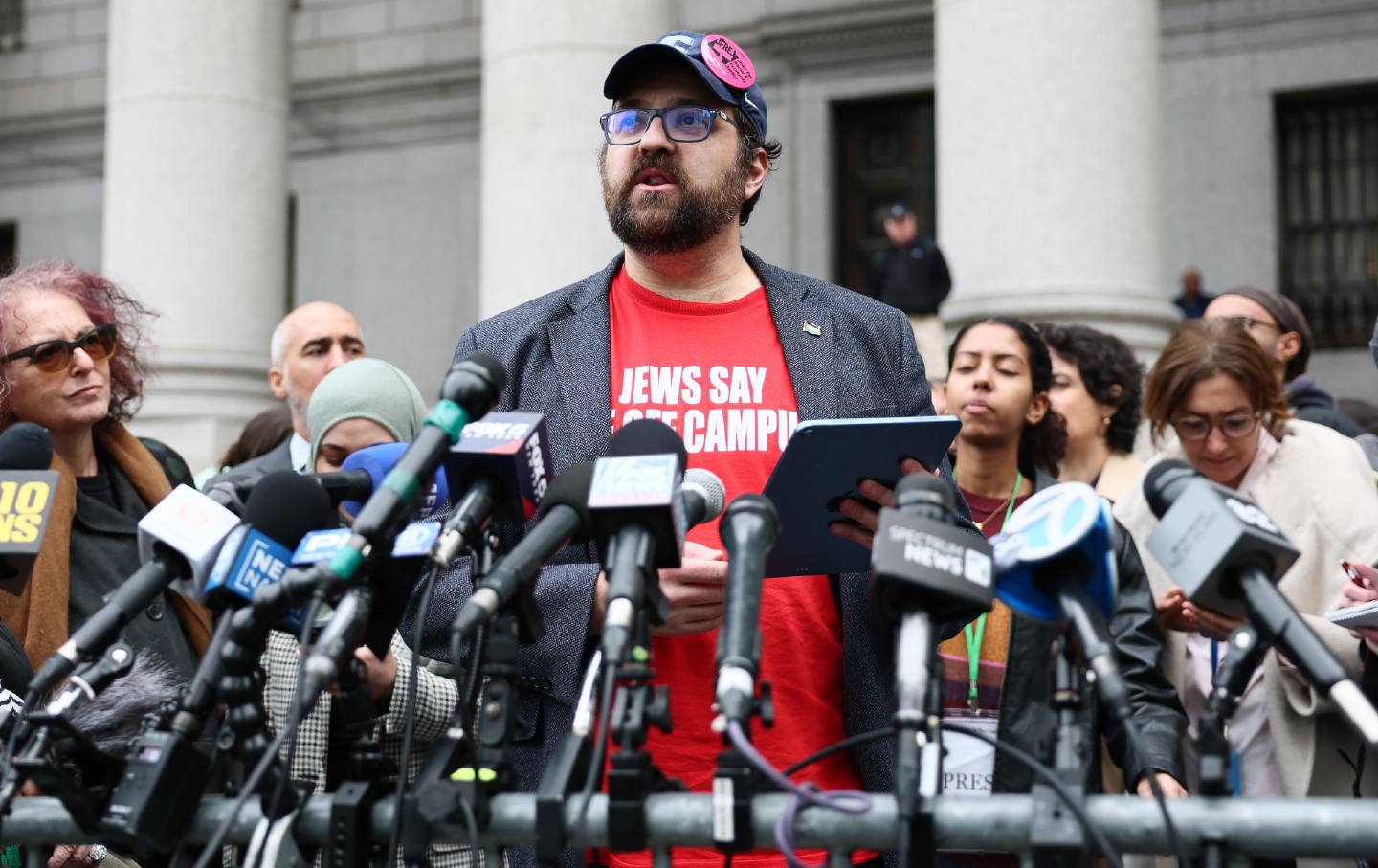
Trump’s war on my colleagues and students helped me understand the play’s political caution, which is not just about bad actors but those who fail to stop them.

An article on Robinson’s military career was restored to the Defense Department’s website. It’s a reminder that we can beat back the racist right.
The release of the John F. Kennedy papers sets a standard for transparency that must also be applied to the current administration.

The nationwide drive to eliminate gender-affirming care has trans youth and their families contemplating a series of agonizing choices.

By all means, let’s unite around a common purpose. But that purpose shouldn’t be a supposedly more efficient way to build killing machines.
