
Valerie A. Ramey of the Hoover Institution has a new NBER paper that examines the impact of lump sum transfer payments on aggregate demand. Here is the abstract:
This paper re-evaluates the effectiveness of temporary transfers in stimulating the macroeconomy, using evidence from four case studies. The rebirth of Keynesian stabilization policy has lingering costs in terms of higher debt paths, so it is important to assess the benefits of these policies. In each case study, I analyze whether the behavior of the aggregate data is consistent with the transfers providing an effective stimulus. Two of the case studies are reviews of evidence from my recent work on the 2001 and 2008 U.S. tax rebates. The other two case studies are new analyses of temporary transfers in Singapore and Australia. In all four instances, the evidence suggests that temporary cash transfers to households likely provided little or no stimulus to the macroeconomy
This comment caught my eye:
I find no evidence that the Singapore election year payouts stimulate the macroeconomy. These results are consistent with the 2001 and 2008 tax rebates in the U.S., as summarized in the earlier section. However, we are left with a puzzle: why are the high household MPCs estimated by Agarwal and Qian (2014) not showing up in aggregate consumption? Since I do not have current access to the micro data, I leave the reconciliation of the conflicting micro and macro results to future research.
Let’s take the example of the 2008 tax rebates, which occurred in April and May. For the sake of argument, assume that 75% of households received a $1000 check, and the other 25% did not receive a rebate. Also assume that the rebate would lead households that received a check to boost spending by 4%, while other households were unaffected. In that case, the rebate might have tended to push consumption 3% higher, in aggregate.
During this period, however, inflation was accelerating sharply, mostly due to rising commodity prices and a sharply weaker dollar. The Fed responded to this inflation surge by tightening monetary policy. This did not take the form of a rise in interest rates, rather the Fed held its target interest rate at 2% even as the natural rate of interest fell sharply during mid-2008. Now assume that the Fed’s tight money policy tended to depress spending by all households by 3%.
If we combine the effects of the fiscal stimulus with the tight money, you might expect the households that received a tax rebate to spend 1% more (the initial 4% increase, minus 3% due to tighter money), while the 25% of households that did not receive a rebate check might be expected to consume 3% less than before. In that case, monetary policy would have completely offset the expansionary effect of the fiscal stimulus.
Of course, this example is merely an illustration of monetary offset. Nonetheless, it demonstrates that “micro data” (i.e., household behavior) might seem to suggest that fiscal stimulus works, even as macro data shows no effect. If monetary policymakers are doing their job, they should always fully offset any fiscal policy initiatives that consist of changes in lump sum taxes and transfers. (Changes in marginal tax rates may have supply-side effects.)
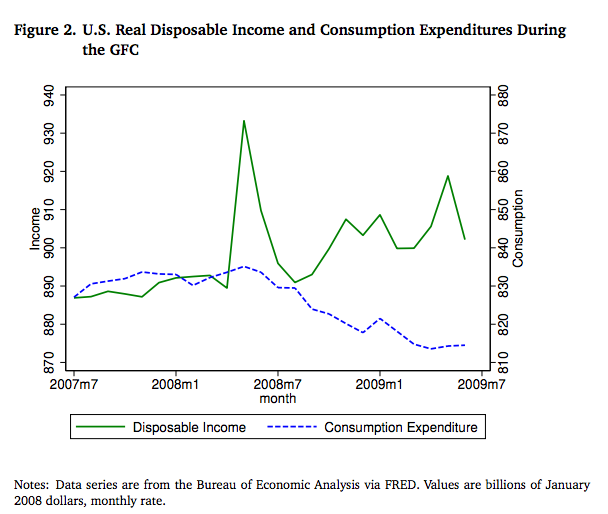
Ramey’s paper provides a number of graphs showing changes in disposable income and consumption. Notice how disposable income spikes in May 2008 due to the tax rebate, whereas consumption remains largely unaffected:

