The flailing and unpopular party elite needs to be replaced with fighting economic populists.
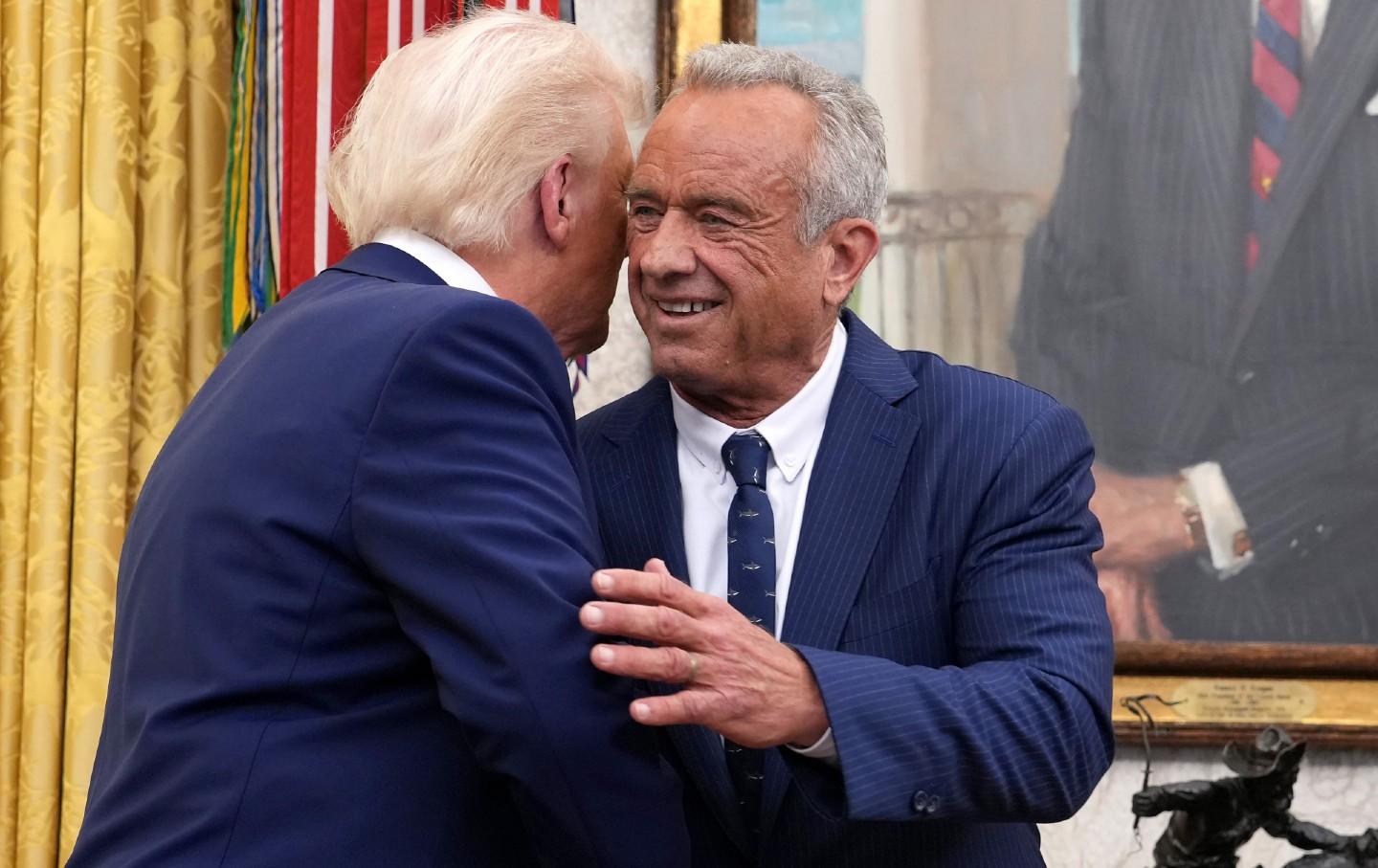
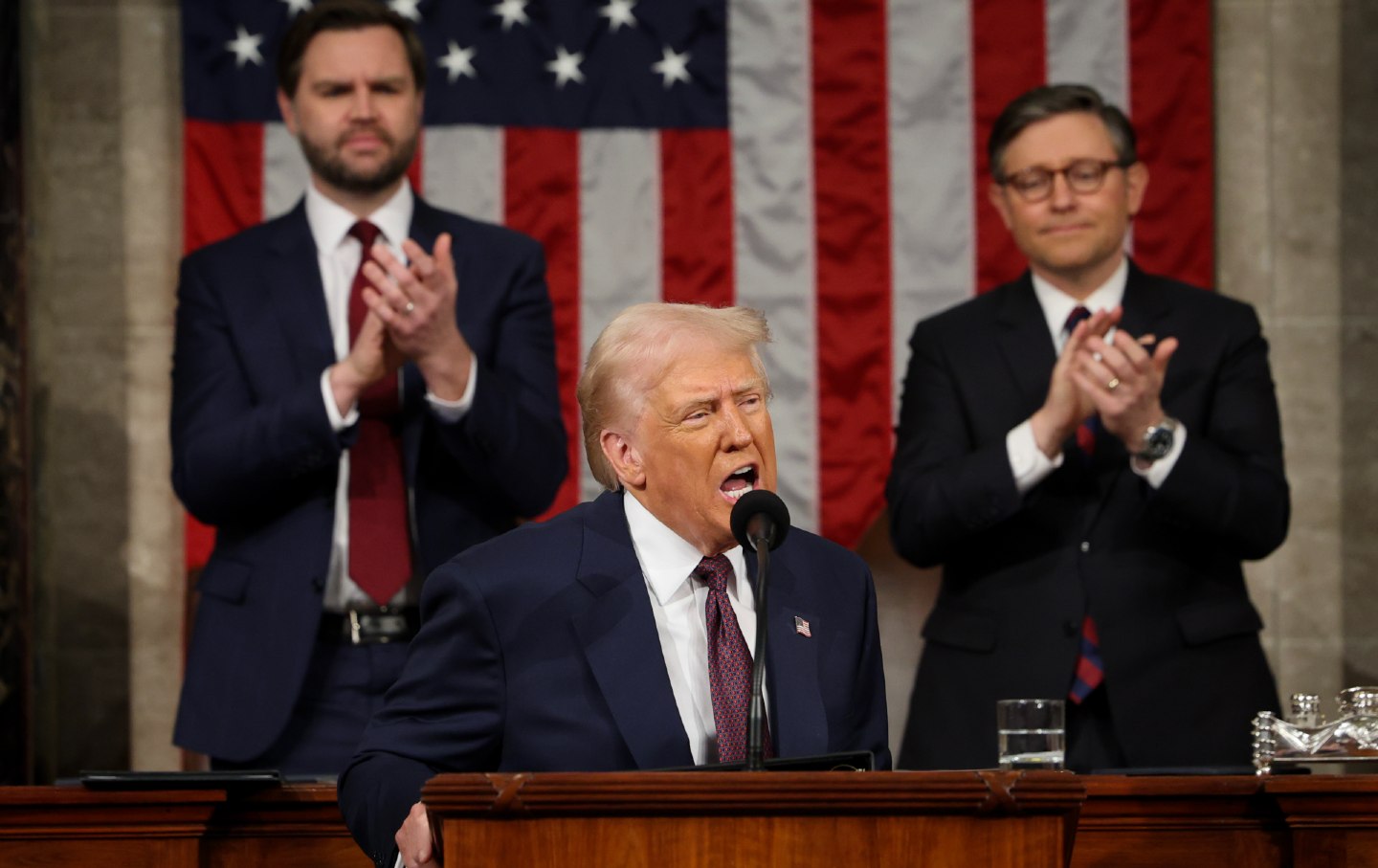
After only seven weeks, Donald Trump’s second go-round as president is already shaping be an even bigger fiasco than his first term, which ignominiously ended in 2020 when the largest electoral coalition in American history tossed him out of the White House. Unfortunately, unlike his first term, the opposition party is currently showing zero skill at harnessing anti-Trump anger to create a disciplined and effective resistance. The combined force of these two dynamics—Trump’s rising unpopularity and the fecklessness of the Democrats—creates the opportunity for a third force in American politics: a grassroots movement that can take over and reshape the Democratic Party in a more populist direction, in the manner that the Republicans were remade by the Tea Party Movement and Donald Trump.
The evidence of Trump’s collapsing political support is all around us: After a fleeting honeymoon period, his approval ratings are sinking and are now net negative, following the trajectory of his first term. Significantly, he is polling low on his handling of the economy, an area where voters had previously given him credit because of the robust job growth they remembered enjoying from 2017 to early 2020. In handling the cost of living crisis, a Reuters/Ipsos poll shows that Trump now has the approval of only 31 percent of voters, and the disapproval of 54 percent.
Trump’s erratic trade policy—which has seen him twice threaten to raise tariffs on America’s biggest trading partners, Canada and Mexico, only to twice back down after the stock market went into a nosedive—is only making the economic news worse. Trying to put a positive spin on continued inflation, Trump’s treasury secretary made the remarkable argument that “access to cheap goods is not the essence of the American Dream.” This might be a politically plausible argument if it were also accompanied by a rapid rise in working-class wages, but otherwise it smacks of political suicide—especially since inflation was one of the major factors that defeated Kamala Harris last fall. Trump himself said the sinking stock market is due to “globalist companies”—another excuse that is unlikely to sooth spooked voters.
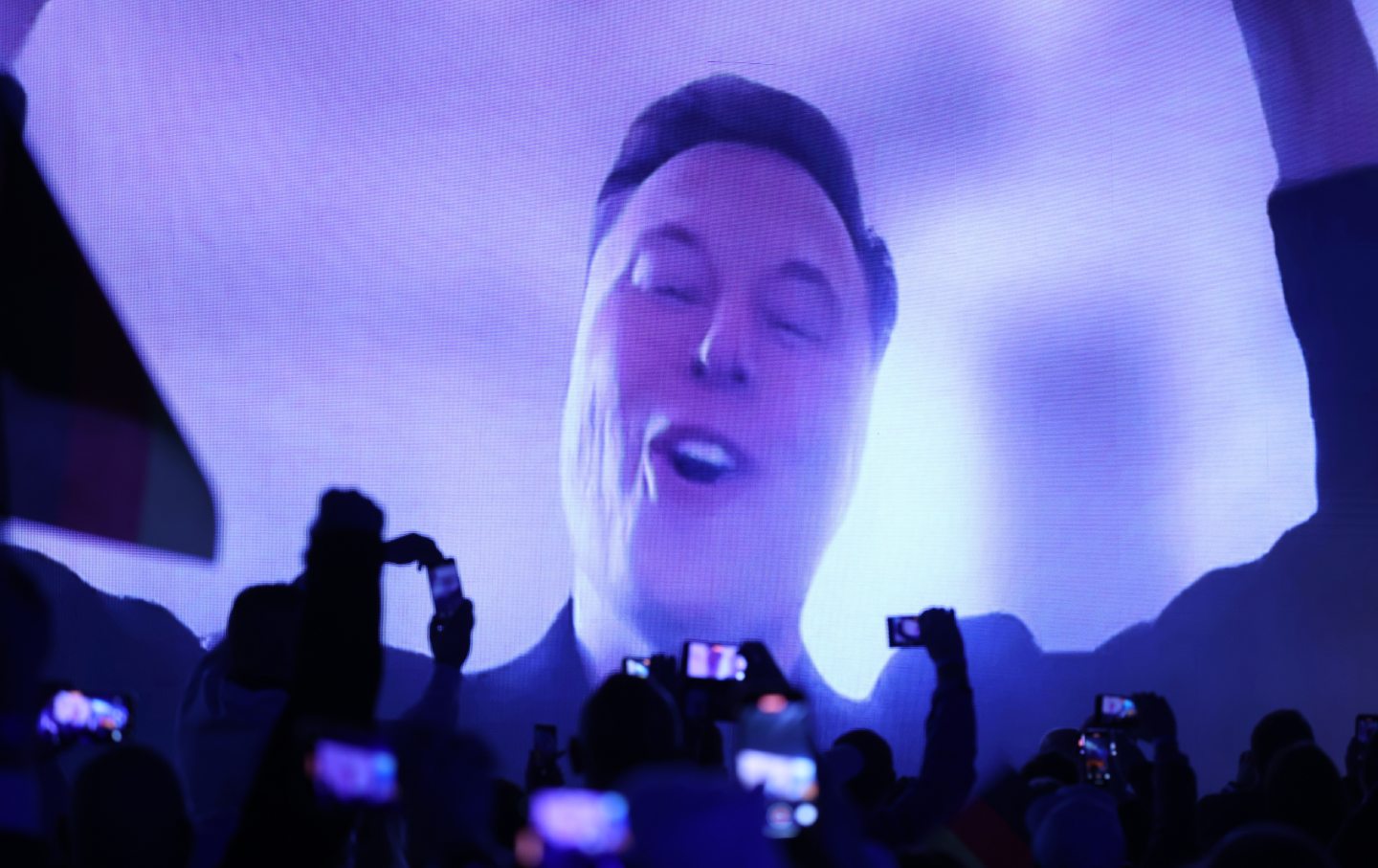
Equally in trouble is the other major Trump economic initiative, putting Elon Musk in charge of spending cutbacks via an agency created by executive fiat—the Department of Government Efficiency (DOGE). The courts have been ruling against DOGE’s ability to make unilateral cuts, setting the stage for a constitutional crisis if Trump disobeys the law. More importantly in political terms, Musk and his efforts are exciting a massive public backlash.
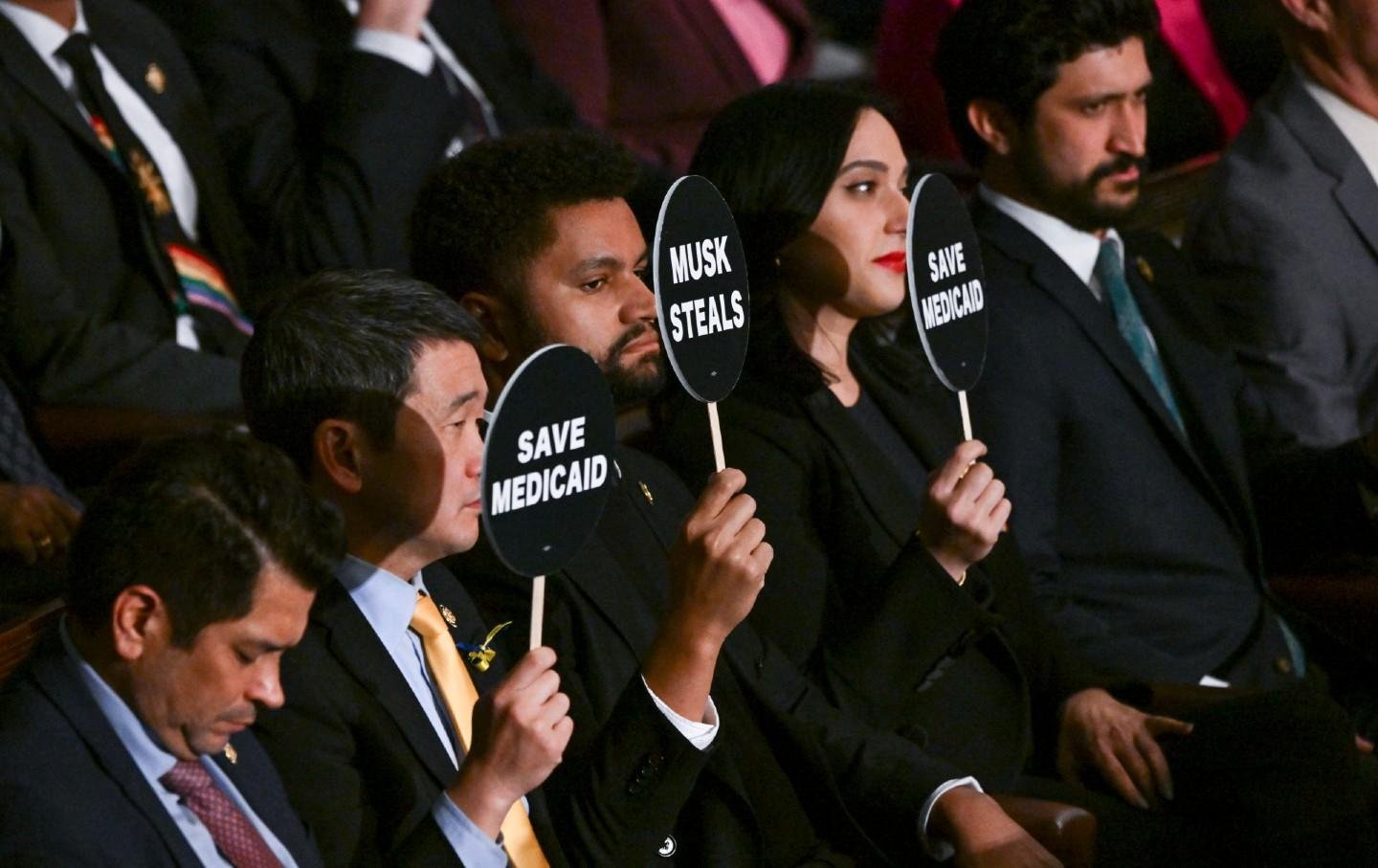
Musk is already one of the most unpopular figures in American politics, with only 34 percent approval and 49 percent disapproval in a Washington Post/Ipsos poll. Public anger is especially focused on the potential use of DOGE as a weapon to gut Social Security and Medicare. After a spate of disastrous encounters between voters and GOP lawmakers, the National Republican Congressional Committee is telling its members in Congress to stop holding town halls to avoid having to face their enraged constituents.
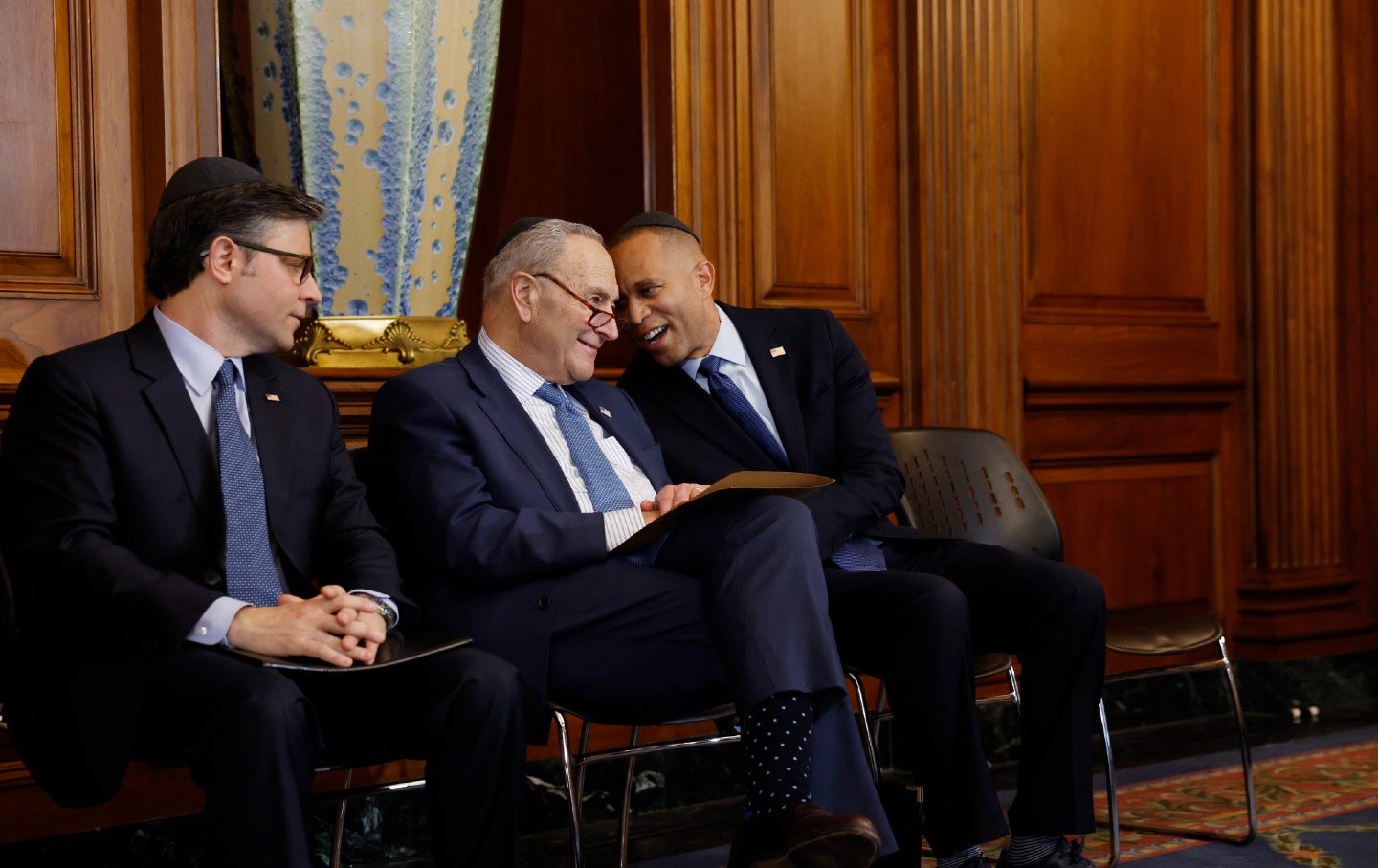
While the disarray of the Republicans should delight progressives, the prospect for Democrats is no brighter. Democrats under the leadership of Chuck Schumer in the Senate and Hakeem Jeffries in the House have adopted the strategy advocated by James Carville, a consultant who last won an election in the Bill Clinton era: “roll over and play dead” in order to “allow the Republicans to crumble beneath their own weight and make the American people miss us.”
Current Issue
In theory, Democrats could “play possum” (to use another colorful Carville colloquialism) and just win by default in the midterms as the Donald Trump crashes the economy and alienates America’s traditional allies. But winning by default gives you no clear identity as a party and only reinforces the sense that Democrats are feckless, opportunistic, and weak. In truth, the “strategic retreat” advocated by Carville and presently being carried out by Schumer and Jeffries is leading to the party’s sending out wildly conflicting messages that only confuse voters. In response to Donald Trump’s first address to Congress, Representative Al Green of Texas staged a forceful act of resistance that got him ejected by the House and censured on Thursday. Ten Democrats in the House joined in the censuring, as my colleague Joan Walsh noted with dismay. Conversely, the official response to Trump’s address was given by Michigan Senator Elissa Slotkin, whose weak-tea attempt to win over moderate Republicans by praising Ronald Reagan replicated the failed strategy of Kamala Harris’s centrist campaign.
The upshot of this confused messaging is that the vast majority of voters rightly feel like Democrats are offering no real challenge to Trump. As Politico reports:
Voters still have a sour view of Democrats six weeks after President Donald Trump and Republicans swept into Washington with control of all branches of the federal government, according to a new poll.
A plurality of voters—40 percent—said the Democratic Party doesn’t have any strategy whatsoever for responding to Trump, according to the survey by the liberal firm Blueprint that was shared first with POLITICO. Another 24 percent said Democrats have a game plan, but it’s a bad one.
A paltry 10 percent said that the party has a solid technique for dealing with Trump. And that’s coming from a Democratic outfit’s survey.
The leadership of the Democratic Party has earned these dismal polling numbers the hard way—through many years of ceaseless work being cowardly, ineffectual, unimaginative, dishonest, and self-serving.
American politics is spiraling rapidly downward, and only a radical intervention can fix the problem. The equation is simple: Trump is failing and becoming more unpopular—but the current Democratic Party leadership is even less popular. Given these two facts the most logical solution is for a third force to emerge, challenge the existing leadership of the Democratic Party, and replace it with a forceful alternative to Trumpism.
The most important fact of American politics—indeed, of global politics—is that we are living in an age of anti-system rage. Since at least the economic meltdown of 2008, the American electorate has consistently rewarded politicians who speak to their anger at the established order: Barack Obama, the Tea Party movement, and Donald Trump. The one exception is Joe Biden in 2020, but his victory was due to the fact that under Covid and amid widespread protests against police violence, Donald Trump became the establishment. Once Biden was president, his brand of ancien régime restoration and bipartisan comity became rapidly unpopular, setting the stage for Trump’s return. Elissa Slotkin shows that Democrats have still not given up on unpopular centrist establishment politics.
The only path forward for Democrats is a hostile takeover by their own brand of anti-system politics. Writing in The New Yorker, Jay Caspian Kang makes a good case for such a hostile takeover:
But there is still hope for the Democrats because they, like the Republican establishment in 2016, are primed for a hostile takeover. In the midterms, will we see candidates crop up across the country who express anger at liberal institutions, at internal corruption in local Democratic governance, and at the selfishness of leaders such as Joe Biden who have put their own egos and legacy over the good of the Party?
I myself have little taste for celebrity candidates with nebulous politics. I do think that in an anti-system age, it’s possible that Stephen A. Smith or Tom Hanks could make it to the White House. But celebrities by definition are winners in the current order, making them unlikely to push for the deep structural changes America needs to address entrenched economic problems.
As Kang notes, the anti-system takeover could take two forms: It could be a Bernie Sanders economic populist, or it could be a centrist celebrity running as a post-political pragmatist. In a subsequent article, Kang advocates for the sports television personality Stephen A. Smith. It’s true that Smith has the requisite charisma, unorthodox politics, and social media virality to make a plausible celebrity candidate. Jon Stewart, Oprah Winfrey, or Tom Hanks are some other potential candidates in the same mold.
Politically, I prefer the option of economic populism. In effect, this would be a third Sanders run. Sanders himself is one of the few anti-Trump political voices who is gaining a wide and appreciative audience. Over 8 million Americans watched Sanders’s response to Trump’s speech on social media.
Sanders twice ran strong anti-system campaigns in the Democratic presidential primaries, coming in second both times. Sanders fell short because a critical mass of Democratic voters still trusted the party establishment. Crucially in 2020, Joe Biden’s success over Sanders owed much to the party elite’s coalescing around Biden, with moderate candidates dropping out and Biden winning the endorsement of Representative James Clyburn of South Carolina as well as the backstage advocacy of Barack Obama. It is highly unlikely that Democratic primary voters will be so favorable to establishment voices in 2026 or 2028.
Bernie Sanders is still, at age 83, the most important voice in the anti-Trumpist resistance. His brand of economic populism is the only plausible path to a post-Trumpist future.
Aside from Sanders, there’s also a model and infrastructure for committed left-wing candidates challenging more conservative Democrats in primaries, developed by groups such as Justice Democrats. The emergence of Alexandria Ocasio-Cortez and the Squad on a congressional level along with many lawmakers on a state and municipal level have at the very least created a voice for the left that didn’t exist before.
Popular
“swipe left below to view more authors”Swipe →
But Sanders is too old to run again. Still, can we imagine a Bernie 2.0, someone who can build on the impressive insurgencies of 2016 and 2020 to launch a final victorious battle to seize the citadel of power in the Democratic Party?
American labor, besieged under Donald Trump but also energized by anger at the cost of living crisis, could be the perfect base for such a hostile takeover. Imagine if the major labor leaders got together to support a plan for seizing the Democratic Party from its current leadership (heavily based in college-educated consultants) in order to return it to the working class. A Labor Popular front could make its first move in the midterms, supporting economic populist candidates in primaries. With the preexisting infrastructure created by groups such as the Justice Democrats, plus the new anger of Democratic voters at their party establishment, the 2026 primaries could be a growth opportunity for left expansion in the Democratic Party. Winning over the institutional support of labor, which shares in the disillusionment with the party elite, could provide the extra level of strength for this push.
In 2028, this Labor Popular Front could field its own candidate (selected in an internal primary before the Democratic primary): Two potential candidates are Shawn Fain (president of the United Auto Workers) and Sara Nelson (the international president of the Association of Flight Attendants–CWA).
Fain or Nelson could run a terrific Bernie Sanders style campaign, one that would be all the stronger because anti-system rage—including anger at the decrepit Democratic Party leadership—will only be stronger after four more dismal years of Trump. Like Sanders, their strength would be that they are not regular Democratic politicians, not beholden to the donors and consultants who have led the party to disaster after disaster. They could run a small-donor-funded campaign and openly advocate the economic populism that more mainstream figures like Kamala Harris shy away from. The situation for the Democrats is dire, but it’s not too late to save the party from its own self-destructive impulses. A hostile takeover organized by a populist insurgency, one rooted squarely in the labor movement, could be the last, best hope for saving America from the current nightmare: an endless cycle of right-wing Republican rule alternating with Democrats winning ineffectual default elections.
Donald Trump’s cruel and chaotic second term is just getting started. In his first month back in office, Trump and his lackey Elon Musk (or is it the other way around?) have proven that nothing is safe from sacrifice at the altar of unchecked power and riches.
Only robust independent journalism can cut through the noise and offer clear-eyed reporting and analysis based on principle and conscience. That’s what The Nation has done for 160 years and that’s what we’re doing now.
Our independent journalism doesn’t allow injustice to go unnoticed or unchallenged—nor will we abandon hope for a better world. Our writers, editors, and fact-checkers are working relentlessly to keep you informed and empowered when so much of the media fails to do so out of credulity, fear, or fealty.
The Nation has seen unprecedented times before. We draw strength and guidance from our history of principled progressive journalism in times of crisis, and we are committed to continuing this legacy today.
We’re aiming to raise $25,000 during our Spring Fundraising Campaign to ensure that we have the resources to expose the oligarchs and profiteers attempting to loot our republic. Stand for bold independent journalism and donate to support The Nation today.
Onward,
Katrina vanden Heuvel
Editorial Director and Publisher, The Nation
More from
Jeet Heer 

America’s greedy gangster president is forcing European elites to finally reckon with the high price of protection.