
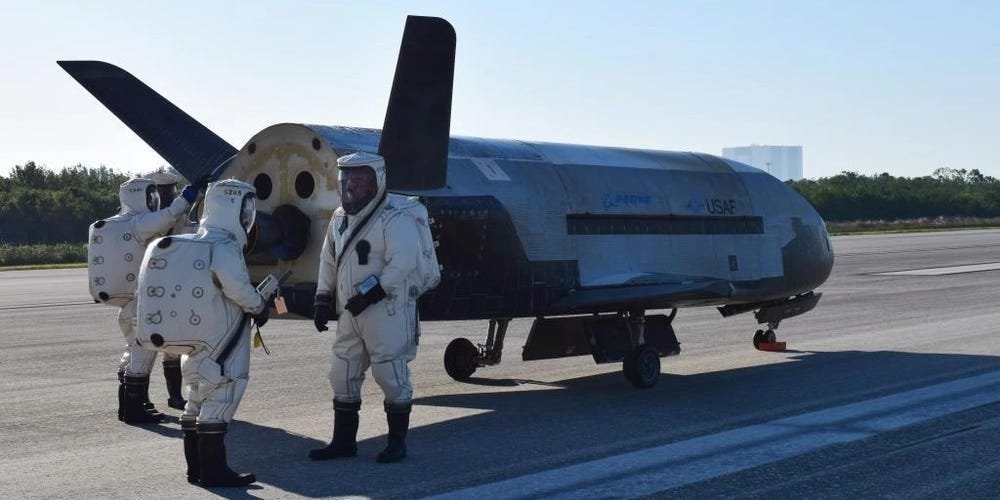
‘Most advanced re-entry spacecraft’

Michael Martin/Released
In 1999, NASA selected Boeing to design a reusable orbital test vehicle to monitor and repair satellites closely.
Over the next four years, the X-37 underwent several design iterations to achieve a more aerodynamic design than the Space Shuttle orbiter. It was initially intended to launch from the cargo bay of a space shuttle. But after the Space Shuttle Columbia crashed and killed all seven astronauts on board in 2003, it was redesigned to launch from a different rocket, making it smaller and more autonomous.
The project cost nearly $192 million, and Boeing was awarded another $301 million contract in 2002 through the Space Launch Initiative, a joint research effort led by NASA and the Defense Department. The X-37 project was transferred to the Defense Advanced Research Projects Agency in 2004 and became classified because of its military applications.
In 2006, the Air Force announced the development of its own variant of the space plane, known as the X-37B, designed to operate with an orbital speed of nearly 17,500 mph for up to 270 days.
The uncrewed test vehicle was nearly 30 feet long and had a wingspan of about 15 feet. Its max takeoff weight was 11,000 pounds, and it could accommodate payloads of up to 500 pounds.
Dubbed the “most advanced re-entry spacecraft,” the X-37B program would focus on “risk reduction, experimentation, and operational concept development for reusable space vehicle technologies, in support of long-term developmental space objectives,” then-Air Force Secretary Michael Wynne said in 2006.
Experimenting in space
Senior Airman Timothy Kirchner
The X-37B was tasked with multiple orbital missions, ranging from testing materials under the conditions of space to releasing a small satellite with its own experimental payloads.
The first X-37B vehicle was launched into orbit from Cape Canaveral in April 2010. The test vehicle spent 225 days in space and returned in December 2010 after conducting several orbit changes, though the data it collected during its maiden mission was classified.
In 2020, the X-37B’s sixth mission involved toting a small service module into space for the first time. The FalconSat-8 was a small satellite developed by the US Air Force Academy carrying five experimental payloads. After a record-breaking 908 days in space, the X-37B completed its mission and landed at the Kennedy Space Center in November 2022.
Because much of the X-37B program is classified, the secrecy fueled speculation about the purpose of its mission sets, with some speculating that the space plane could be a weapons platform or used for intelligence, surveillance, and reconnaissance from space.
Launched from a SpaceX rocket
US Air Force courtesy photo
The X-37B embarked on its seventh and current mission in December 2023, launching from the Falcon Heavy rocket, manufactured and launched by Elon Musk’s SpaceX.
The Falcon Heavy is capable of launching payloads over 22,000 feet above Earth, so the X-37B was launched higher than any other spaceplane and flew in a highly elliptical orbit.
The purpose of its seventh mission was to experiment with “future space domain awareness technologies” and analyze the radiation effects on plant seeds during spaceflight, according to the Space Force.
Another key objective of the X-37B’s current mission is to refine and execute novel maneuvers called aerobraking, using the drag of Earth’s atmosphere to quickly shift into low orbit and safely dispose of service module components using minimal fuel. Changing orbit is a crucial capability should the spaceplane be used to upgrade US satellites or disable those of its adversaries.
The US’ X-37B vs. China’s Shenlong
Senior Airman Timothy Kirchner
The X-37B is known for conducting tests and scientific experiments in space, but details about its military applications remain highly classified.
Operating space-based technology for decades, including the X-37B, has given the US an edge on the new frontier of orbital warfare. China follows closely behind the US with its own spacecraft known as the Shenlong, named after a dragon god in Chinese mythology.
Like the X-37B, much about the aircraft is still shrouded in mystery. The Shenlong was first announced in 2007, but China has publicly disclosed few details about the top-secret space plane program. There are no known images of the Shenlong, and among the few capabilities that are known about the unmanned vehicle is that it can deploy via a rocket, quickly maneuver in space, and deploy payloads into space, much like the X-37B.
During its first orbital flight in September 2020, the Shenlong remained in space for two days to release an object into orbit before returning to Earth.
Its second launch in August 2022 lasted considerably longer, operating in orbit for nine months. The Chinese spaceplane was reportedly practicing maneuvers to deploy and recover a subsatellite, operations that require similar techniques to capture an enemy satellite.
In December 2023, the Shenlong’s third mission, which began just seven months after the second, reportedly had a similar objective, releasing an object from its cargo hold to test proximity operations. It completed its mission after nine months in space, returning to China this past September.
