
Unlock the Editor’s Digest for free
Roula Khalaf, Editor of the FT, selects her favourite stories in this weekly newsletter.
Japan is betting $1.5bn on a breakthrough in next-generation ultra-thin, light and bendy solar panels, subsidising the commercialisation of a technology that analysts say could disrupt China’s dominance of renewable energy and reduce Tokyo’s dependence on fossil fuels.
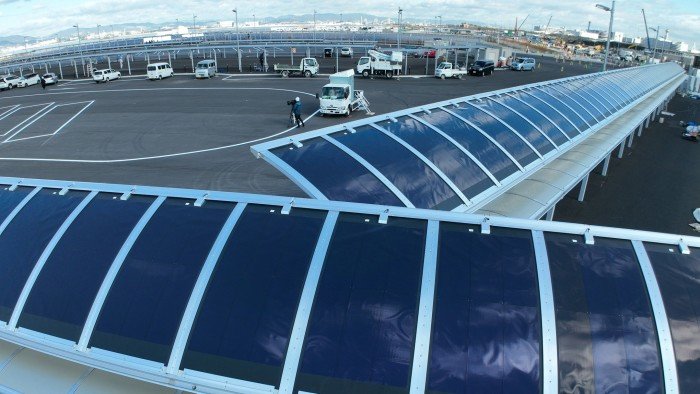
Perovskite cells are 20 times thinner than regular solar panels and could be plastered over stadiums, airports and office buildings, enabling mass adoption of solar in a mountainous country that lacks the open space needed for more conventional solar farms.
Officials in Tokyo have set an ambitious goal of installing enough cells to generate energy equivalent to 20 nuclear power plants by 2040, positioning the technology as essential for Japan to achieve its target for up to 50 per cent of its electricity to come from renewables.
With this in mind, the government is providing subsidies worth up to ¥157bn ($1bn) to Sekisui Chemical, the company at the forefront of efforts to develop perovskite solar film. That comes on top of ¥60bn of support for the technology’s earlier development, and more could be handed out through funds aiming to build green supply chains.
“Perovskite solar cells are a vital trump card to pursue simultaneously decarbonisation, economic growth and energy security,” said Sadanori Ito, the government official behind the plan. “We view it as an indispensable technology for the further spread of renewables in Japan.”
China produces 85 per cent of the world’s solar cells and 79 per cent of polysilicon, the material that goes into them. By contrast, perovskite cells’ main ingredient is iodine, for which Chile and Japan are the world’s top suppliers. This could help reduce risks to critical supply chains and energy infrastructure from overreliance on a single country, analysts said.
Given the cells will be at least three times more expensive to make than current technology in the early years of production and uncertainty about how much mass output will lower costs, initial demand is more likely to come from denser cities such as Tokyo, Taipei and Singapore.
Yana Hryshko, head of solar supply chain research at Wood Mackenzie, a consultancy, said Japan’s plans were “feasible”, noting that “it’s not secure in terms of energy security to buy from China”.
“But the only place capable of scaling up a particular technology and bringing down the cost is China,” she added.
Even so, Japan’s focus “is not only the right way, it’s the only way they have” to try to regain competitiveness and control of their supply chains, said Hryshko.
Perovskite solar cells are layers built out of chemical components, including a power-generating crystal structure, that are together only a millimetre thick and can absorb large amounts of light.
Because China has land for solar farms, its manufacturers focus on heavier forms of perovskite cells encased in glass or used in tandem with silicon solar panels, rather than the ultra-thin film type that Japan is focusing on.
“We feel a very strong threat from China’s speed and scale,” said Yusuke Sakurai, business development manager for Toshiba’s perovskite cells. “But because China is developing glass-type perovskite cells . . . I see it as a different market.”

Sekisui Chemical has set up a new company, with 1,000 employees after deploying its devices at its Osaka headquarters, bus stops outside Osaka station and Tokyo cruise terminal. Sekisui controls an 86 per cent stake in the new company, while the remaining 14 per cent is held by the government-owned Development Bank of Japan.
The plastics producer has solved the biggest technical bottleneck of avoiding moisture from seeping in by developing a special sealing resin. It plans to invest ¥310bn ($2bn) to produce 1 gigawatt of the cells by 2030 at a former Sharp factory, half of which will be covered by state subsidies. At this scale, it expects costs will be on par with traditional silicon solar cells.
More immediately, it is aiming to achieve stable production of film at 1 metre width, up from 30cm currently. It will start producing 100MW per year by 2027 to bring the cost to three or four times that of regular solar panels, according to Futoshi Kamiwaki, president of Sekisui Solar Film, the new company.
The other outstanding challenge is developing the materials to affix the panels on different types of walls, roofs and urban surfaces.
“If we can clear these two challenges, then we will be able to firmly enter into mass production,” said Kamiwaki, who is also eyeing export of the cells to the US and Europe. “In the domain of solar energy, this is the last chance to tackle China’s market dominance.”
Climate Capital

Where climate change meets business, markets and politics. Explore the FT’s coverage here.
Are you curious about the FT’s environmental sustainability commitments? Find out more about our science-based targets here
