
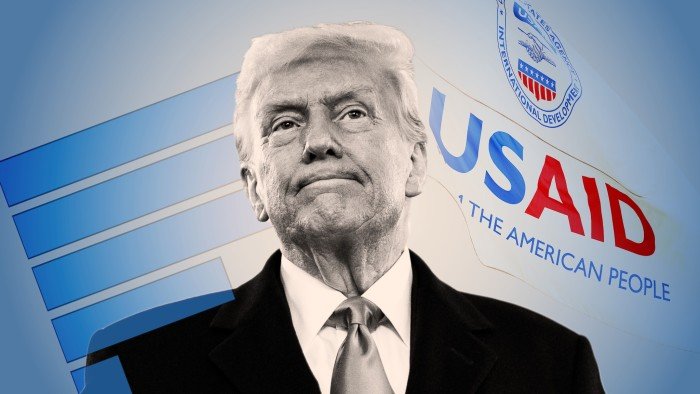
Donald Trump’s administration has slashed US international aid commitments, removing a big source of assistance in sectors from economic development to health.
The planned shrinking of the US Agency for International Development (USAID) is the headline move in a wave of overlapping actions that global institutions and recipient countries are scrambling to address.
Washington has announced its exit from the World Health Organization, while the fate of its big contributions to other global development and health institutions across the world is in the balance.
How do US contributions compare to other aid providers?
US foreign assistance obligations amounted to $68bn across 204 countries and territories for 2023, according to official figures.
Almost two-thirds of the total was managed by USAID, with most of the rest overseen by the state department. Much of it is spent by agencies themselves, US contractors and local partners, rather than given to foreign governments.
The biggest share of total spending — just under a third — was devoted to economic development, roughly a fifth to humanitarian aid, while peace and security and health each received around $10bn.

The US is the biggest international donor by some distance. The $63.5bn it gave in 2023 compared with $34.7bn from EU institutions, according to OECD data. Germany was the next largest nation state donor with $32.2bn, ahead of Japan on $19.3bn and the UK on $17.3bn.
Other big international institutions make significant contributions, mainly in the fields of economic development and health. The World Bank weighed in with $16.3bn and the charitable Gates Foundation with $4.9bn.
While the volume of US funding is large, it is not a particularly generous donor in per capita terms. Norway led the way among countries with assistance worth 1.09 per cent of its gross national income in 2023, followed by Sweden with 0.91 per cent and Germany with 0.79 per cent. The US was at 0.24 per cent — well under half the proportion given by Turkey.

What cuts has the US made?
US aid is relatively diversified, reflecting the fact that its uses vary from military assistance to poverty relief. In 2023, more than a quarter of its aid obligations were to Europe and Eurasia and a little less than a quarter to sub-Saharan Africa.
The biggest international aid recipients as a share of national income are in Africa. The proportion rises to almost a quarter in Central African Republic and a third in Somalia, according to the OECD figures.
The biggest change since Trump returned to the White House has been the gutting of USAID’s activities. On February 3, Elon Musk, head of Trump’s so-called Department of Government Efficiency declared: “We spent the weekend feeding USAID into the wood chipper”.
Last week a judge temporarily blocked the Trump administration from placing 2,200 USAID employees on leave, reducing the agency’s staff to just a few hundred.

The moves in Washington are already having knock-on effects in the aid world. One example is the Pepfar initiative, which has invested more than $110bn in the international effort to combat HIV/Aids since President George W Bush launched it in 2003. It is often cited as one of the big public health success stories of this century.
While the US has issued a humanitarian waiver allowing treatment to continue for most Pepfar recipients, health workers on the ground describe significant disruption. This is because drug purchase is just a small part of the logistics required to deliver such a programme across so many communities.
What other effects might the cuts have?
Ukraine has been the largest single recipient of USAID funding in each of the years since Russia launched its full invasion in 2022. US strategic allies such as Jordan also receive USAID financing.
Global health has been perhaps the most immediately and acutely affected area, highlighting the effects that cuts to one organisation can have on the work of others.
The changes have already slowed disease eradication and containment efforts across Africa, according to people familiar with the situation on the ground.
Amanda McClelland, senior vice president of Prevent Epidemics at Resolve to Save Lives, a global health organisation, said the Centers for Disease Control and Prevention normally provided “a lot of the technical support, a lot of the staffing and a lot of the key pieces that keep the engine moving, in particular disease tracking”. Gaps were emerging “as things don’t work as they normally would, and as staff pull out”.
Current outbreaks across the continent include Ebola, Marburg fever, bird flu and mpox. “These are all high impact outbreaks . . . and it doesn’t take much for them to get out of control and end up costing billions of dollars and thousands of lives,” McClelland said. “The disease tracking systems are dark, and the US is less safe by not knowing what is going on out on the ground.”
Ashish Jha, dean of the Brown University School of Public Health and a former US coronavirus response co-ordinator, warned: “We’re just substantially increasing the likelihood that we are going to start seeing outbreaks of haemorrhagic viral fevers like Ebola spread beyond the original country into Europe, into the US.”
“I think that risk has just gone up very, very dramatically,” he added.
What is the case for curbing international aid?
There is a long-standing debate over the desirability and effectiveness of aid flows. Critics charge that they can build unhealthy patterns in which poorer countries develop dependencies on and obligations to richer ones.

Aid organisations themselves have evolved in response. Some now lay more emphasis on how their work can boost economic development and trade. Others have explicit exit mechanisms for when countries become wealthier: 19 nations no longer receive support from Gavi, the international vaccine alliance, because they have hit certain national income milestones.
Opponents of the Trump administration’s approach say it goes far beyond a reasoned aid-sceptical case to wind-down of existing commitments. Rather than managed it has been sudden, disruptive to people’s lives — and is likely to have consequences that have not been fully anticipated.
Can others fill the gap?
A big question is how the US will engage with leading development organisations, particularly in health.
US withdrawal would leave a large hole in some global institutions at an already difficult time. It would amplify difficulties caused by potential shortfalls from other donors. Many are more reluctant to provide finance when struggling with other demands, from conflict to climate change.
Two big tests are looming. Gavi is partway to its goal of a minimum of $9bn for its next five-year funding cycle starting next year. The Global Fund to Fight AIDS, Tuberculosis and Malaria is due to launch its three-year replenishment round this year; last time, the US committed to providing up to one-third of total donor contributions.
China has been touted as a possible candidate to fill the gap in multilateral aid, but it is not clear this fits with its policy goals. Beijing has historically invested heavily in bilateral relationships that are often infrastructure focused, with a significant loan element.
Announcements are continuing to flow from Washington, leaving financial recipients and other donors struggling to gauge their impact. The one certainty is that the international aid world is facing its biggest disruption for decades.
