Close Menu
    What's Hot

    Sonova unveils next-gen AI hearing aids to drive growth (SONVF:OTCMKTS)

    August 24, 2026

    Aegon expands 2H 2026 share buyback program to €350M

    August 24, 2026

    Anthropic investigates elevated errors across Claude AI models

    August 24, 2026
    Facebook X (Twitter) Instagram
    Hot Paths
    • Home
    • News
    • Politics
    • Money
    • Personal Finance
    • Business
    • Economy
    • Investing
    • Markets
      • Stocks
      • Futures & Commodities
      • Crypto
      • Forex
    • Technology
    Facebook X (Twitter) Instagram
    Hot Paths
    Home»Business»‘Road map’ of how cancers spread offers hope for new treatments
    Business

    ‘Road map’ of how cancers spread offers hope for new treatments

    Press RoomBy Press RoomFebruary 15, 2025No Comments3 Mins Read
    Facebook Twitter Pinterest LinkedIn Tumblr Email
    Share
    Facebook Twitter LinkedIn Pinterest Email

    Unlock the Editor’s Digest for free

    Roula Khalaf, Editor of the FT, selects her favourite stories in this weekly newsletter.

    Scientists have discovered a way to predict which cancers are most likely to spread around the body, widening a path to potential new treatments to halt the most aggressive forms of the disease.

    Researchers found some malignant cells changed shape in response to biological structures around them, making it easier for them to break out to seed fresh tumours elsewhere.

    The work highlights a growing focus on the chemical targeting of surrounding tissues as part of efforts to stop cancerous cells expanding to other organs. This process of spread, known as metastasis, is a feature of many cancer deaths because it makes the disease much harder to treat.

    “Our research has uncovered the road map that cancer cells follow to break out of a tumour, enabling it to cause a secondary tumour elsewhere in the body,” said Victoria Sanz-Moreno, professor of cancer cell and metastasis biology at the Institute of Cancer Research in London, who led the study.

    “Now that we understand this road map, we can look to target different aspects of it, to stop aggressive cancers from spreading.”

    The study, published in Nature Communications on Friday, is the product of almost 10 years’ work on how cancer cells interact with surrounding biological support structures known as the extracellular matrix. This physical framework for cells, which the researchers describe as a kind of a biological “scaffolding”, influences how tumours develop.

    The scientists, including experts from Barts Cancer Institute at Queen Mary University of London, examined tumour tissue from 99 patients suffering from melanoma skin cancer and breast cancer.

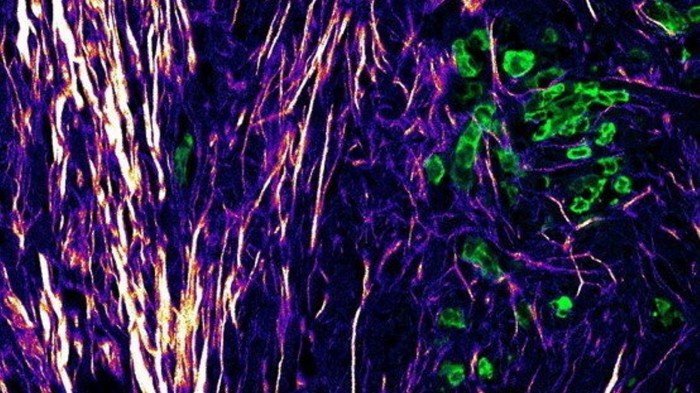
    Melanoma cells from centre and border of tumour
    Melanoma cells and border of a tumour © Oscar Maiques Carlos
    Melanoma cells from centre and border of tumour
    © Oscar Maiques Carlos

    They saw that extracellular matrix fibres at the outer edges of tumours pointed away from the malignancy, providing a “track” for the cancer to follow to spread. In addition, the tumour cells in that region were rounded in shape — a common feature of highly invasive cancers.

    Cancer cells at the tumour border had more genetic traits linked to their abilities to survive and spread, the researchers found. Cancer patients with a higher presence of these kinds of genes died sooner than peers whose genes did not show these characteristics, they said.

    Cancer is one of the biggest killers worldwide, affecting about one in five people during their lifetimes, according to the World Health Organization. It accounted for 20mn new cases and nearly 10mn deaths in 2022, the WHO says.

    The research may intensify interest in the development of treatments targeting lysyl oxidase enzymes, which play a role in binding the extracellular matrix together. One such drug is being investigated as a means to target pancreatic cancer.

    Understanding how cancer spreads is “crucial to finding treatments which can stop the disease advancing”, said Iain Foulkes, executive director of research and innovation at Cancer Research UK, a co-funder of the study.

    “This research shows how much cancer relies on the scaffolding around it to move and spread elsewhere,” Foulkes said. “Cutting down this scaffolding could deprive cancer of opportunities to spread and improve the chances of successful treatment, and I look forward to further research which hopes to achieve this aim.”

    Share. Facebook Twitter Pinterest LinkedIn Tumblr Email
    Press Room

    Related Posts

    Rheinmetall investors to get bumper dividend from booming arms sales

    March 11, 2026

    How to fight deepfakes

    March 11, 2026

    Best Employers: UK

    March 11, 2026
    Leave A Reply Cancel Reply

    LATEST NEWS

    Sonova unveils next-gen AI hearing aids to drive growth (SONVF:OTCMKTS)

    August 24, 2026

    Aegon expands 2H 2026 share buyback program to €350M

    August 24, 2026

    Anthropic investigates elevated errors across Claude AI models

    August 24, 2026

    How Taiwan’s Troops Train to Fight China Right Next to Civilians

    August 24, 2026
    POPULAR
    Business

    The Business of Formula One

    May 27, 2023
    Business

    Weddings and divorce: the scourge of investment returns

    May 27, 2023
    Business

    How F1 found a secret fuel to accelerate media rights growth

    May 27, 2023
    Advertisement
    Load WordPress Sites in as fast as 37ms!

    Archives

    • August 2026
    • July 2026
    • June 2026
    • May 2026
    • April 2026
    • March 2026
    • February 2026
    • January 2026
    • December 2025
    • November 2025
    • October 2025
    • September 2025
    • August 2025
    • July 2025
    • June 2025
    • May 2025
    • April 2025
    • March 2025
    • February 2025
    • January 2025
    • December 2024
    • November 2024
    • April 2024
    • March 2024
    • February 2024
    • January 2024
    • December 2023
    • November 2023
    • October 2023
    • September 2023
    • May 2023

    Categories

    • Business
    • Crypto
    • Economy
    • Forex
    • Futures & Commodities
    • Investing
    • Market Data
    • Money
    • News
    • Personal Finance
    • Politics
    • Stocks
    • Technology

    Your source for the serious news. This demo is crafted specifically to exhibit the use of the theme as a news site. Visit our main page for more demos.

    We're social. Connect with us:

    Facebook X (Twitter) Instagram Pinterest YouTube

    Subscribe to Updates

    Get the latest creative news from FooBar about art, design and business.

    Facebook X (Twitter) Instagram Pinterest
    • Home
    • Buy Now
    © 2026 ThemeSphere. Designed by ThemeSphere.

    Type above and press Enter to search. Press Esc to cancel.