
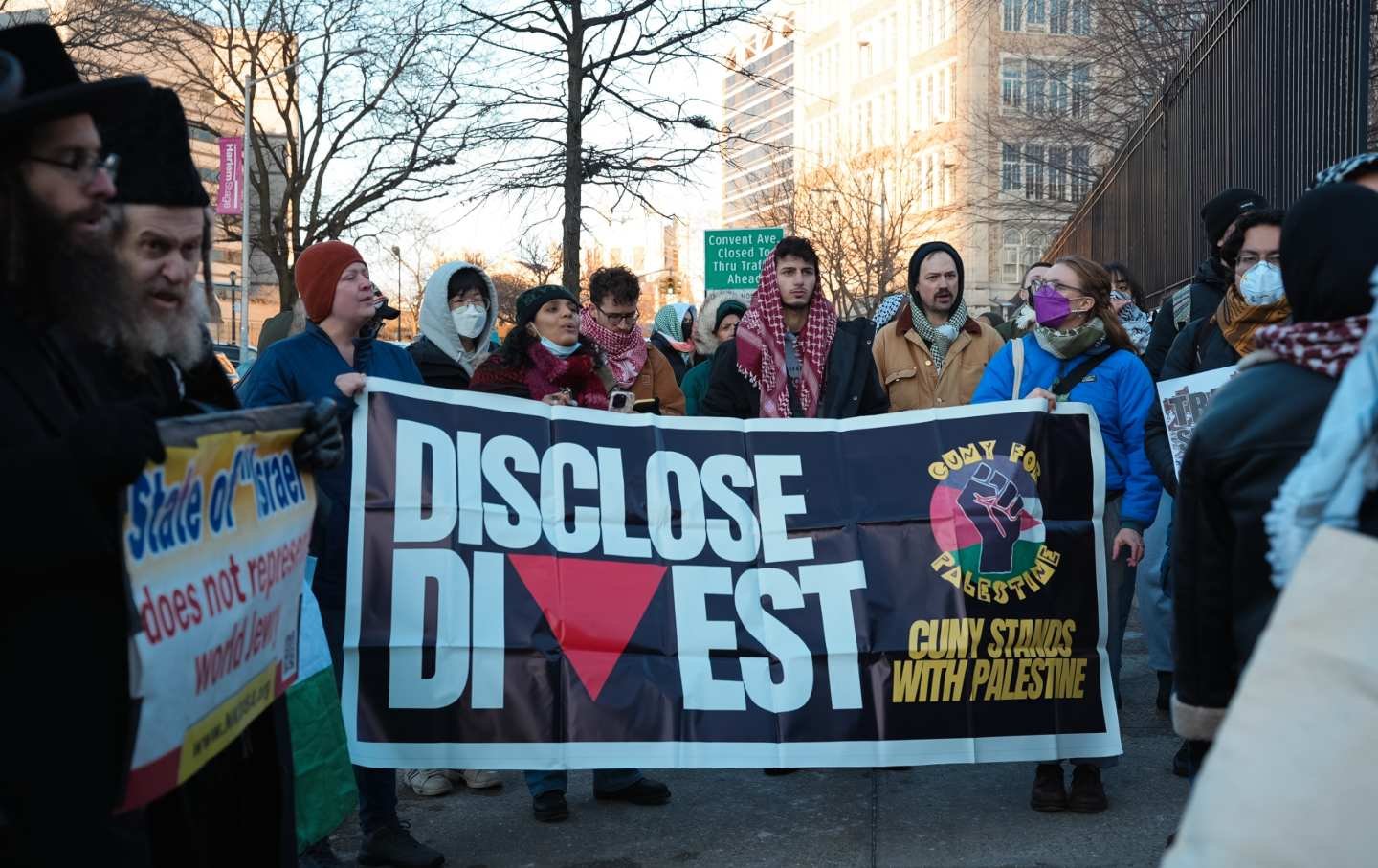
Three members of CUNY Graduate Center’s student government face an anti-discrimination investigation for a resolution endorsing the demands of last year’s Gaza Solidarity Encampment.
CUNY students and faculty rally at City College before testifying at a board of trustees meeting on February 10.
(Hümeyra Çelik)
The NYPD had already fenced off City College by the time Dan West, a PhD candidate at the City University of New York’s Graduate Center, arrived last April 30. West had come to the flagship campus in Harlem to join students who had mounted a Gaza solidarity encampment just six days earlier. Instead, he watched as hundreds of police officers stormed in.
West said he was struck by how indiscriminate the arrests seemed to be, with many happening on the street outside the school. “People showed up to provide support and were scooped up and zip-tied on a school bus,” he said. “The NYPD and Adams’s spectacle was indifferent to a target.”
Watching that raid—which was approved by the school’s chancellor—motivated West, who had previously focused on labor organizing. He was already running for the Graduate Center’s student government, the Doctoral and Graduate Student Council, as part of a coalition of student groups that included members of CUNY for Palestine. Within weeks of the raid he and over 30 others from the same slate of candidates were elected to the DGSC, securing a majority.
That slate of representatives, organized under the banner “Free Palestine, Strike CUNY, Access for All!,” is an attempt “to carry that memory [of the encampment] forward with us, especially as the genocide has dragged and dragged,” West said. To them that meant passing a resolution in the DGSC that supported the CUNY encapment’s “Five Demands for Palestine.”
On October 18, the student government voted 31 to 8 to adopt a resolution that endorsed the demands word for word.
Those demands include calls for CUNY to economically and culturally boycott Israel. Based on previous records, CUNY is believed to have millions of dollars in investments and contracts with weapons manufacturing, technology, and construction companies—like Northrop Grumman, Dell, and Caterpillar—that Palestinian civil society says are complicit in Israeli crimes against the Palestinian people. Its refusal to reveal its current investment records after CUNY for Palestine and CUNY Law Students for Justice in Palestine filed a Freedom of Information Law request is the subject of an ongoing lawsuit by the New York Civil Liberties Union.
Current Issue
In the spirit of those demands, the DGSC instituted a boycott of its own. It restricted the use of its resources—student activity fees and grants for student events—from being used on “products or services that support or benefit from the US-backed Israeli occupation of Palestine,” according to the resolution. To avoid ambiguity, the resolution listed the companies the DGSC would boycott, including HP, Starbucks, McDonalds, and Sabra.
By November, though, the DGSC’s three cochairs—West included—learned they were facing an investigation by their school for the resolution’s alleged violation of Title VI of the Civil Rights Act of 1964, the federal law prohibiting discrimination based on race, color, or national origin in institutions that receive federal funding. Depending on the investigation’s outcome they could face stiff penalties, including expulsion. In the case of one of the co-chairs, an international student, it could result in their visa being revoked—a possibility all the more real with President Trump’s recent executive order. The students say the inquiry shows that CUNY is escalating a crackdown on the student movement for Palestinian freedom that threatens academic freedom at the school.
“It seems like a very uneven application of this Title VI policy,” said Simone Parker, a doctoral student at the Graduate Center and one of the three DGSC representatives under investigation. “That it’s directed at what was a democratic decision seems unprecedented,” she said.
Pro-Israel students and faculty, interest groups and donors, as well as city, state, and federal politicians have slammed CUNY’s administrators for failing to crack down on pro-Palestinian student organizing, saying the demonstrators are contributing to a climate of anti-Jewish hatred across the university’s 25 campuses. In September, a report commissioned by Governor Kathy Hochul that focused on a supposed crisis of unchecked antisemitism at CUNY recommended changes to CUNY’s discrimination policies and procedures that Hochul has since said CUNY must fully implement.
But legal advocates, students, and faculty are warning some of its guidelines could infringe on students’ right to protected political speech, particularly on a matter of grave public concern: US support for the Israeli genocide of Palestinians. The DGSC leaders fear the investigation into their roles in student government is a reflection of the political pressure bearing down on the administration and could signify intensifying repression at CUNY.
“The more the CUNY administration attempts to silence students and faculty speaking in support of Palestine the more they reveal their utter ethical bankruptcy,” said CUNY for Palestine in a statement to The Nation. “We are inspired by the incredible steadfastness of the Palestinian people, and what students and faculty undergoing repression here in the US face is obviously nothing compared to the injustice and violence that Palestinians have faced now for over 77 years.”
Popular
“swipe left below to view more authors”Swipe →
In November, CUNY chancellor Felix Matos-Rodríguez appeared before the City Council Committee of Higher Education for a hearing on the antisemitism probe’s findings. Matos-Rodríguez was quick to assure the council that the university was implementing its recommendations. An area of particular interest to the council members was one of the report’s more controversial positions: its suggestion that CUNY adopt the definition of antisemitism put forth by the International Holocaust Remembrance Alliance—which suggests criticism of Israel as a racist endeavor is antisemitic—in its antidiscrimination investigations.
In a letter written to Matos-Rodríguez in January, the New York Civil Liberties Union argued that the IHRA framework has been “weaponized” against “first amendment-protected criticism of Israeli policies,” with the most common targets of these attacks being “university students, professors, and grassroots organizers.”
While Matos-Rodríguez refrained from saying that CUNY would adopt a singular definition of antisemitism, he assured the legislators that each campus’s chief diversity officer—those in charge of antidiscrimination investigations like the one faced by the DGSC cochairs—had received training on the IHRA definition.
That CUNY could be enforcing a definition of antisemitism that conflates criticism of Israel with anti-Jewish bias is “deeply concerning,” said Golnaz Fakhimi, legal director of Muslim Advocates, a legal advocacy organization that defends Muslims from discrimination. “When anti-Jewish bias is defined to include criticism of [Israel’s] practices, the consequence of that is itself discriminatory. It amounts to anti-Palestinian racism,” she said.
In April, Muslim Advocates represented eight CUNY students in a federal lawsuit that claimed CUNY Law School was illegally repressing student advocacy for Palestinian rights. Muslim Advocates also brought a civil rights complaint against the law school to the Office for Civil Rights at the US Department of Education, alleging anti-Palestinian discrimination. The group also supported students from two other CUNY campuses in bringing similar complaints. All three complaints were folded into a settlement between CUNY and OCR that included other complaints alleging antisemitism, requiring CUNY to update OCR on the spread of its discrimination complaints and what changes it makes to its policies.
Despite being on the hook with OCR, Fakhimi fears CUNY isn’t giving equal weight to the concerns raised in the three complaints. “That is hugely worrisome, knowing what I do about CUNY as an institution,” she said. “It’s the largest urban public university system in the country. It includes so many students and faculty who come from communities that are Black, African, Arab, Middle Eastern, Muslim, and South Asian. It includes so many community members who are speaking up for Palestinian lives and freedom.”
On January 29, Trump signed another executive order aimed at “combating antisemitism.” The order directs federal agencies like the Justice and Education departments to evaluate all legal frameworks at their disposal to curb what is an IHRA-like definition of antisemitism. That order was followed by a memorandum from Attorney General Pam Bondi establishing a joint task force that would, among other things, investigate and prosecute “antisemitic civil rights violations, and other federal crimes committed by Hamas supporters in the United States, including on college campuses.” Altogether, the executive order and DOJ memo signal that the Trump administration is “considering trying to strong-arm campuses in ways that could be unlawful,” Fakhimi said. “Campuses should reject any invitation to capitulate blindly to the administration. If they do, it could create legal exposure for them and otherwise hurt their standing and their stated mission of promoting learning.”
The investigation into the DGSC leaders—two of whom have since stepped down from their positions as cochairs—stems from at least four complaints filed through CUNY’s University Wide Discrimination and Retaliation Portal alleging that the boycott resolution constitute a variety of forms of discrimination including those based on ethnicity, religion, nationality, and military status. None of those reports, however, name the three cochairs of the DGSC as offenders.
Though Parker was a cochair of the DGSC at the time of the resolution’s passage, her status as an alternate representative means she didn’t cast a vote—though she said she would have. “This is the will of my peers. It’s not even just about my opinion. It’s a democratic process and it seems like certain members of the administration are trying to undermine it.”
Both Parker and West feel that they are being targeted as part of a strategy meant to pressure them into publicly recanting the resolution as leaders of the student body. “It becomes way harder to organize as a collective if risk is fundamentally different for different individuals,” West said. “This strategy has forced us to think about that all the time.” But they say that their resolve, and that of their peers, is strong despite the administration’s tactics.
On February 3, during a public meeting held by CUNY’s board of trustees, dozens of students and faculty reiterated their demands for Palestinian liberation and denounced the school’s escalating crackdown on solidarity efforts. The protesters highlighted the “repeated weaponization of Title VI discrimination complaints against CUNY students and workers to chill academic freedom and intimidate those who would speak out about Palestine,” a press release from CUNY Law SJP read.
In 2016, a different resolution endorsing a boycott of Israel was passed by the DGSC that did not garner a Title VI inquiry into the body. An executive order signed that year by then-Governor Andrew Cuomo outlawed all state agencies from investing in companies or institutions determined to boycott Israel by the state. In conversations with the co-chairs, CUNY Graduate Center President Joshua Brumberg wielded a popular misinterpretation of the executive order as one that bans state agencies from engaging in boycotts of Israel to claim that the DGSC resolution is illegal.
But Parker disagrees. “We are protected by free speech. You can have executive orders—we’re seeing it happen in real time now—that come into conflict with constitutional law,” she said. Ultimately, Parker believes the resolution embodies what academia is supposed to be about. “I feel like [administrators] think that we’re doing irrelevant things to our work, but this is actually at the crux of our jobs,” Parker said. “Academia needs to take a look at itself.”
More from The Nation
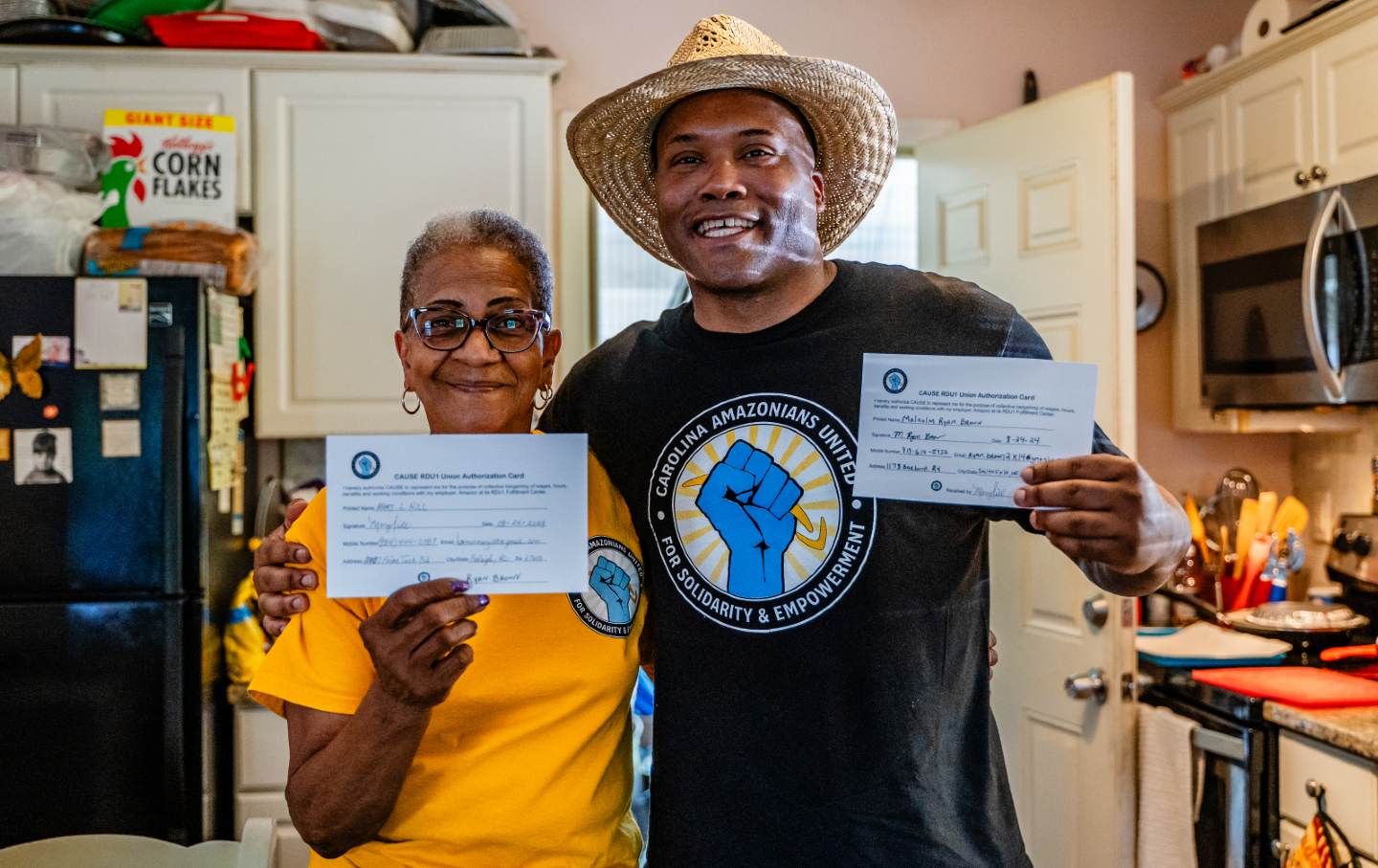
Organizers describe fear tactics, amped-up security, and daily town halls as workers vote on whether to unionize.
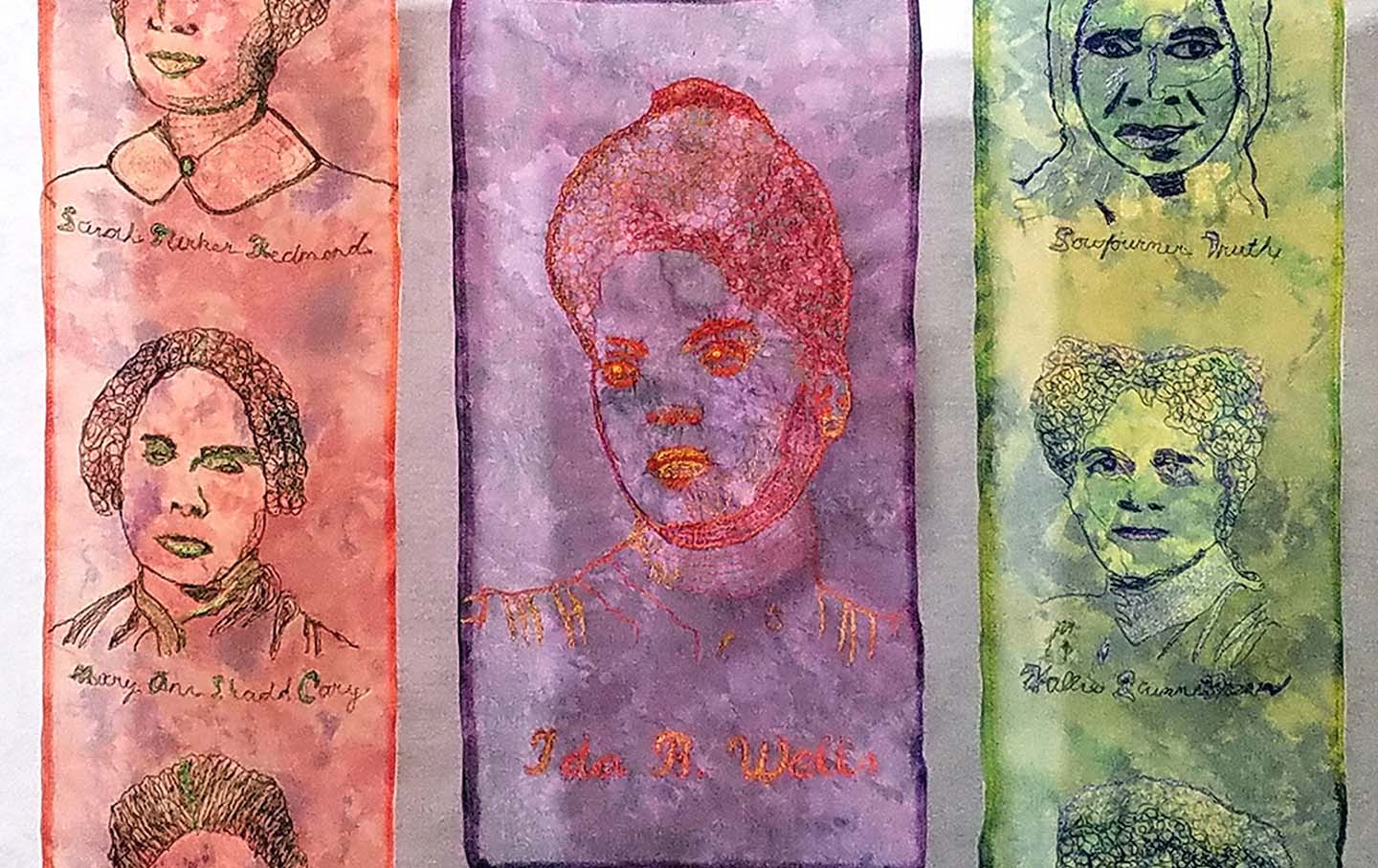
Black leaders: Sarah Redmond Parker, Mary Ann Shadd Cary, Charlotte “Lottie” Rollin, Ida B. Wells, Sojourner Truth, Hallie Quinn Brown, and Mary Church Terrell.
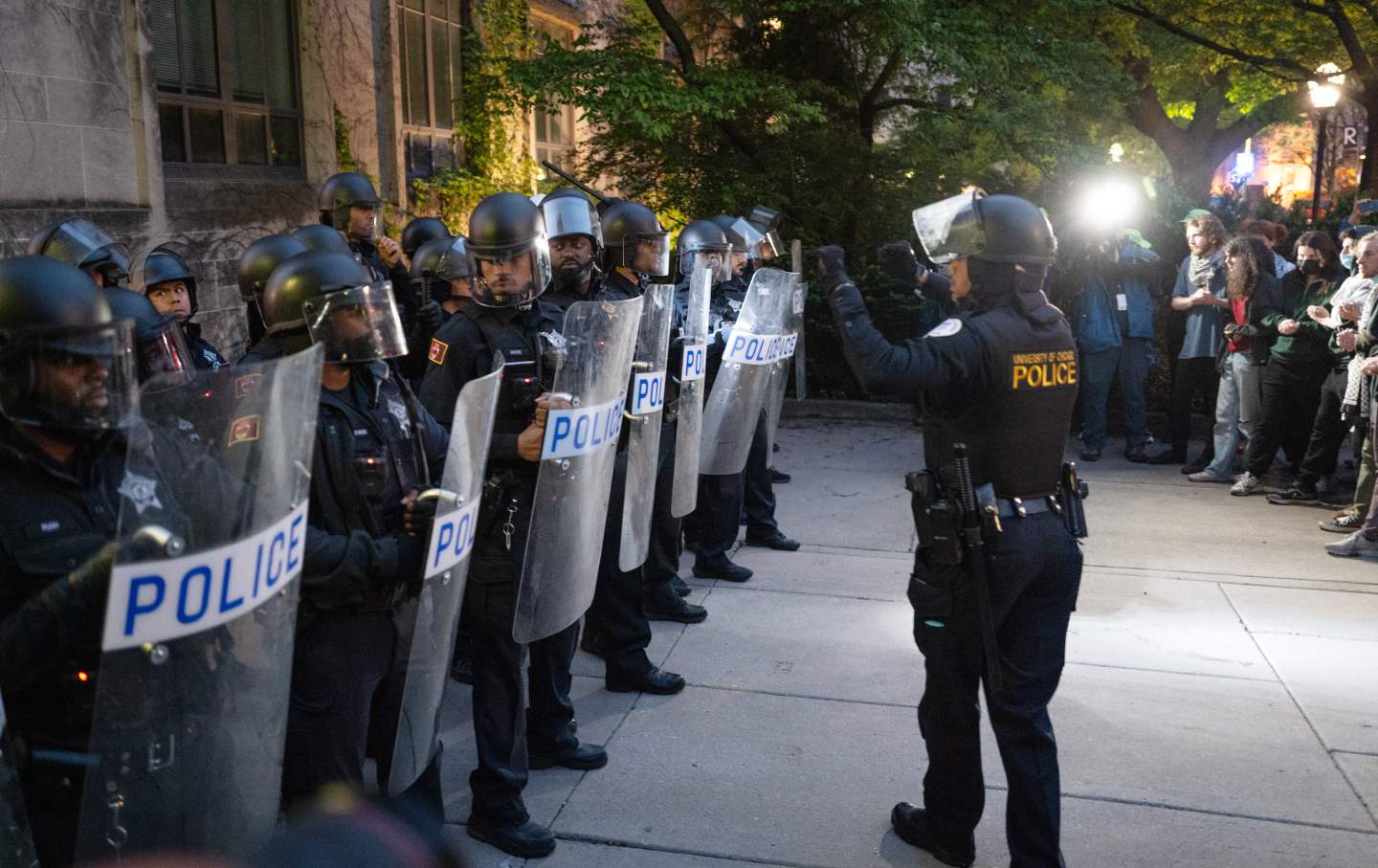
The University of Chicago, despite its free speech reputation, has laid the groundwork for the president’s threats against students who protest for Palestine.
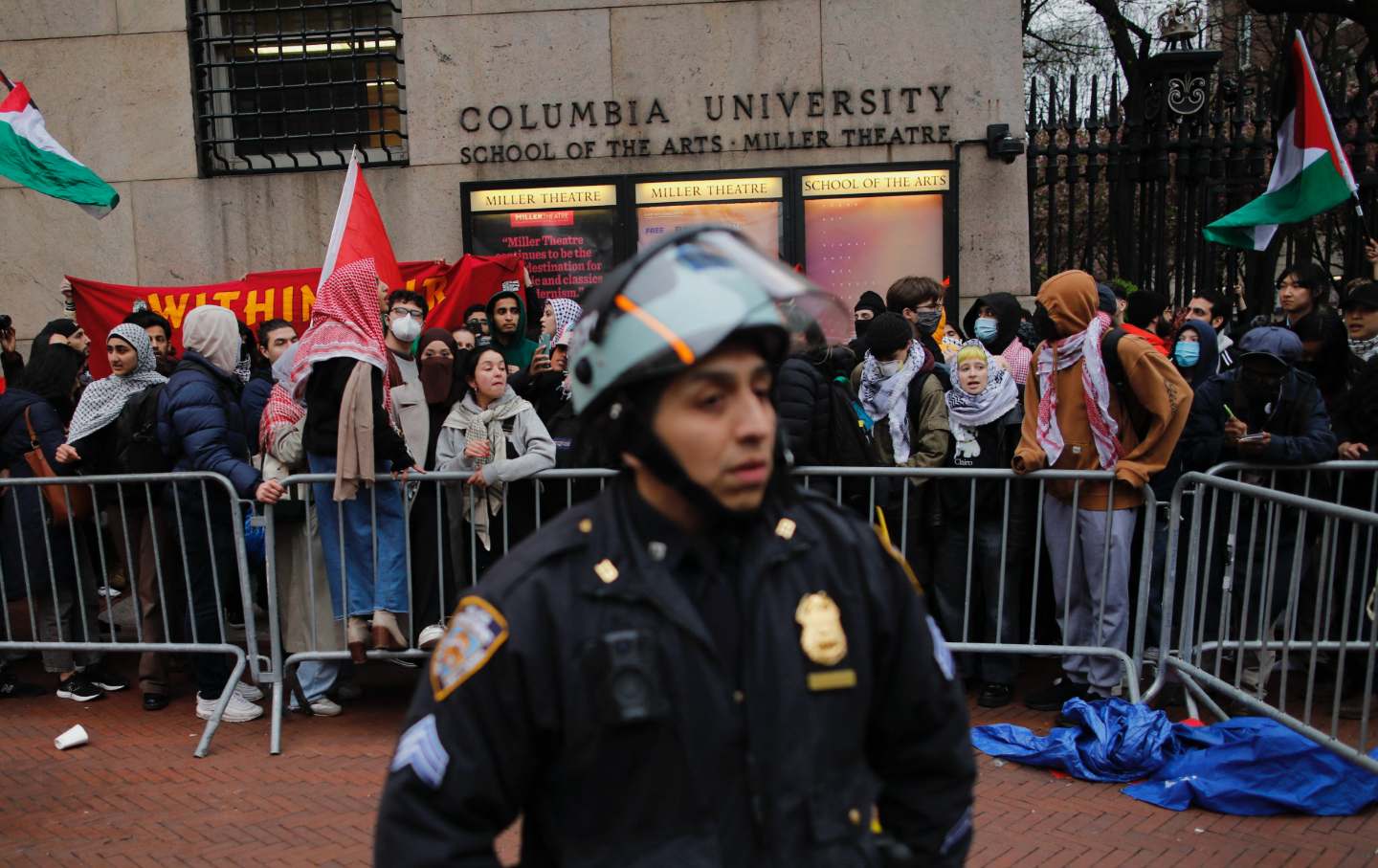
Three graduate students identified over 30 violations of long-standing protocols, including using the NYPD to mass-arrest activists, in a New York civil suit against the universit…
The activist lawyer speaks to Laura Flanders about his radical self-help book, “Love in a F*cked Up World.”
The struggle against climate change has long been demoralizing and draining. But we need to gather our strength to meet this moment.
