
This article is an on-site version of our Energy Source newsletter. Premium subscribers can sign up here to get the newsletter delivered every Tuesday and Thursday. Standard subscribers can upgrade to Premium here, or explore all FT newsletters
Hello and welcome back to Energy Source, coming to you from New York.
My Financial Times colleagues Amanda Chu, Claire Bushey and Gregory Meyer have reported how Donald Trump’s tariffs on steel and aluminium could affect companies ranging from manufacturers to oil and gas drillers.
Steel and aluminium are essential for oil and gas drilling, pipelines, grid infrastructure and clean energy components. Tariffs could raise costs and complicate the US president’s plan to boost domestic energy production.
Higher costs have been an ongoing problem for the US. New figures yesterday showed that US inflation reaccelerated in January, bolstering the case that the Federal Reserve will extend a pause on interest rate cuts, which would hurt renewable developers that pay high upfront costs for projects.
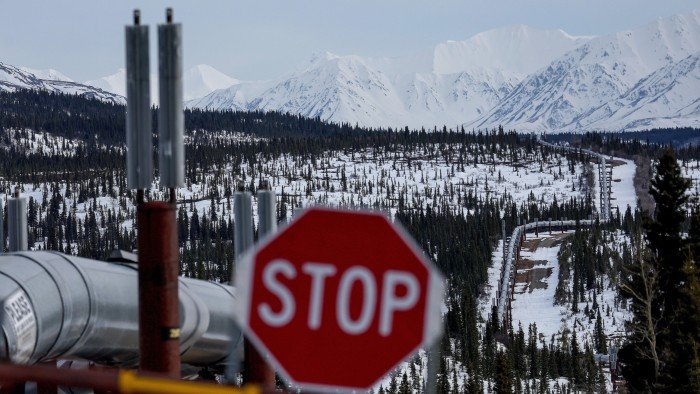
In today’s Energy Source we look at the Trump administration’s initiative to revitalise the oil and gas industry in Alaska. Despite the White House’s backing, the state’s high costs, lack of regulatory stability and litigation risks from environmental groups still make it a challenging place to invest. Trump’s support may only be the first step in boosting oil and gas development there.
Can Trump unleash Alaska’s resource potential?
On his first day in office, Trump signed an executive order to “unleash Alaska’s extraordinary resource potential”, undoing Joe Biden-era climate protections that restricted oil and gas development in the state.
The president’s order vowed to expedite permitting and leasing of energy projects in Alaska, reverse resource development restrictions on state and federal lands including crucial areas such as the Arctic National Wildlife Refuge (ANWR) and the National Petroleum Reserve (NPR-A), rescind cancellation of any leases within the ANWR and prioritise the development of liquefied natural gas.
The administration has singled out Alaska LNG, a $44bn project proposed by the state-owned Alaska Gasline Development Corporation (AGDC), as a permitting priority. Alaska LNG has undergone 10 years of planning but has not yet attracted big corporate backers or private funding. If constructed, it is estimated to export 20mn tonnes a year, becoming a potential game-changer in supplying US liquid natural gas to Asia.
But the AGDC is the only company pursuing the development of the project after BP, ConocoPhillips and ExxonMobil pulled out in 2016.
Last Friday, Trump name-checked the Alaskan project and disclosed that Japanese Prime Minister Shigeru Ishiba had agreed to import more US LNG, adding momentum to the president’s push to boost oil and gas development in the Arctic state.
“[Alaska] is the closest point of major oil and gas to Japan by far. We’re talking about a joint venture of some type between Japan and [the US] having to do with Alaska oil and gas,” Trump said at a joint press conference.
But Trump will need to do a lot more to convince oil and gas producers to boost investment in the state.
Alaska’s oil production has fallen from about 2mn barrels a day at its peak in 1988 to 426,000 b/d in 2023, the lowest level since 1976, according to the US Energy Information Administration. While two big projects — ConocoPhillip’s $8bn Willow and Santos’ Pikka — are in development, they are only expected to raise output to 650,000 b/d, according to consultancy WoodMackenzie.
Mark Oberstoetter, head of Americas upstream research at Wood Mackenzie, said there had been a “quiet revitalisation” in Alaska of onshore drilling, but added that the development had not been as “quick” as other regions in the lower 48 states. “There’s been uncertainty as you go west into federal administered lands. How fast can you get your permits? How fast can you get your developments approved?”
The last lease sale in the ANWR, which was held days before Trump entered office, received zero bids.
Despite the new administration’s support, Alaska has been a challenging place to operate as high costs, lack of regulatory stability and litigation risks cause some producers to shy away from further investments.
Drillers also face a global oil market that is already well supplied as demand growth slows, putting pressure on prices. The US EIA expects the price of Brent crude will average $74 a barrel in 2025 and fall further to $66 a barrel in 2026.
“The market is just not in a state where a lot of operators are going to explore such an uncertain and high cost Arctic area when the market is already well-supplied,” said Tom Liles, vice-president of upstream research for Rystad Energy.
Companies must also adapt to the winter elements in Alaska’s North Slope — a northern region that is home to the ANWR and NPR-A — by building gravel pads or ice roads, which Wood Mackenzie estimates can cost $1mn a mile. The ice roads would need to be rebuilt every winter and producers must bring in crews from out of state because of a limited number of rigs, crews and services, Oberstoetter said.
There is also the political pendulum of Washington.
The first Trump administration opened up the ANWR for development and mandated at least two lease sales in the refuge by 2024. The Biden administration scrapped all but the two legally required oil and gas lease sales in the ANWR.
Much of Alaska’s oil and gas reserves are located in federally protected lands such as ANWR and NPR-A. As a result, producers can be vulnerable to a change in administration that may not be friendly to oil and gas drilling in the Arctic.
“We’re hoping that there can be some durable foundational changes made . . . that allows for consistent regulations moving forward to get away from this . . . pendulum swing that we see from one administration to the next,” said Kara Moriarty, president of Alaska Oil and Gas Association.
David Hobbs, executive chair of Alaskan operator Pantheon Resources, said “it is likely that capital will be easier to access in an environment that is as supportive as the executive orders issued by the Trump administration indicate.”
Then, there’s the fear of litigation.
Rystad’s Liles said he expects there to be lawsuits around Trump’s decision to rescind restrictions on drilling in the NPR-A. “The presence of that kind of litigation in itself can create a lot of risk and maybe detract from the attractiveness of the policy announcement itself,” he added.
Environmental groups have vowed to closely watch the Trump administration’s actions and are largely prepared to follow a similar playbook that saw them fight court battles with the first administration.
“We’ve seen this before . . . where this administration breaks the law we will fight and we will enforce the environmental laws in Alaska,” said Carole Holley, managing attorney at Earthjustice. (Alexandra White)
Job moves:
-
Donald Trump has nominated Kathleen Sgamma, president of Western Energy Alliance, to lead the Bureau of Land Management.
-
Scott Mason, the former deputy secretary of energy for Oklahoma, has been appointed as the new administrator for the US Environmental Protection Agency in Region 6, which covers Arkansas, Louisiana, New Mexico, Oklahoma, Texas and 66 tribal nations.
-
Ken Mackenzie, chair of Australian mining company BHP, is retiring. Ross McEwan, the former chief executive of National Australia Bank, will succeed him.
Power Points
-
Chevron said it would cut 20 per cent of its workforce by the end of 2026 as part of its cost-cutting drive and follows the relocation of its headquarters from San Ramon, California to Houston, Texas.
-
Greenpeace is suing US pipeline operator Energy Transfer in a Dutch court, alleging it used spurious legal actions to try to silence and bankrupt the organisation.
-
Siemens Energy’s chief executive Christian Bruch warned that European companies would not become more competitive unless the EU radically simplifies environmental regulations.
Energy Source is written and edited by Jamie Smyth, Myles McCormick, Amanda Chu, Tom Wilson and Malcolm Moore, with support from the FT’s global team of reporters. Reach us at energy.source@ft.com and follow us on X at @FTEnergy. Catch up on past editions of the newsletter here.
Recommended newsletters for you
Moral Money — Our unmissable newsletter on socially responsible business, sustainable finance and more. Sign up here
The Climate Graphic: Explained — Understanding the most important climate data of the week. Sign up here
