
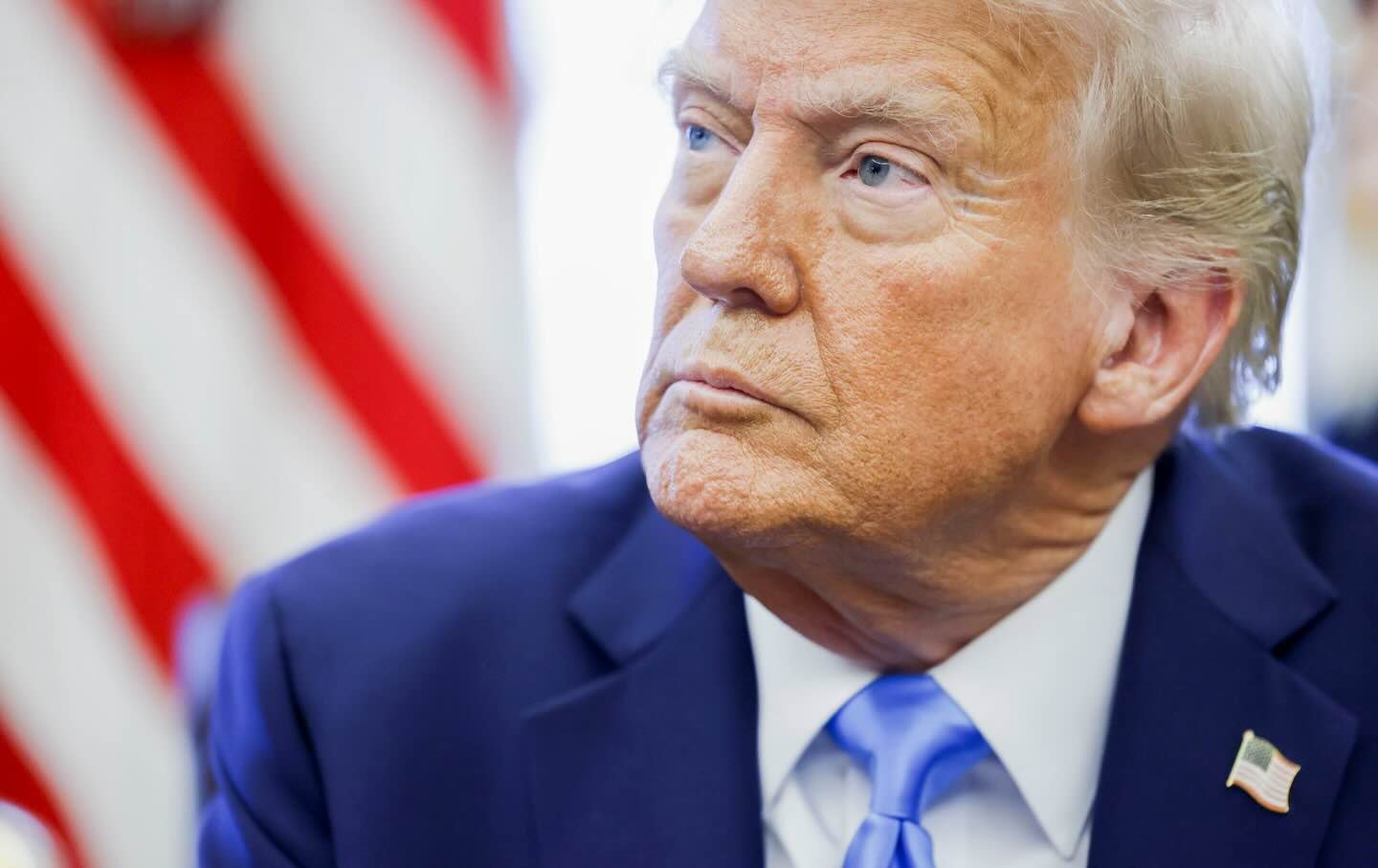
The American experiment depends on institutional checks on power’s exercise. If there are no checks, then these indeed will be devastating times.
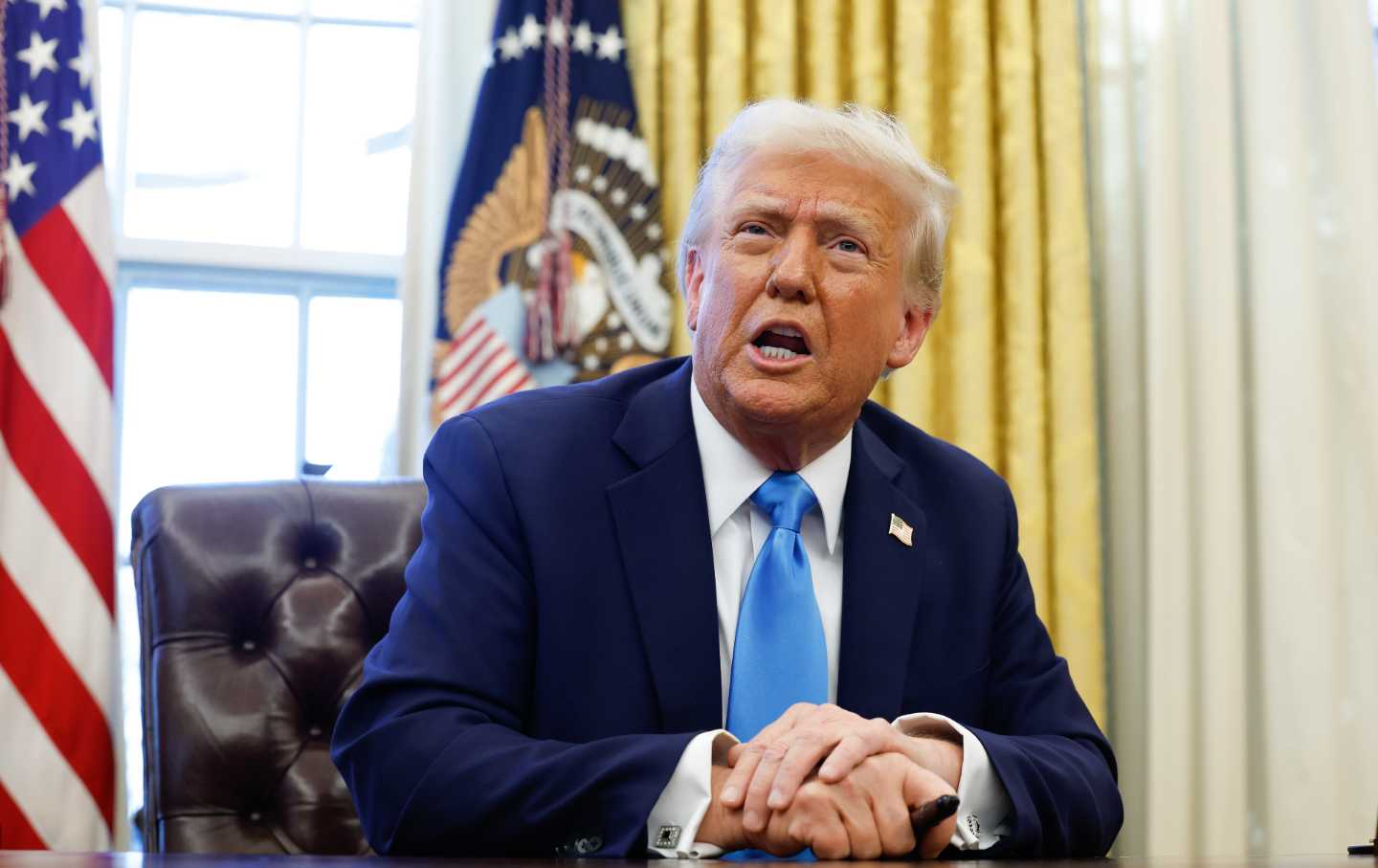
President Donald Trump during an executive order signing ceremony in the Oval Office of the White House in Washington, DC, on February 4, 2025.
(Shawn Thew / EPA / Bloomberg)
In the first three weeks of his second term, President Donald Trump has tested the rule of law in the United States like never before. Just yesterday, a Rhode Island federal judge ruled that the White House acted in defiance of a temporary injunction pausing its federal grants freeze. We are in a serious constitutional crisis. Not since Watergate has there been such a glaring abuse of presidential power and attempt to seize power, flout checks and balances, and place government employees and Americans in fear.
Already there are threats against civil servants related to their employment, attacks and pushback on journalists for reporting on unlawful executive orders, proposed investigations into critics of the administration, an atmosphere of hostility toward civil rights, and prosecutions against critics and individuals who have served in prior administrations, further heightening alarm. We are reminded of the authoritarian trope: “For my friends, everything; for my enemies, the law.” If anything is to be learned from his first presidential term, Trump will test and defy the limits of his authority while creating a chilling atmosphere of intimidation and embedding thuggery into national discourse and politics. But can the rule of law curtail the extent to which Trump can or will get away with what he’s doing?
There are important checks on presidential authority that can be used by Congress, the courts, governors, and state legislatures. State attorneys generals can push back against executive orders and policies implemented by this administration. Congress possesses Article I, Section 8 authority, granting it power to control the federal purse. Trump does not have that authority.
Since 1862, members of Congress have sworn an oath: to “solemnly swear (or affirm) that [they] will support and defend the Constitution of the United States against all enemies, foreign and domestic.” This oath includes a provision to “bear true faith and allegiance to the same…without any mental reservation or purpose of evasion, and…[to] faithfully discharge the duties of the office.” In other words, they need not be stunned into paralysis while Department of Government Efficiency (DOGE) staffers—hired by the unelected billionaire tech mogul at Trump’s side, Elon Musk—pirate sensitive data belonging to Americans.
Courts can and should also check Trump’s unlawful agenda. Judges can issue injunctions, temporarily and permanently barring Trump’s executive orders from going into effect. In fact, successful injunctions were won by Democracy Forward last week, and reinforced by judges like Monday’s ruling, and states have authority independent of the federal government.
So while Trump seeks to undo the policies of prior Democratic and Republican presidential administrations with his myriad executive orders, the president is not exempt from abiding by the rule of law. The act of signing his name to unconstitutional executive orders does not make those documents enforceable or legal.
Current Issue
In his first three weeks as president, Donald Trump has already lost 15 times before courts that have blocked his dangerous and unconstitutional executive orders relating to ending birthright citizenship for American-born children whose parents are immigrants, placing 2,200 employees of the United States Agency for International Development (USAID) on leave, sending transgender women to men’s prisons, and offering buyouts to 2 million federal employees, among others. Even though it is onerous to bring litigation, civil society organizations are not backing down.
The rule of law is designed to protect individuals from the arbitrary exercise of power. This applies no matter who serves in the role as president, governor, or mayor.
Yet Trump has shown time and again that he intends to disregard norms and is almost daring anyone to stop him. In too many cases, it appears no one will—which is a strategy. The Department of Education may soon be dismantled or gutted from within, leaving a hollowed shell. Referring to his nominee for Secretary of Education, Linda McMahon, and the dismantling he hopes for, the president said on February 4: “I told Linda, ‘Linda, I hope you do a great job in putting yourself out of a job.’ I want her to put herself out of a job.”
USAID has effectively been shut down. Employees have been told not to return to work. And, without congressional approval, all payments, including those previously appropriated, are now frozen, meaning that the United States is also not paying its debts. Alarmingly, the Consumer Financial Protection Bureau, which was established to protect consumers against predatory lending and financial abuse has stopped its work and its director has been fired. The agency is now under review. As well, federal protections for employee safety may soon be gutted.
Skeptics believe that the only checks on Donald Trump’s lawless actions to eliminate governmental agencies and control federal spending will be Republicans in Congress, who hold the majority, but they are not a sure bet given how the White House has succeeded at bullying lawmakers into getting its way on Trump’s cabinet nominations. Others say the courts will fail to hold the president accountable because Trump has already vowed to stack them. And should the Supreme Court rule against him, it’s not clear what he will do. His advisers have cautioned that he should ignore the courts.
Checking the arbitrary exercise of power will be the country’s central challenge these next years, because Trump’s attempt to expand his presidential authority is unprecedented. Richard Nixon’s conduct pales by far in comparison.
Popular
“swipe left below to view more authors”Swipe →
Most of the challenges to Trump’s executive orders argue that his conduct is arbitrary—a glaring red flag in constitutional law, because laws should not be based on whim, personal discretion, or the intent to discriminate. This has been a smart and necessary tactic. Yet there are concerns among the legal community about this approach.
Historically, federal courts have refused to give safe harbor to arbitrary laws such as when the law would not apply to those in power. Yet the Supreme Court’s decision in Trump v. United States created a new doctrine of “absolute immunity” for “core” presidential acts combined with “presumptive immunity” for other “official acts.” Armed with this decision, the Trump administration will test it when he is challenged, under the belief that the rule of law does not apply to him when he is in office. To our point, JD Vance recently posted on X, “If a judge tried to tell a general how to conduct a military operation, that would be illegal.… Judges aren’t allowed to control the executive’s legitimate power.”
None of this should come as a surprise given that Trump openly vowed to be a dictator “on day one.” He also told his supporters, “We’ll have it fixed so good, you’re not going to have to vote” again. What possibly could he have meant? That voting rights under a Trump presidency would be suspended or suppressed? That voting would be rigged? It’s unclear exactly what Donald Trump was referencing. Over the years, pundits have claimed that Trump speaks in hyperbole, but his slew of executive orders, mass firings, layoffs, and more suggest that this is not all hot air. The president is claiming power that exceeds his constitutional authority and waiting to see what happens next.
The United States has institutional machinery to protect this defiance of the rule of law, yet its actual and perceived vulnerabilities are clear. In response to the Monday ruling in which a federal judge called out the administration for not complying with a court order, a White House spokesperson said, “Each executive order will hold up in court because every action of the Trump-Vance administration is completely lawful. Any legal challenge against it is nothing more than an attempt to undermine the will of the American people.”
It’s not only that the White House is brazenly ignoring the rule of the courts. The hirings of prosecutors, civil servants, and senior military officials who signal that they will prioritize Trump’s policies over constitutional norms is alarming. Supporters of Trump label his appointees as institutional “disruptors.” It is one thing to disrupt institutions in terms of policy. It is another to undermine institutional checks against the uncontrolled exercise of power. And altogether, there is something unprecedented in the chaos unleashed on millions of citizens who now experience fear and anxiety regarding their future. With the weaponization of government in defiance of the rule of law, questions abound about whether Trump’s nominees will keep all Americans safe. Rather, these appointments of Trump loyalists may only serve to carry out Trump’s white nationalist agenda while keeping the opposition at bay.
It’s important to remember that this is not a new playbook. For example, Putin’s Russia used law to destroy the opposition. One test will be how the Trump administration uses tax law against his political opponents. It is a tactic used by authoritarians around the globe. Already, Trump has warned that he will target organizations that have 501(c)(3) status who are doing work that conflicts with his presidential mandate. That is, any branch of government can be weaponized, including the Internal Revenue Service.
Further, Trump already has called three “national emergencies” and deployed the military domestically. More national emergencies that are not justified under current legal policies and norms may follow. These tactics aim to create openings for lawlessness. Infamously, Carl Schmitt invoked the “exception” in law, writing, “The rule proves nothing; the exception proves everything.” Arguably, declaring national emergencies is the biggest exception of all. Trump is testing it now.
For democracies to continue and thrive, the rule of law must be preserved. This nation’s founders stressed the importance of institutional checks against “factions.” As James Madison wrote, “Ambition must be made to counteract ambition. The interest of the man must be connected with the constitutional rights of the place.”
The president does not exist or operate in a vacuum. Courts, federal lawmakers, attorneys general, and state legislatures are responsible for checking abuses of power. And they should be answerable and accountable when they fail. The 10-point plan released by Democratic leader Hakeem Jeffries is a start. Independent media outlets can also be a bulwark against authoritarianism. The media must document it all.
Protecting the rule of law is a radical accomplishment in human history. It is the result of persistent, hard-fought struggles over time. The struggle is ongoing precisely because power is at stake. The American experiment depends on institutional checks on power’s exercise. If there are no checks, then these indeed will be devastating times, embedding a personalist, authoritarian rule.
More from The Nation
In the malignity of his intent and the scale of his graft, the second term is significantly worse. But it’s also his last.
The Philadelphia Eagles and Kendrick Lamar’s collective of geniuses made this the Super Bowl we needed.
The president is taking a chainsaw to our public health infrastructure—and people will die as a result.
With Trump back in the White House, the Democrats are floundering instead of fighting.
In the first English translation in half a century, Paul Reitter and Paul North distill the essence of the Marxist masterpiece by going back to basics.
