
Today’s jobs report provides more evidence for the view that inflation remains a very significant problem. Average hourly earnings rose by 0.5%, well above the 0.3% rate consistent with the Fed’s inflation target.
Over the past 12 months, wage inflation has averaged 4.1%, which is only modestly above the roughly 3.0% to 3.5% figure consistent with 2% price inflation. Unfortunately, progress against inflation seems to have stalled, and may be going into reverse. Over the past 6 months, wage inflation has average 4.6%. We seem to be moving in the wrong direction. High nominal wage inflation increases the risk of recession.
Jed Kolko suggests that there is evidence of a cooling job market:
The first thing to know is that the job market is cooler than previously reported. As foreshadowed last August, average monthly job growth was revised downward from 251,000 to 216,000 in 2023, and from 186,000 to 166,000 in 2024. Whether job growth is too fast and risks overheating the market and pushing up inflation, or too slow and risks pushing up unemployment, depends on how job growth compares with the growth of the labor force. Unfortunately, the annual adjustment to the household survey is not applied historically, so you aren’t supposed to compare labor force estimates over time. But I did a quick-and-dirty simulation in order to do just that. It shows that the big upward adjustment to the population implies that the labor force grew by 150,000 people per month on average in 2024, versus 90,000 as officially reported.
He’s referring to revisions in the jobs data for previous months. The payroll survey of businesses is generally viewed as more reliable, and job growth in that series was revised downward. Job growth in the household survey (used for constructing the unemployment rate) was revised upward. Kolko points out that these two revisions mostly closed an unusual gap in the two series that had opened up during 2024:
The upward adjustment to employment in the household survey and the downward revision to employment in the payroll survey closed most of the gap in reported employment between the surveys that opened in recent years.
In my view, we put too much weight on the employment figures, at least when it comes to forecasting inflation. It is true that wage inflation and employment are correlated, but the link depends on a number of factors. For instance, the recent immigration crackdown (which began in mid-2024) has likely led to slower population growth. This means that a slower pace of job growth does not necessarily imply a “cooling” jobs market. I expect job growth to slow fairly significantly in 2025, as the recent immigration crackdown filters through to the job market, and also because the Fed may tighten policy to bring inflation down to its 2% target. And that’s not even accounting for possible Trump administration policies such as the expulsion of illegal immigrants and a trade war with the rest of the world.
In the end, it is the wage inflation figures that matter most for macroeconomic stability. At the most fundamental level, good macro policy is mostly about getting low and stable nominal wage inflation. All the other outcomes that we wish to see (a strong jobs market, low price inflation, etc.), require low and stable nominal wage growth.
Unfortunately, nominal wages are sticky. Thus we may not know whether wage growth is excessive until it is too late. That’s why economists look at “real” indicators such as job growth when trying to figure out if the economy is overheating or underheating. But these real indicators are also hard to interpret, because just as we don’t know the underlying rate of wage inflation in real time, we don’t know the underlying rate of labor force growth in real time.
Given all of these uncertainties, I still believe that NGDP level targeting is the least bad monetary policy framework. We are now almost 5 years past the Covid lockdowns. The Fed is running out of excuses and losing credibility. It is time to take the inflation target seriously, or else set a new target that honestly reflects what the Fed is trying to achieve.
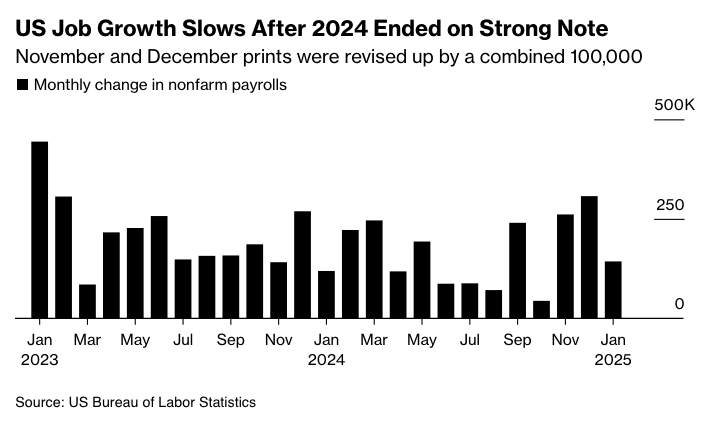
PS. The Bloomberg article linked to at the top of the post has a graph of monthly employment gains in the payroll survey:

