
Unlock the Editor’s Digest for free
Roula Khalaf, Editor of the FT, selects her favourite stories in this weekly newsletter.
The rapid advances in artificial intelligence that have transfixed the tech industry have put another potentially transformative idea — quantum computing — in the shade. It’s hard to focus on the more distant and unproven benefits of quantum machines when the headlong rush of AI dominates the headlines.
This is more than just a question of perception, though. According to two of the leading figures in AI, quantum computing could be much further off, and of considerably less importance, than many of the people working in the field like to claim.
Their comments have forced the quantum computing industry into a defensive crouch and revived a question that has been hard to shake off: where is the line between hype and reality for a supposedly world-changing technology that has yet to produce anything of practical value?
This year, Nvidia chief executive Jensen Huang predicted that useful quantum computers were still 20 years away — much longer than companies working in the field claim. Huang’s own company works closely with many quantum companies, including adapting its CUDA software to help researchers create quantum simulations. That didn’t prevent his comments hitting the stocks of publicly traded companies.
Less dramatic in the reaction it caused, but potentially of even greater significance, was the suggestion by Demis Hassabis, CEO and co-founder of GoogleDeepMind, that AI could take on many of the tasks that only a quantum computer had been thought capable of tackling.
One of the biggest hopes for quantum machines is that they will be able to model molecular activity in far more detail than traditional, or “classical”, computers ever will. That could pave the way for new pharmaceuticals or battery technologies. According to Hassabis, however, AI running on today’s computers is already proving adept at modelling complex systems and could handle this type of work.
Not surprisingly, such comments have brought a swift response from the quantum crowd. Hartmut Neven, head of Google’s quantum effort, said this week that he was confident that “real world applications that are possible only on quantum computers” would arrive within five years. Exactly what form these will take is not clear.
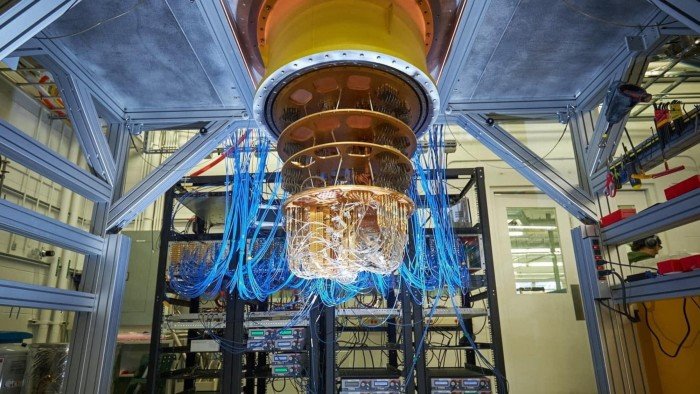
Google’s big bet has been on full-scale, fault-tolerant quantum machines that can far outpace classical computers. Late last year it demonstrated that it had been able to overcome the “noise” that builds up in quantum systems as a result of the inherent instability of their basic components, known as qubits — an important step as it tries to scale up to produce a practical system.
Nearer term, though, the industry’s hopes rest on what are known as NISQ — noisy, intermediate-scale quantum — machines. These can only handle brief quantum calculations before they are overwhelmed by noise, but might still be harnessed to produce something useful. Neven’s claim coincided with the publication of Google research in Nature outlining a new technique that might make NISQ quantum simulations more practical.
However, backers of NISQ systems have for years claimed to be close to a breakthrough. Until they are able to demonstrate useful computing tasks that could never be handled on a classical machine, the doubts will remain.
But the headlong advance of AI may have opened new avenues for quantum computing. Quantinuum — formed from the merger of Honeywell’s quantum arm with Cambridge Quantum in the UK — this week unveiled a way to use its quantum machines to generate extra data to train the large language models that underpins much of today’s AI.
According to CEO Raj Hazra, simulating nature at a molecular level inside a quantum computer produces data that can’t be generated any other way. That could be valuable, he adds, for companies looking to train AI models for drug discovery or research into new materials. But it has not been shown that this will result in a meaningful advance over classical computing.
Quantinuum’s work also points to a broader point about the interaction of quantum computing and AI: that the boundaries between the two fields are shifting as both evolve. It always seemed likely that the two technologies would work alongside each other, with each taking on the computing work it is best suited to.
With AI advancing at a breakneck pace, and with quantum computing still more promise than reality, how the marriage of the two will work is still hard to predict.
richard.waters@ft.com
