
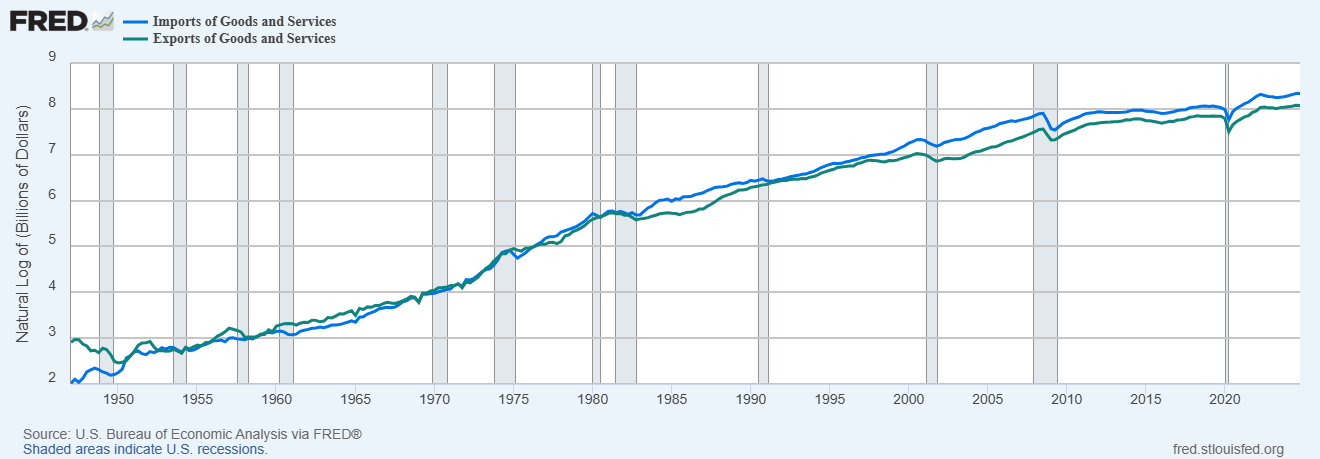
Are we in a trade war today? Who knows? Doesn’t really matter. It’s always a good time to review important principles. A good source is Doug Irwin’s Three Simple Principles of Trade Policy published in 1996. Below I have updated occasionally with more recent data.
Principle 1: A Tax on Imports is a Tax on Exports
Exports are necessary to generate the earnings to pay for imports, or exports are the goods a country must give up in order to acquire imports….if foreign countries are blocked in their ability to sell their goods in the United States, for example, they will be unable to earn the dollars they need to purchase U.S. goods.
…The equivalence of export and import taxes is not an obvious proposition, and it is often counterintuitive to most people. Imagine taking a poll of average Americans and asking the following question: “Should the United States impose import tariffs on foreign textiles to prevent low-wage countries
from harming thousands of American textile workers?” Some fraction, perhaps even a sizeable one, of the respondents would surely answer affirmatively. If asked to explain their position, they would probably reply that import tariffs would create jobs for Americans at the expense of foreign workers and thereby reduce domestic unemployment.Suppose you then asked those same people the following question: “Should the United States tax the exportation of Boeing aircraft, wheat and corn, computers and computer software, and other domestically produced goods?” I suspect the answer would be a resounding and unanimous “No!” After all, it would be explained, export taxes would destroy jobs and harm important industries. And yet the Lerner symmetry theorem says that the two policies are equivalent in their economic effects.
Exports and imports rise and fall together. It is surely obvious that if you want more imports you must export more (barring a bit of borrowing see below). The same thing is true in other countries. As a result, it is also true that when you import more you export more.

Principle 2: Businesses are Consumers Too
Business firms are, in fact, bigger consumers of imported products than are U.S. households.
As of 2024, more than 64% of imports are intermediate products. See here for the data.
By viewing imports not as final consumer goods but as inputs to U.S. production, policy makers can more clearly recognize that the issue is not so much one of “saving” jobs but of “trading off’ jobs between sectors. This brings home forcefully the most important lesson in all of economics-there is no such thing as a free lunch. Every action involves a trade-off of some sort. Higher domestic steel prices help employment in the steel industry but harm employment in steel-using industries. Higher domestic semiconductor prices help employment in the semiconductor industry but harm employment in semiconductor using industries. As john Stuart Mill wrote in 1848 in the context of import protection, “The alternative is not between employing our own country-people and foreigners, but between employing one class or another of our own country-people.”
Principle 3: Trade Imbalances Reflect Capital Flows
There is a fundamental equation of international finance that relates this net borrowing and lending activity to the current account. The equation is:
Exports – Imports = Savings – Investment
The powerful implication of this equation is that if a country wishes to reduce its trade deficit, the gap between its domestic investment and its domestic savings must be reduced.
…A country’s trade balance is related to international capital flows–not with open or closed markets, unfair trade practices, or national competitiveness. If a country wants to solve the “problem” of its trade deficit, it must reverse the international flow of capital into its country. In many cases net foreign borrowing can be reversed by reducing the government fiscal deficit. [emphasis added, AT]
Doug concludes:
These three simple principles of trade policy…[have] stood the test of time, they come as close to truths as anything economists have to offer in any area of policy controversy. Yet they are routinely denied, explicitly or implicitly, in trade policy debates in the United States and elsewhere. I do not imagine that a greater appreciation of these principles would invariably bring about more liberal trade policies; I offer them, rather, in the more modest hope that they might lead to sounder debates in which the real consequences of government policies are confronted more seriously than at present.
Hat tip: Erica York.
The post Three Simple Principles of Trade Policy appeared first on Marginal REVOLUTION.
