

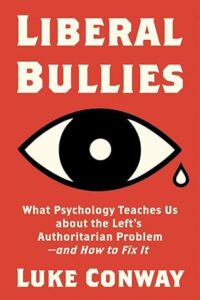
- … [those] who score high on the authoritarianism scale agree that (italicized words are direct quotes from the scale) our country needs a mighty leader; that the leader should destroy opponents; that people should trust the judgment of the proper authorities, avoid listening to noisy rabble-rousers in our society who are trying to create doubts in people’s minds, put some tough leaders in power who oppose those values and silence the trouble-makers, and smash the beliefs of opponents; that what our country needs is a strong, determined leader who will crush the evil; that society should strongly punish those they disagree with. They also deny that an opponent has a right to be wherever he or she wants to be, and support the statement that the country would be better off if certain groups would just shut up and accept their group’s proper place in society.
- —Luke Conway, Liberal Bullies: What Psychology Teaches Us About the Left’s Authoritarian Problem—and How to Fix It, p. 160
In the aftermath of the Second World War, psychologists developed the theory that there is an authoritarian personality type. They wanted to understand the support for fascism in their day, and they assumed that authoritarianism was a characteristic of people with right-wing political beliefs.
Psychologists eventually arrived at a scale that could be measured using a questionnaire. Someone who scores high on the authoritarian scale will have responses that reflect a belief that bad people need to be controlled, suppressed, and punished.
What Conway and others have found is that high-scorers on the authoritarian scale are prevalent on the political left as well as on the right. They have been digging further to try to understand the authoritarian personality.
Authoritarians tend to display what Conway calls intellectual apathy. When given a slightly challenging mental exercise (having nothing to do with politics), they tend to answer quickly, without the patience for finding the correct answer. They have cognitive rigidity.
- High-rigidity persons ignore evidence and rational argument; instead, they focus on lazy, quick-and-easy heuristics that are functionally irrelevant to the argument itself. p. 54
Conway argues that intellectual apathy and cognitive rigidity are contagious to some extent. Some of this is unconscious imitation. However, it also can be due to authoritarian repression of dissent. People just come to accept that it is wrong to question established narratives.
- Why should you bother listening to your opponents’ arguments when you can simply ignore them, knowing that they will be punished by an authority figure sooner or later? p. 59
Another authoritarian characteristic is an obsession with misinformation. Conway attributes this to an inability to handle ambiguity. In practice, many issues, such as whether COVID came from a lab leak or arose naturally, are contestable. Freedom of speech is necessary in order for people to have a chance to arrive at the best approximation of the truth. Someone who cannot tolerate ambiguity reacts to contestable situations by trying to shut down opposing views, labeling them as misinformation.
- Authoritarians really, really dislike uncertainty. The don’t like ambiguous ideas; they don’t like ambiguous poems; heck they don’t even like ambiguous pictures. p. 85
Conway cites a study that showed that people on either the political left or the political right who have a low tolerance for uncertainty respond to political debate in a more polarized fashion. Another study, which looked at the extent to which people admitted to “mixed feelings” about a topic, found that liberals were actually less likely than conservatives to manifest ambivalence.
“[P]eople who cannot tolerate uncertainty are not only intolerant of what they perceive to be misinformation. They are more prone to believe misinformation themselves.”
He points out that people who cannot tolerate uncertainty are not only intolerant of what they perceive to be misinformation. They are more prone to believe misinformation themselves.
Conway argues that another characteristic of authoritarians is the use of double standards. They overlook authoritarian behavior on their own side while accusing the “other” side of authoritarianism for lesser transgressions.
Another characteristic of authoritarians is what Conway calls simplicity.
- We did a linguistic analysis of over 6,000 people ourselves using many different linguistic variables, and for both left- and right-wingers, simple language was one of the most consistent predictors of authoritarianism. p. 128
What to do about authoritarianism? Conway says that the obvious answer is to fight intellectual apathy, intolerance of ambiguity, and other characteristics of the authoritarian.
He argues that many people, perhaps most, are neither strongly authoritarian nor anti-authoritarian. Unfortunately, these moderates often find it easier to go along with authoritarians rather than take them on. I wonder if moderates who are unwilling to stand up for professors with unpopular viewpoints enable the radical authoritarianism that one finds on college campuses today.
Conway says that resistance to authoritarianism can be self-defeating if it takes on authoritarian forms. I think that this was shown in the late stages of the U.S. Presidential election of 2024, which took place several months after his book appeared. In October, both sides made statements that sounded authoritarian to the other side.
Conway asks,
- Do you want the temporary satisfaction of crushing you enemies or do you want your children to grow up in a free society? Because ultimately, you cannot have both. p. 239
In his final chapter, Conway offers a set of six principles for fighting authoritarianism. These principles, such as “win gracefully,” struck me as vague and general.
What I was waiting for was a way to apply the insights of personality psychology. If authoritarianism is something that is ingrained in someone’s personality, then that suggests that to remain free we have to make a determined effort to identify and fend off the authoritarians.
For more on these topics, see
Conway seems to lean in the direction of believing that authoritarianism arises in people based on social context. If so, then how can we guide people away from intellectual apathy, intolerance for ambiguity, and tribal double standards? It seems to me that this used to be the function of education, especially higher education. That realm is where things have gone badly wrong, and where we need to focus if we are to fix things.
Footnotes
[1] Luke Conway, Liberal Bullies: What Psychology Teaches Us About the Left’s Authoritarian Problem—and How to Fix It. Pitchstone Publishing, 2024.
[2] Fifteen years ago, Jonah Goldberg wrote Liberal Fascism, in which he pointed out that in the 1920s liberalism and fascism resembled one another. Conway seems to be unaware of Goldberg’s book. Arguably, Goldberg foresaw the attraction of progressive ideology to someone with an authoritarian personality. You are welcome to go back and read my review, although it is not one of which I am particularly proud. Available online through the Wayback Archive, from TCS Daily, January 23, 2008.
