
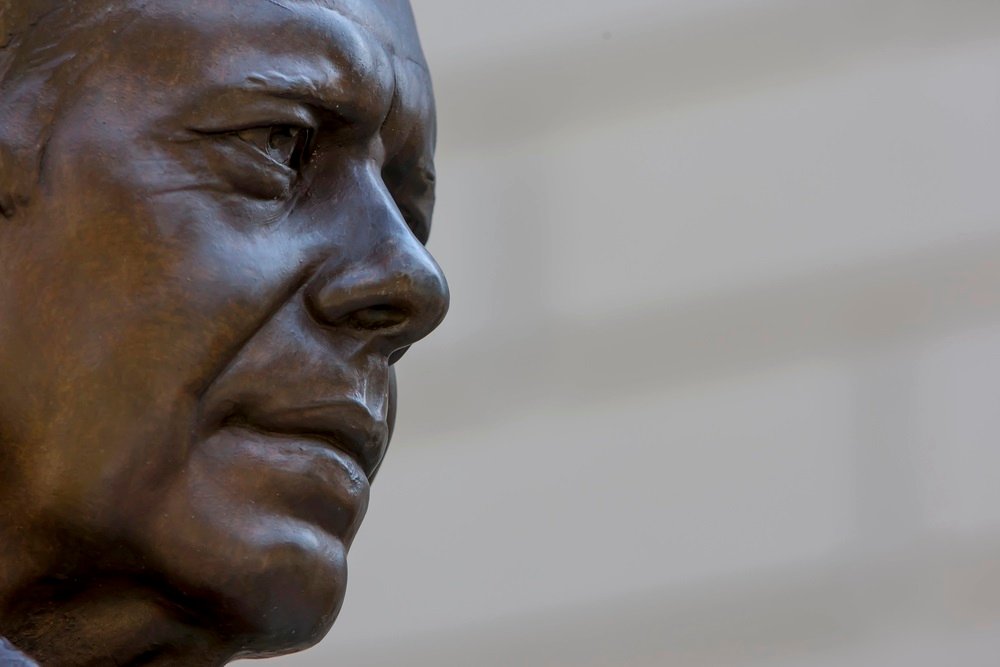
Until Joe Biden came along, conservatives rated Jimmy Carter as the worst US presidents in the post-WWII era. There are many reasons to criticize Carter’s record: high inflation combined with economic stagnation, weak foreign policy, and a general sense that America’s best days were behind us. Ronald Reagan crushed Carter in the 1980 election with a promise of American renewal—renewed prosperity, renewed strength, renewed optimism in the American Dream (sound familiar)?
The Romans had a saying, de mortuis nil nisi bonum—of the dead, nothing but good. In that spirit, let’s acknowledge there is something in Carter presidency for free-marketers and conservatives to admire.
Carter was strongly against deficit spending and fought hard for balanced budgets both as governor of Georgia and as president. According to Johns Hopkins historian Joe Renouard:
Carter was a fiscal conservative who touted balanced budgets and anti-inflationary measures. By and large, he stuck to his campaign self-assessment: “I would consider myself quite conservative . . . on balancing the budget, on very careful planning and businesslike management of government.” Under Carter, the annual federal deficit was consistently low, the national debt stayed below $1 trillion, and gross federal debt as a percentage of GDP peaked below forty percent, the lowest of any presidency since the 1920s.
Carter even burned some political capital early in his presidency, attempting to eliminate what he saw as wasteful spending on local pet projects in Congressional appropriations. Carter’s unwillingness to participate in legislative horse-trading came from a deep sense of fiscal responsibility, honed by Carter’s upbringing and his experience as a frugal and successful farmer. This reluctance to play ball with key Congressmen would, however, hamper Carter’s ability to get things done throughout his term.
Despite his stick-in-the-mud proclivities, Carter did have some notable successes on the economic front. Libertarians have properly labeled Carter “the great deregulator.” Carter enthusiastically supported legislation that deregulated prices and opened competition in the airline, trucking, and railroad industries, and he supported federal policies to decontrol energy markets. These policies would quickly and very noticeably lead to lower prices and improved service in these key transportation industries. Carter even signed legislation that effectively legalized homebrewing and kicked off the great craft beer movement. (The Concise Encyclopedia of Economics has excellent summaries of airline and trucking deregulation).
In a late-1978 speech that might make Elon misty-eyed, Jimmy Carter eloquently spelled out the rationale for these widespread deregulation efforts. His remarks are worth quoting at length:
As president, I will personally use my authority to ensure that regulations are issued only when needed and that they meet their goals at the lowest possible cost. We are also cutting away the regulatory thicket that has grown up around us and giving our competitive free enterprise system a chance to grow up in its place. Last year we gave the airline industry a fresh shot of competition. Regulations were removed. Free market forces drove prices down, record numbers of passengers traveled, and profits went up. Our new airline deregulation bill will make these benefits permanent. For the first time in decades, we have actually deregulated a major industry. Next year we will work with Congress to bring more competition to others, such as the railroad and trucking industries. Of all our weapons against inflation, competition is the most powerful. Without real competition, prices and wages go up, even when demand is going down. We must therefore work to allow more competition wherever possible so that powerful groups — government, business, labor — must think twice before abusing their economic power. We will redouble our efforts to put competition back into the American free enterprise system.
Unfortunately, Carter is remembered more for the infamous “malaise” speech, in which he encouraged Americans to lower their thermostats and drive less in order to save energy. Carter didn’t get at the root causes of inflation until it was too late to benefit him politically. As astute economists have long noted, inflation is fundamentally the result of the Federal Reserve issuing too much money. It took Carter more than 3 years to undertake effective action on inflation, when he wisely installed Paul Volcker to chair the Fed in mid-1979. Carter did not interfere with Volker’s harsh anti-inflation program, but it took a few years of painful recession—starting on Carter’s watch—to wring inflation out of the system. The bad economy helped propel Reagan into the White House. While Reagan implemented his own pro-growth platform centered on tax cuts, the “Reagan boom” rode on a track that had largely been laid down by Carter and Volcker.
So why did Carter earn his ranking among America’s worst presidents? Carter earned scorching criticism for foreign policy failures, projecting American weakness and appeasement abroad. On the economic front, Carter failed to link his good instincts for fiscal and monetary restraint to a comprehensive prosperity agenda. For instance, Carter whiffed hard on the all-important issue of taxation. As economic historian Brian Domitrovic pointed out, the Reagan tax cuts could have been the Carter tax cuts, as Congress was working out an extensive supply-side tax bill in late 1978. Carter, possessing the common Democrat allergy to “tax cuts for the rich,” stiff-armed this large across-the-board tax rate cut package, thereby losing his chance to implement the kind of tax policy that would propel the Reagan boom.
Jimmy Carter was a (relatively) responsible politician and an ostensibly decent man, but a weak leader who completely lacked a positive, pro-growth vision. “Where there is no vision, the people perish (Prov. 29:18).” Carter appeared content with stagnation, urging personal restraint and austerity more than promoting a return to growth and greatness. Most Americans don’t want to hear this; we want leaders who say “I will make energy cheaper so you can have more and do more.” Ronald Reagan might have lost out to Carter in a personal character competition—Hollywood divorcee vs. moralistic Baptist Sunday School teacher. But as Reagan and even more Donald Trump demonstrate so well, the people want a positive vision of growth, opportunity, and prosperity, much more than we want a do-gooder in the office. In other words, we want a President who articulates an agenda of winning, not one who is seen as tolerating mediocrity so he can assuage his every scruple.
Perhaps America has learned that we need a great man, but not necessarily a good one, to lead us into strength and prosperity. Jimmy Carter was in many ways a good man, but unfortunately he fell short of greatness, at least in the minds of American voters. May he rest in peace.
Tyler Watts is a professor of economics and management at Ferris State University.
