
Unlock the Editor’s Digest for free
Roula Khalaf, Editor of the FT, selects her favourite stories in this weekly newsletter.
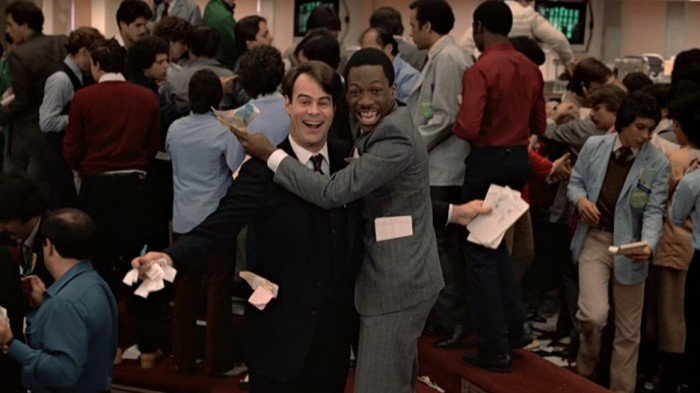
The trading pits of yore are mostly dead. A few years ago even the CME announced that it would permanently close most of its remaining open-outcry trading venues in Chicago. It felt like the end of an era.
Does it matter though? After all, equity trading is overwhelmingly electronic, and Alphaville’s assumption has long been that everything will eventually migrate to entirely algorithmic platforms. Our cynical view is that the New York Stock Exchange’s floor is even now mostly a very elaborate TV set for CNBC.
However, there’s an interesting new paper in the latest Journal of Finance that has forced a revisit to our priors (ugh). Here’s the abstract, with Alphaville’s emphasis below:
Although algorithmic trading now dominates financial markets, some exchanges continue to use human floor traders. On March 23, 2020 the NYSE suspended floor trading because of COVID-19. Using a difference-in-differences analysis around the closure of the floor, we find that floor traders are important contributors to market quality. The suspension of floor trading leads to higher spreads and larger pricing errors for treated stocks relative to control stocks. To explore the mechanism, we exploit two partial floor reopenings that have different characteristics. Our finding suggests that in-person human interaction facilitates the transfer of valuable information that algorithms lack.
The floor traders in question are mostly “designated market markers” that remain a cornerstone of the NYSE’s model, and a bunch of smaller independent floor brokers who act as on-the-ground agents for investors around the world. Most of the trading is electronic, but the DMMs — from firms like Citadel Securities, GTS and Virtu — have actual people on the floor of the exchange who can step in when the stocks they’re responsible for get a bit frazzled.
The NYSE has long bragged that this hybrid model leads to “superior market quality”, but the suspicion has always been that these floor traders are partly there for show, and partly out of habit. They could just as easy do the same job from their respective headquarters. After all, there’s a reason why no other major exchange has this hybrid model any more.
Obviously, the closure of the NYSE floor in March 2020 in isolation is a poor way of measuring the impact of humans, given that there was a hell of a lot of other stuff going on at the time.
But the researchers Jonathan Brogaard, Matthew Ringgenberg and Dominik Roesch looked at stocks trading on NYSE versus the Nasdaq — which is entirely electronic — and a subset of stocks that trade on both exchanges to examine the impact of the former’s floor closure.
In both cases, they found a clear deterioration when humans were sent home
Under our first identification strategy, which uses Nasdaq stocks as a control group, we find that pricing errors for NYSE stocks increase approximately 6% relative to the control group after floor trading is suspended. Under our second identification strategy, which compares trading in the same stock on two different exchanges, we find that pricing errors increase approximately 2% after floor trading is suspended. Overall, the results consistently show that market quality deteriorates after the removal of floor traders.
The subsequent two-stage reopening — floor brokers returned on May 26, 2020 and DMMs on June 17, 2020 — allowed Brogaard, Ringgenberg and Roesch to try to disentangle the effects.
They found no evidence of spreads narrowing when just the floor brokers returned, but this allowed the reintroduction of so-called specialist “discretionary orders” (or D Orders), which improved the opening and closing auctions.
Moreover, the researchers found a “strong reversal” of bid-offer spreads more broadly when both floor brokers and DMMs were back and could interact in person. Here’s what they reckon that shows:
We find evidence of two, nonexclusive, mechanisms: (i) the floor facilitates the transfer of information between designed market makers (DMMs) and floor brokers in a way that electronic trading cannot replicate, and (ii) the use of special order types that only floor traders can access allows floor traders to improve auction outcomes. Our results show that floor trading does matter, even in the age of electronic trading.
It’s notable that the CME also elected to maintain the eurodollar options trading pit even as it was closing other ones. As a DRW trader told the FT back then: “It’s far more efficient to execute that type of complex trading when all the parties are talking to each other in real time versus seeing flashes on a screen.” Maybe the old cliché about humans + computers > humans/computers is true?
That said, eyeballing the accompanying charts it actually looks more like there’s no real difference before the floor was shut down, that non-NYSE liquidity recovered more quickly, and that liquidity remained better even after the full reopening . . .

Wouldn’t that imply that floor trading is more like a crutch for the NYSE, rather than a durable advantage?
In other words, it doesn’t give any meaningful advantage most of the time, and if the floor traders suddenly were to disappear then the uncertainty is worse for the NYSE than for rivals. Maybe our priors are still safe.
