
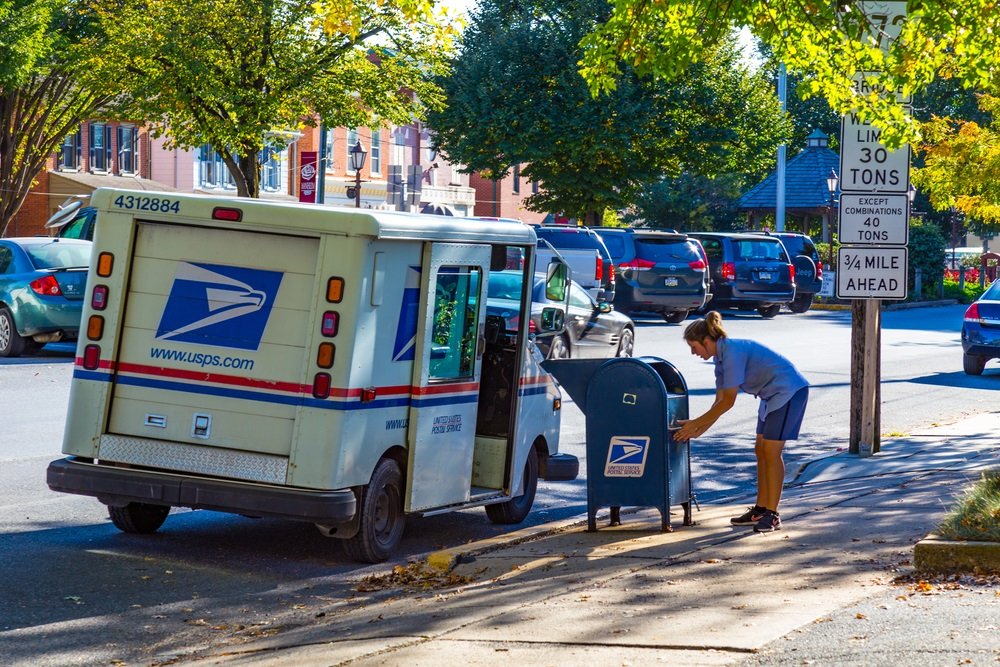
Given the news that the U.S. Postal Service could be privatized, it’s a good time to explore why privatizing mail delivery and opening it up to market competition is a wise idea.
To start, it’s helpful to consider cases where privatization might be unwise and why mail delivery is different. In particular, many economists and political philosophers are skeptical about privatizing public goods—that is, goods that are characterized by nonexcludability and nonrivalrous consumption. National defense is a classic example: when a military protects a nation from attack say, via nuclear deterrence, all individual citizens enjoy that protection (nonexcludability) and one person’s protection doesn’t diminish the protection enjoyed by others (nonrivalrous consumption).
Yet because individuals cannot be excluded from national defense once it’s provided, they have little incentive to pay for it; instead, they prefer to free ride on the contributions made by others. Since everyone (or nearly everyone) prefers to free ride, the good won’t get provided by voluntarily market transactions. So there’s a case to be made that national defense should be provided by the state.

Notice, though, that this argument doesn’t speak against the privatization of the post office. Mail delivery isn’t a public good. Critically, mail delivery is excludable—delivery companies can restrict their service to paying customers. If you don’t buy a DoorDash subscription, DoorDash won’t deliver your food. If you don’t pay FedEx to deliver your parcel, it won’t deliver your parcel. Indeed, if you don’t put a stamp on your letter, the United States Postal Service won’t deliver it.
From here, the positive case for privatizing mail delivery is straightforward. Competing private delivery providers have a strong incentive to supply fast, cheap, and reliable service. After all, if their service is slow, expensive, or unreliable, customers can simply vote with their dollars and give their business to a competitor that does a better job. This option is not available when the delivery provider is a government-run monopoly and thus the monopoly has a much weaker incentive to provide good service.
Why, then, do so many people resist the idea of privatizing mail delivery given that it’s a private good that can be efficiently provided by a free market like other delivery services such as DoorDash? Robert Reich, for instance, says that privatizing the USPS is “a terrible idea that would sacrifice the public interest to private profits.” Here’s one possibility: status quo bias. We often irrationally prefer the status quo, not because it is better than a change, but simply because it’s the status quo. So perhaps people are uncomfortable with postal service privatization simply because it disrupts the current state of affairs even though a disruption would be better.
To guard against status quo bias, we can use the reversal test. That is, imagine that the status quo were reversed such that private, competing mail delivery companies were the norm. We’d have DoorDash for mail, Uber Mail, and so on. Would we want to switch this arrangement back to the actual status quo of a government-run, monopolistic mail delivery service? Surely not. Think of it this way: if you wouldn’t support nationalizing DoorDash and banning Uber Eats, Grubhub, and the rest of its competition in the food delivery business, why would you support a similar model for mail delivery?
Now, you might worry that, just as Uber Eats won’t deliver buffalo wings to a customer when it’s unprofitable for them to do so, Uber Mail wouldn’t deliver mail to a customer when it’s unprofitable for them to do so. As the American Postal Workers Union notes, unlike private delivery companies, “The USPS can’t walk away from unprofitable neighborhoods.”
But the claim that everyone is entitled to mail delivery regardless of its profitability doesn’t justify the nationalization of mail delivery. Consider that the most effective way to ensure that everyone has access to groceries is not to nationalize grocery stores, but rather to provide those in poverty with SNAP benefits to shop at the grocery store of their choice. Similarly, the state could issue mail vouchers to those in poverty or living in particularly hard-to-reach areas. This system would maintain the advantages that result from market competition as well as ensure universal access to mail delivery.
Christopher Freiman is a Professor of General Business in the John Chambers College of Business and Economics at West Virginia University.
