
The experience of the two last federal elections in America suggests that “the left” is more interested than “the right” in a peaceful transfer of power. (By “the left” and “the right,” I simply mean most individuals who identify with either the Democratic Party or the Republican Party.) Kamela Harris gave a magistral lesson to Donald Trump. But there is more to the left’s support for the peaceful transfer of power.
One reason may be that the peaceful transfer of power constitutes the main content of their thin democratic ideology. Isn’t majoritarian democracy the only thing they believe in? This hypothesis is not satisfactory because it is not clear why they would invoke the peaceful transfer of power in favor of a contender who, they claim, wishes, or is tempted to, abolish majoritarian democracy and who has already tried to interfere with it.
Another hypothesis is that the left believes in more than just the peaceful transfer of power, they believe in the peaceful transfer of unlimited power in order to engineer the sort of society defined by their century-old ideology or its remnants. But why wouldn’t they then object to a contending party gaining power to engineer a different kind of society?
The simplest hypothesis and perhaps the most plausible one is that the left believes that a majoritarian and unlimited democracy is bound to ultimately approve their program. “The people” cannot vote against itself—which, interestingly, is also what the populist right believes, a paradox that portends interminable strife.
These justifications for a peaceful transfer of power stand in stark contrast with the classical liberal tradition. For the latter, the peaceful transmission of power is not a means to impose on minorities the preferences and values of the majority, but simply a sort of veto against a totalitarian design from the party in power, to prevent unlimited power. The expression “liberal democracy” is not a pleonasm but emphasizes limited democracy.
A good (albeit a bit technical) expression of this opinion can be found in the book of political scientist William Riker, Liberalism Against Populism (1982). It is interestingly close to Friedrich Hayek’s conception of democracy as a way to keep the state constrained by long-term (thus “traditional”) and abstract “opinion” of what is just (see his book Law, Legislation, and Liberty [1973-1978], the three volumes of which are referenced at the bottom of the post just linked to). James Buchanan added a test of (plausible) unanimity for the general rules that result from an autoregulated social order; his book with Geoffrey Brennan, The Reason of Rules (1985), may be the best exposé of this theory.
If we follow Anthony de Jasay, one problem is that the left may very well be correct: in a regime of majoritarian democracy, he argues, it will ultimately prevail. De Jasay had two arguments which, however they fit together, lead to the same result. First, in a majoritarian democracy, those who promise to redistribute from the “rich” to the “poor” will necessarily win because the 51% at the bottom of the income distribution are arithmetically more numerous than the 49% at the top. Second, electoral competition will lead politicians to try to satisfy every grievance group at the expense of other people, simultaneously generating growing government power and mounting discontent, until the government has no choice but to abolish electoral competition.
To counter this prospect, is our only recourse to James Buchanan’s call to have “faith” in the maintenance of an autoregulated social order and in the classical-liberal ideal that “we can all be free”? (See his Why I, Too, Am Not a Conservative [2006].) This would still imply, it seems, that the peaceful transfer of power only makes sense for the classical liberal if it is a limited power that is trnasferred, and that the social, political, and economic institutions will protect its limitation.
The invocation of the peaceful transfer of power is generally taken to imply that power has not been gained fraudulently. This introduces another level of fuzziness. Anybody can claim that an election has been fraudulent because “the people” cannot vote against itself (even if tens of different independent courts find no technical fraud). If we expect an election to represent the “will of the people,” anybody can easily find that it doesn’t because, for “the people” does not exist (see Riker again). Anybody can claim that the will of a unicorn is on his side.
It seems that the peaceful and non-fraudulent transfer of power is only meaningful if the transferred power is not unlimited and if voters consequently don’t expect too much from, or fear too much of, an election or referendum. An illiberal democracy is one where, at each election, many people fear for their peaceful lifestyles—“peaceful” meaning not imposed on, or coercively supported by, others.
Another argument for the peaceful transfer of power is that a temporary break in legality or a vacancy of constitutional legitimacy raises the age-old problem of who will rush into the breach. Those who will are not necessarily the most enlightened and liberal specimens of mankind. And judges may not be able to protect anyone against them. Reestablishing the rule of law and the so-called “norms” is not a simple matter.
All these considerations depend on where we are on the road to serfdom. And except if the “we” means 100%, it is not a numerical “we.”
******************************
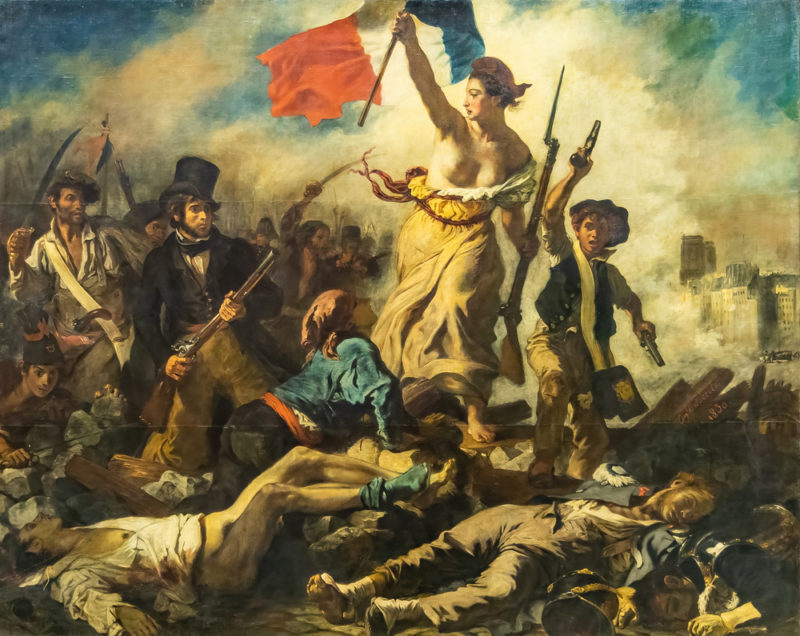
La Liberté guidant le peuple (Liberty Leading the People), by Eugène Delacroix to commemorate the July Revolution of 1830, which toppled King Charles X of France
