
January 20, 2025
And while the “I was for it before I was against it” crowd opposing the ban now stretches from Chuck Schumer to Donald Trump, that doesn’t mean they’re right.
(Photo Illustration by Costfoto / NurPhoto via Getty Images)
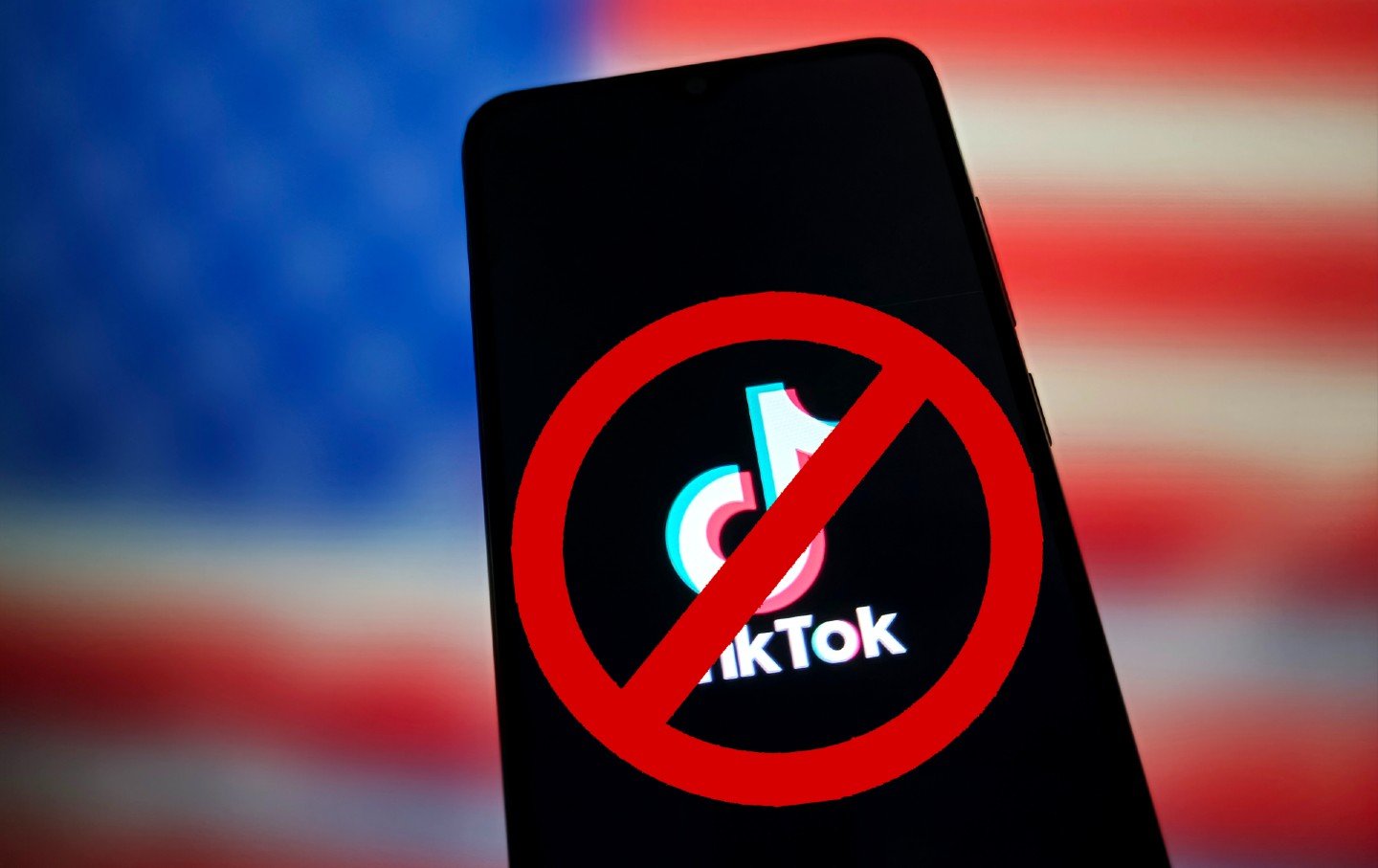
On Friday, the Supreme Court upheld the Protecting Americans from Foreign Adversary-Controlled Applications Act—the law that requires Chinese government–controlled corporation Bytedance to divest Tiktok or have the application barred from US-based platforms (individual users of the app would not be subject to prosecution). The court’s short decision in this case is very good news for the future of state and federal regulation of artificiaI intelligence, and for efforts to hold social media corporations liable for harms they cause—and for state and local efforts to ban foreign corporate super PACs. There’s even an indication that the court may be finally open to moving past a neoliberal vision of the First Amendment.
What is most striking about the decision is what the Supreme Court did not do. First, it did not accept the premise that all regulation of social media requires heightened scrutiny. This position—which both the ACLU and the social media giants have been pushing—would mean that any time the government increases a social media platform’s liability for harms it causes or enables, or bans forms of social media design that it deems harmful, federal judges would have to treat those laws with suspicion and closely analyze their justifications, most likely striking them down.
There was a good chance that the court might adopt this posture, and both Justice Gorsuch and Justice Sotomayor, in concurrences, railed against the other seven justices for refusing to adopt the automatic heightened scrutiny standard. But Justices Jackson, Barrett, Kagan, Kavanaugh, Thomas, Roberts, and Alito resisted using this case for developing a framework for thinking about social media and AI regulation, recognizing that doing so could straitjacket the future.
Instead, the court signaled a genuine openness to the notion that new technologies raise hard new questions, and some of the regulation of those new technologies may have only incidental impacts on speech, and not be direct regulation of speech itself. That means that antitrust laws, data protection laws, and design code laws for social media can probably go forward—laws that the public needs more than ever given the outsize power of Big Tech platforms.
(While some advocates claimed that the TikTok ban was motivated by animus toward a particular viewpoint, the court rejected that argument, while rightly reasserting that if a law is motivated by an effort to censor a particular viewpoint, that law should indeed be scrutinized more carefully.)
In another nice nod to the non-content-directed nature of antitrust regulation, the court also explicitly recognized that laws governing the structure of corporate control should not be treated as a direct regulation of expressive activity or semi-expressive conduct.
Current Issue
The court also—while not explicitly deciding on a level of scrutiny—treated the TikTok ban as if it were to be subject to intermediate scrutiny, and said it would withstand such scrutiny, signaling that there may be a broad category of regulations that fit in this category, while also sending a clear signal to states and the federal government that tech regulation is not off limits.
Finally, the TikTok opinion also recognized that laws with an incidental impact on foreign speech are different in kind. This is good news for the growing effort to ban corporations that are partially owned by foreign interests from contributing to super PACs. Representative Jamie Raskin has introduced a bill to do just that, and some cities have already adopted such a ban.
Speaking of Congress: what a mess the TikTok bill, which was passed with strong bipartisan support, is causing now that its actually going into effect! Schumer, who championed the law then is now trying to position himself as the savior by seeking to block it—and he’s not alone in his inconsistencies. Trump initiated a TikTok divestment policy—and now is inviting the TikTok CEO to sit prominently at his inauguration. Joining the crowd of “for it before I was against it” is the safe bet now that public fury is rising, but that doesn’t make it the right place to be. It’s actually a good idea to prohibit foreign adversaries from owning massive communications infrastructure. There’s a reason we do it all the time in radio and TV.
You might be forgiven if, as a progressive, you heard lots of messages suggesting that this decision was bad. The ACLU, for instance, responded with an alarmist press release slamming the decision and calling it an endorsement of government censorship.
But the ACLU’s position in this case—as it was in Buckley v. Valeo (the case in which the court found that donating or spending money on political campaigns is a form of speech) and Citizens United (the decision in which the court struck down all limits on political spending by corporations and outside groups, and which the ACLU celebrated)—is that corporations deserve maximal speech protection and state regulation of political activity is suspect. In other words, if you want speech rights for people—not corporations—the ACLU is exactly the wrong entity to look to for analysis. They were the key drivers of that “Free Speech for Corporations” agenda that has made commonsense, content-neutral laws very hard to enact or uphold.
The TikTok decision, instead of being anti-speech, actually suggests that the court—with its current cast of very strange bedfellows—may be open to finally moving past the broken 1970s model of First Amendment corporate speech rights. Big Tech has broken a lot of things, and it could be that it finally breaks the neoliberal consensus on the First Amendment that has ruled for 40 years.
More from The Nation
A nonprofit is trying to get the FDA to approve crucial methods of gender-affirming care. Its battle will be even more important in Trump’s second term.

The relentless progression of eviction proceedings isn’t merely a grim irony amid sudden displacement mere miles away—it’s also a harbinger of the city’s future.
Once Harris became the nominee, women voters surged behind her. But on Election Day, she won a smaller share of them than Biden did. This is how it fell apart.
The “defund Planned Parenthood” campaign is back—and headed to the US Supreme Court.
With the rise in Name, Image, and Likeness compensation for NCAA student athletes, a 70-year-old Ivy League policy may be holding the league back more than ever.
