
Unlock the Editor’s Digest for free
Roula Khalaf, Editor of the FT, selects her favourite stories in this weekly newsletter.
As chief executive of a major London hospital, it’s not unusual for Matthew Trainer to log into his A&E department database at 2am and check how many patients are being treated in his corridors.
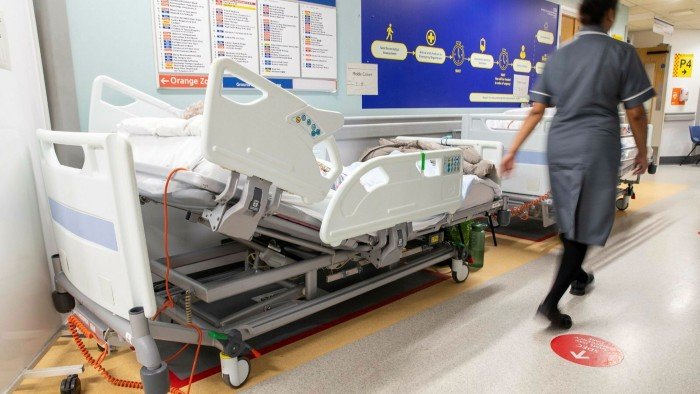
What was initially a temporary measure to deal with limited capacity has become a bitterly accepted part of the emergency department hospital operations, compromising both patient safety and dignity.
“The first time I walked through a corridor with bedded patients I was almost in tears,” says Trainer, speaking to the Financial Times in the bursting A&E ward. “There is the risk of missing someone who is really unwell, that’s what scares us.”
When the A&E department at Queen’s Hospital in Romford was built almost 20 years ago, it was designed to accommodate 325 patients a day. Today, staff are regularly seeing more than 600 come through their doors.
With ambulances stuck outside the department waiting to drop patients so they can respond to more call-outs, demand for beds has left Trainer and his overstretched staff forced to use as many as six corridors a day to provide care.

“I am not proud of the fact we have to provide care in the corridors, but I am proud of the staff who bust a gut here,” Trainer says. The strained service is grappling with a “quad-demic” of flu, Covid-19, norovirus and respiratory syncytial virus.
The NHS guidance is clear. The delivery of care in “temporary escalation spaces” is “not acceptable and should not be considered as standard”. But the reality for health staff across England is that hospitals are changing the structure of their teams and buildings to better enable care to be administered in makeshift settings.
According to a new survey for the Royal College of Nursing, 67 per cent of nursing staff in the UK are delivering care on a daily basis in “inappropriate” settings such as corridors and converted cupboards.
The union is calling on the government to introduce mandatory reporting of all “corridor care” in the NHS and for data to be regularly published.

“It sometimes feels like a war zone given the ways we are being forced to respond,” says Jayshree Appadu, a deputy matron in Queen’s hospital A&E, referring to her working conditions. “Morale is low.”
One reason for the rise in the practice of corridor care is the pressure on ambulance services as a result of increased demand caused by the growing number of elderly patients living longer and rise in mental health patients.
The number of people waiting more than 12 hours in A&E departments from a decision to admit them to being admitted has been growing steadily in recent years and stood at 54,207 in December 2024, according to NHS England.
Forced to consider whether patients are better off being treated in makeshift wards or in the community, without medical supervision, many staff accept what Ruth Green, director of nursing for acute and emergency medicine at the hospital, describes as the “lesser of two evils”.

“The other option is that patients sit in the back of an ambulance, which means you have huge ambulance queues and people left at risk in the community. Are you better in the corridor, or lying on the floor at home with nobody with you?” she says.
Walking through the corridors among 19 patients lying on trolleys, Green says the highest number of patients her team had treated in this setting in any one day was about 50.
“We have had to create a role called ‘patient support worker’, who is someone who will literally stand and keep an eye on patients in corridors”, she says. “We are doing what we can to make sure patients are in sight.”
The NHS said local teams were doing everything possible to ensure people can access the safest possible care in the face of rising demand and constrained capacity.
But another reason for the lack of patient flow through hospitals is the growing number of patients who are medically fit to leave hospital, but have nowhere to go because of inadequate social care provision in their community.

The FT spoke to half a dozen nurses from different hospitals who recounted incidents of holding up sheets for patients forced to use bed pans to urinate, giving treatment in store cupboards and mental health patients spending hours on trolleys.
“These powerful testimonies from nursing staff are sadly something we hear about each day,” says Professor Nicola Ranger, head of the RCN. “Our members don’t go into the profession to watch patient safety and dignity get so routinely compromised, but that is their reality.”

Matthew Taylor, chief executive of the NHS Confederation, which represents health managers in England, said healthcare leaders were having to make “complicated decisions” on a daily basis. “Despite doing all they can to innovate and find extra, more appropriate treatment spaces within their estates, often their hands have been tied,” he added.
Nicola Loncke, another A&E matron at Queen’s hospital, says staff are being forced to work in ways that go “completely against” how they were trained. “But what choice do we have?” she asked.
“Every nurse still has that hope, but if it continues I fear you will see them leave.”
Data visualisation by Amy Borrett
