
One would think that businessmen should easily understand the importance of trade. Some certainly do who are trying to lobby President-elect Donald Trump not to follow through on his protectionist threats (“CEOs Want Trump to Change Course on Tariffs. He Isn’t Budging,” Wall Street Journal, December 15, 2024). They seem to be defending their freedom to trade, to buy and to sell goods (and services) as they want.
I take “businessman” to mean roughly what “supplier” means in economics: anybody whose main occupation is to make some good or service available to its market demanders (consumers or other businesses). They include owners of business enterprises, corporate executives, and intermediaries like merchants or traders. Laborers are suppliers, but only of the services of human capital on labor markets, and would not generally be included among businessmen. (It goes without saying that the “men” in “businessmen” includes the two sexes of mankind.) According to Nobel economist John Hicks, the rise of the merchant or trader as a specialized middleman, buying goods only to resell them, marks the first stage in the rise of the market economy.
Merchants governed city-states and largely autonomous medieval cities. These cities were not only wealthier than the rest of the country but also far freer. A legal maxim circulating in Europe was that “the city air makes you free.” A serf could be liberated from his landlord if he could “make it to a city and reside there for a year and a day” (see Alexander William Salter and Andrew T. Young, The Medieval Constitution of Liberty, which I recently reviewed in Regulation). Merchants understood that for them to be (relatively) free to trade, a general institutional climate of freedom was necessary.
Many analysts, however, have noted that businessmen, especially perhaps corporate executives, have become bad defenders of trade and markets. Samuel Brittan, the late Financial Times columnist, wrote in his 1973 book Capitalism and the Permissive Society:
A further difficulty is that the type of intellectual professionally qualified to explain the case for capitalism is the economist. Businessmen can usually be relied upon to defend the indefensible aspects of their activities while giving in to their collectivist opponents on all essentials. Nor is it a criticism: businessmen are paid to operate the system rather than to understand or expound it, and nothing is more pathetic than to see politicians of either party coming cap in hand to industrialists or bankers for advice that the latter are not qualified to give.
A contrarian may note that Brittan’s expression “running the system” belittles the liberal idea of an autoregulated order that doesn’t need to be “run” and naturally resists authority from above. This slip of the tongue is of course nothing compared to the collectivist preaching of naïve business associations, of which the World Economic Forum is a paragon.
Juan Perón, a former army officer, ruled the Argentine government as a left-wing populist politician from 1946 to 1955 and 1973 to 1974. His economic knowledge of economics was inexistent, a phenomenon not rare among politicians, especially populist ones. He seemed to believe that businessmen who had become rich understood economics ipso facto. Economist Roberto Cortés Conde notes (The Political Economy of Argentina in the Twentieth Century [Cambridge University Press, 2009]):
Perón did not have a very well developed or sophisticated economic ideas [sic]. During both of his administrations he put the treasury in the hands of men who knew how to get rich, demonstrating his exaggeratedly simplistic view of economic phenomena.
Merchants, the ancestors of all businessmen, were pushers of trade, if we may use the expression. Today’s businessmen often seem to be the clients and courtiers of those in power. How is it that businessmen have become so estranged from economics and laissez-faire? One reason might be that the economy has become more complex and more difficult to understand.
Another hypothesis—formalized by public choice theory—is that when the state has reached a certain size or a certain level of what it has become fashionable to call “state capacity,” the name of the game becomes rent-seeking. The opportunity to put their hands in the public treasury through government contracts and subsidies grows more valuable. To obtain privileges from the good graces of the rulers, they have to align with, and obey, the state. When the rule of law fades before the government of men, businessmen come to fear that these men can ruin their businesses. To survivd , they must kiss the ring of the state. As the Wall Street Journal puts it after observing how CEOs of large tech companies felt obliged to contribute to the inauguration of the new US president, it was “The Week CEOs Bent the Knee to Trump.”
Yet, isn’t it still better to allow businessmen to bribe politicians or bureaucrats, directly or indirectly, legally or illegally, as opposed to silencing their customers’ demand intensity? Perhaps, but the cost of this crony capitalism is high. Pareto-enhancing corruption encourages politicians and bureaucrats to finance their activities through this sort of extorsion. It amounts to a tax that will cary a deadweight loss like any other tax. It also undermines the rule of law and the ethics of reciprocity on which a free and prosperous society rests. As James Buchanan suggests, the corruption of public morality can lead to the debasement of private morality (see Buchanan’s Why I, Too, Am Not a Conservative), which will further weaken the social institutions on which efficient cooperation depends.
The degradation of public and private morality and the transformation of the businessman from a pusher of consumer satisfaction to a client and courtier of the state is illustrated by the automobile manufacturers threatened with arbitrary and disruptive tariffs on their imports from Mexico and Canada. They are vying to wheedle the politician who has the power to interfere with their trading (“Hyundai Goes All In on Effort to Woo Trump as Tariffs Loom,” Wall Street Journal, January 11, 2025):
Hyundai in particular has launched an aggressive campaign to build relationships with Trump advisers. The company has told the president-elect’s aides that it is working to be a U.S. job creator and a supporter of the American auto industry.
Hyundai executives, including Muñoz and Hyundai Motor Group Vice Chair Jaehoon Chang, may attend inauguration events, the people said. A $1 million donation provides six tickets to a private candlelight dinner with Trump and his wife Melania Trump on Jan. 19, one day before Trump is sworn in as president, according to a benefits package reviewed by The Wall Street Journal. The contribution also allows for six tickets to a private reception on Jan. 18. with Trump’s cabinet picks, as well as other exclusive events.
Hyundai, of course, is only one example among many of the perverse incentives created by bullying politics.
******************************

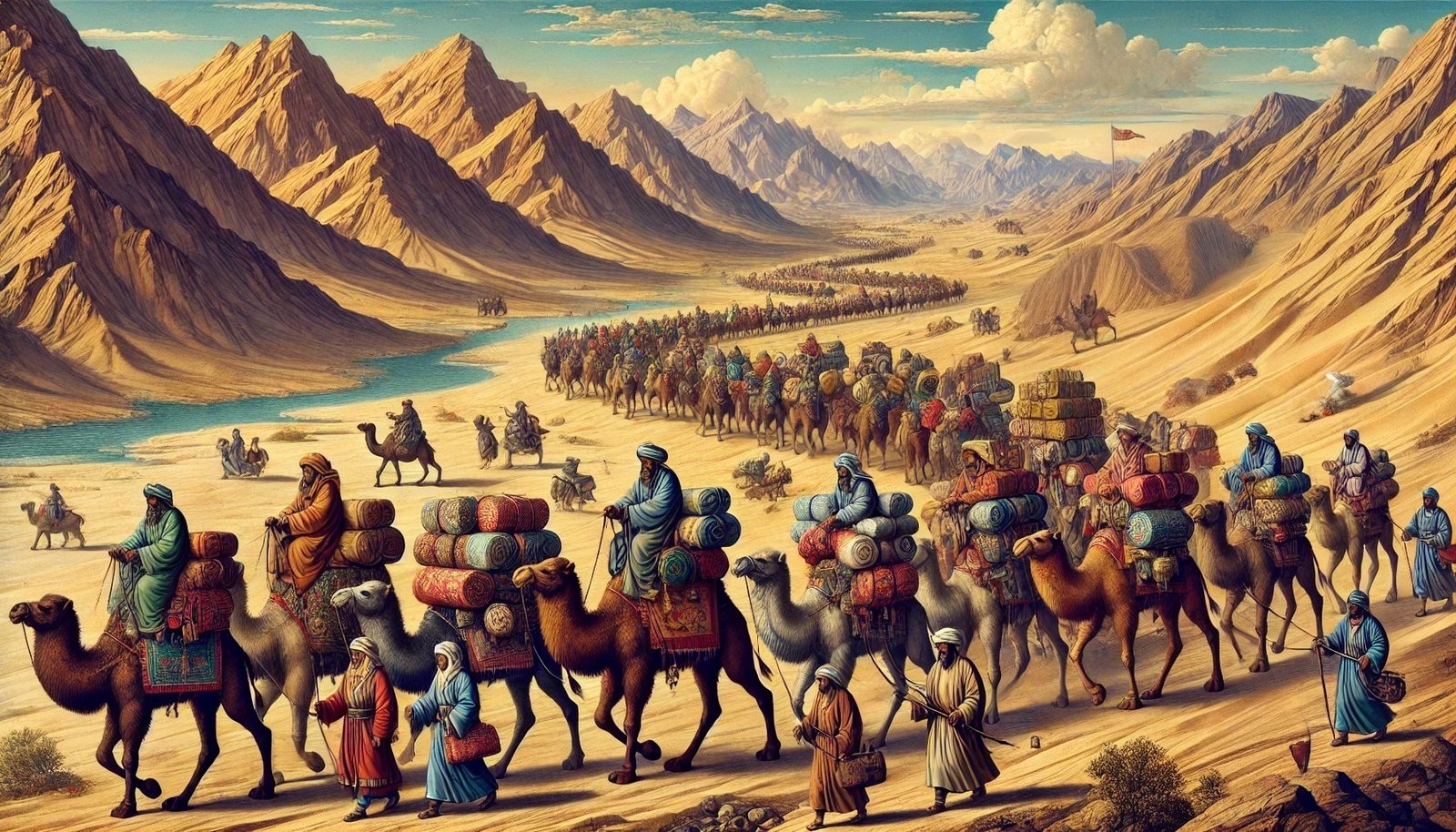
A caravan on the Silk Road around 200 A.D. according to DALL-E
