
The elder Le Pen is dead, but far-right populists across the world still echo his mix of violent rhetoric, brazen lies, and outreach to mainstream conservatives.
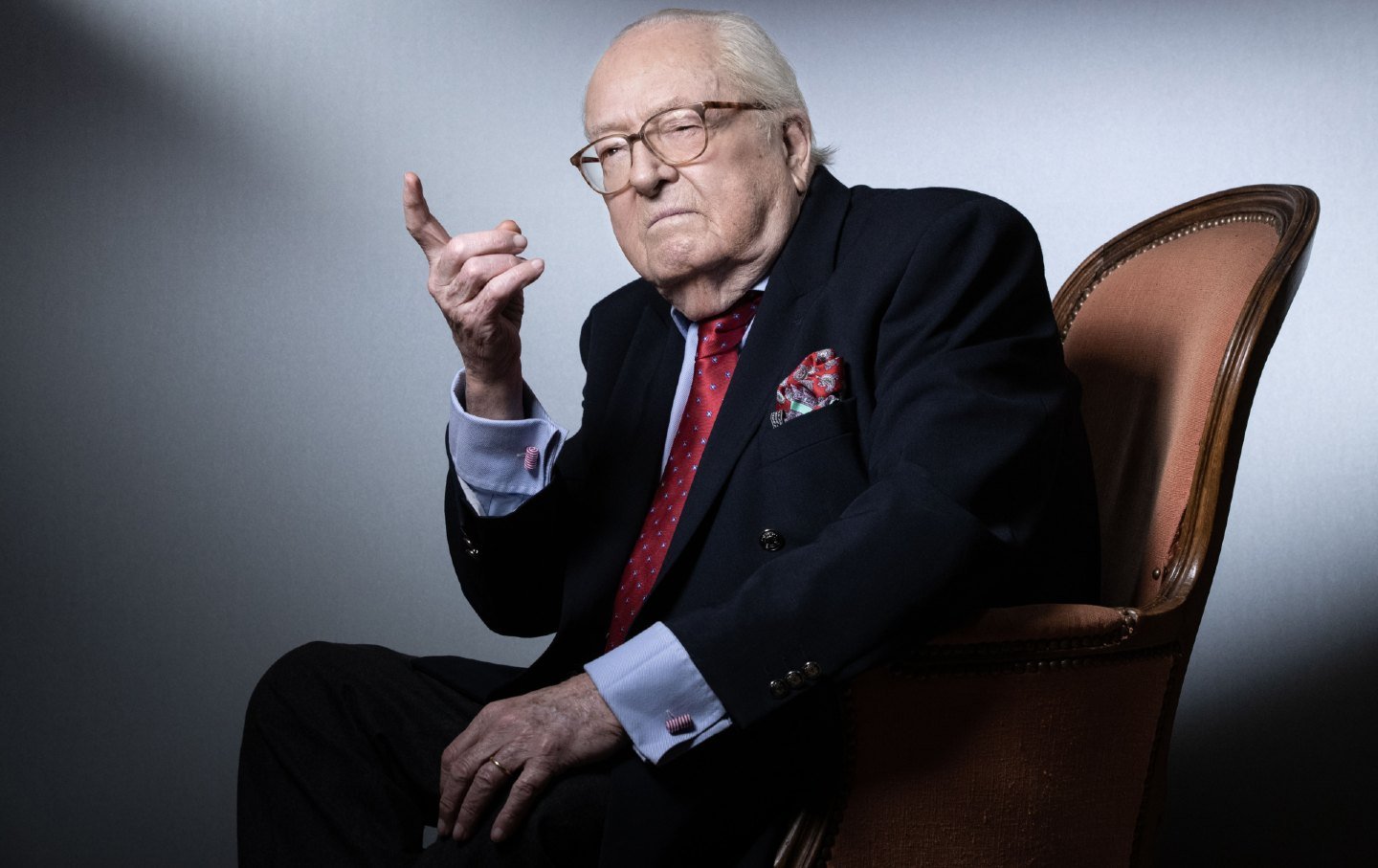
Founder of the far-right National Front party Jean-Marie Le Pen points his finger as he poses during a photo session at his home in Saint-Cloud on January 14, 2021.
(Joel Saget / AFP via Getty Images)
Donald Trump probably doesn’t know it, but he owes a great deal to Jean-Marie Le Pen, the noxious leader of the French far right who died on Tuesday at the age of 96. Back when Trump was nothing more than a blowhard nepo-baby developer and fixture of the gossip columns, Le Pen was creating a model of far-right national populism that has since swept much of the globe. He did more than any other single figure to pioneer its artful mix of violent rhetoric (above all directed against immigrants), brazen mendacity, dog-whistles to neofascists, and careful outreach to mainstream conservatives. Steve Bannon has been an admirer of Le Pen, while direct imitators in Europe include Austria’s Jörg Haider, the Netherlands’ Geert Wilders, Britain’s Nigel Farage, Hungary’s Viktor Orbán, and, not least, Le Pen’s daughter Marine, who stands a good chance of winning France’s next presidential election.
Le Pen’s political record was long, ugly, vicious, and depressingly successful. Born into a Breton fishing family, he embraced the extreme from an early age. As a law student in the early 1950s he was drawn into far-right circles linked to wartime French fascists and Nazi collaborators and became known for his love of street brawling against Communists. He was a physically imposing man, standing six feet tall and over 220 pounds, with a loud voice and blunt, aggressive manner. Constantly gesturing with his fists, he easily drew attention.
At just 28, he won election to the parliament of France’s Fourth Republic as a member of the short-lived UDCA populist party led by Pierre Poujade. (Le Pen was, in fact, the last surviving deputy of the Fourth Republic, which fell in 1958.) His frequent attacks on Jewish Prime Minister Pierre Mendès-France were laced with unabashed antisemitism: “I say to him: You don’t put a country up for sale like cut-price carpets.” His military experience, first in Indochina and then in Algeria, left him with a devotion to France’s colonial empire and a deep loathing for the politicians who surrendered it, first and foremost Charles de Gaulle. Le Pen openly boasted about having tortured Algerian militants during his final tour in North Africa in a paratrooper regiment in 1957, and he had connections to the Secret Army Organization (OAS), which tried to assassinate de Gaulle.
Through the 1970s, Le Pen remained a creature of the political fringe. The far right had been a powerful force in France throughout the late 19th and early 20th centuries. But the German occupation of 1940–44, during which a far-right government in Vichy collaborated with Hitler (and sent 77,000 Jews to their deaths in the Holocaust), left it largely discredited. As a result, few mainstream politicians saw Le Pen as a threat when, in 1972, he founded the National Front. Much of its early membership came from the neofascist New Order movement, and a key early figure, Victor Barthélémy, had served as lieutenant to Jacques Doriot, head of the wartime fascist and collaborationist French Popular Party. The Front won just 1.3 percent of the vote in parliamentary elections in 1973, and 0.7 percent for Le Pen himself in the presidential election of 1974.
Current Issue
But memory of the war years was fading, and the slow collapse of the once-powerful Communist Party provided a surprising source of support for the Front in industrial areas with high unemployment, where aging and resentful populations proved all too receptive to anti-immigrant messages. Le Pen worked steadily, received lavish donations from wealthy reactionaries, and won a series of internecine party battles. And in 1983, he had his first breakthrough when the Front won 16 percent of the vote in the industrial city of Dreux and joined mainstream conservatives in a coalition government. The Machiavellian Socialist President François Mitterrand helped him along by cynically proposing to give new immigrants the right to vote in local elections, knowing this would weaken the mainstream right by driving part of its electorate to the Front.
In 1986, the party gained an unprecedented 35 seats in the National Assembly, and two years later Le Pen himself scored 14.4 percent in the first round of the presidential election against Mitterrand. Le Pen remained toxic, however—still linked to former fascists and Nazi collaborators and given to racist and antisemitic outbursts that won him convictions for hate speech. In a 1987 interview, he notoriously referred to the gas chambers of the Holocaust as a “point of historical detail.”
Even so, the party continued its ascension. Cannily, Le Pen was now presenting himself as an opponent of European integration, claiming that feckless French elites were surrendering the nation’s sovereignty to Brussels. The message struck home among working-class French people, especially after a burst of inflation widely blamed on France’s adoption of the euro. And in 2002, Le Pen provoked a political earthquake by making it into the runoff round against incumbent Gaullist Jacques Chirac, winning nearly some 4.8 million votes. Although Chirac rallied nearly all political factions behind him and ended up crushing Le Pen (who increased his score only slightly), the result was undeniable: The National Front was now a major political party. In 2005, the electorate delivered another shock to French elites when, in a referendum, it voted down a proposed European constitutional treaty, demonstrating the continuing power of Le Pen’s nationalist message.
The first decade of this century was marked by the rise of Le Pen’s daughter Marine, who succeeded her father as head of the party in 2011. The two did not have an easy relationship, to say the least. Marine, who strikingly resembles Jean-Marie, consistently pushed for the Front to “de-demonize” itself. She wanted the party to cut ties with fascists and open antisemites, cultivate the support of French Jews, and emphasize its loyalty to the French Republic and the heritage of the French Revolution. During the 2007 presidential campaign, she persuaded her father to announce his candidacy on the anniversary of the great revolutionary military victory of Valmy at the battlefield. She strove to clothe the Front’s anti-Muslim racism in the language of “laïcité”—French republican secularism.
In the decade’s fierce debates over whether to ban “conspicuous religious symbols” in schools (i.e., the hijab), the Front effectively joined forces with many left-wing “laïcs.” But Jean-Marie refused to break his old habits, saluting an antisemitic comedian and continuing to associate with neofascists. In 2015, after he defended his old comment about the gas chambers, Marine led a move to exclude him from the party, and the two did not speak for several years (although they reconciled before his death). In 2018, she renamed the party the National Rally. But she remains a Le Pen: ferociously hostile to immigrants, contemptuous of French elites and the European Union, and viscerally authoritarian in manner and rhetoric.
More on Jean-Marie Le Pen:
Like a malignant Moses, Jean-Marie Le Pen died without ever setting foot in the promised land—the Élysée Palace, residence of French presidents. But his movement may well get there. Since 2015, the mainstream Republican (neo-Gaullist) and Socialist parties have both experienced catastrophic drops in support. Centrist Emmanuel Macron managed to cobble together unstable coalitions and twice defeated Marine Le Pen for the presidency. But in the parliamentary elections of 2022, the National Rally won 89 deputies—the greatest number for the far right since the 1880s. Over the next two years, Macron’s arrogant insistence on pushing neoliberal reforms over the objections of both public opinion and parliament (in France, the president and prime minister can enact legislation by decree) sent his popularity crashing.
In the European elections last June, the National Rally scored a massive victory, garnering more than twice the votes of its nearest competitor, and sending France into political chaos from which it has not yet emerged. In a desperate move, Macron called for snap parliamentary elections, which resulted in a disastrously divided National Assembly. A hastily created New Popular Front of the left managed to outpace the National Rally but fell short of a majority. A new government headed by conservative Michel Barnier stumbled along for three months with the Rally’s tacit support, but in December Marine Le Pen withdrew that support and joined the left in a no-confidence motion. Macron then selected veteran centrist François Bayrou to replace Barnier, but he too effectively serves at Marine Le Pen’s sufferance. It is entirely possible that if Bayrou’s government collapses in its turn, Macron may have no choice but to resign, forcing a new presidential election. Whether Marine herself could compete is in question: As a result of a corruption scandal, a court may soon bar her from running from office for five years. But her charismatic young protégé Jordan Bardella is ready to stand in for her.
So in the year that Donald Trump is coming back to power and his ideological allies across the globe are making terrible strides, Jean-Marie Le Pen’s awful daughter or her protégé may finally fulfill his dearest ambition: taking power as president of France.
