
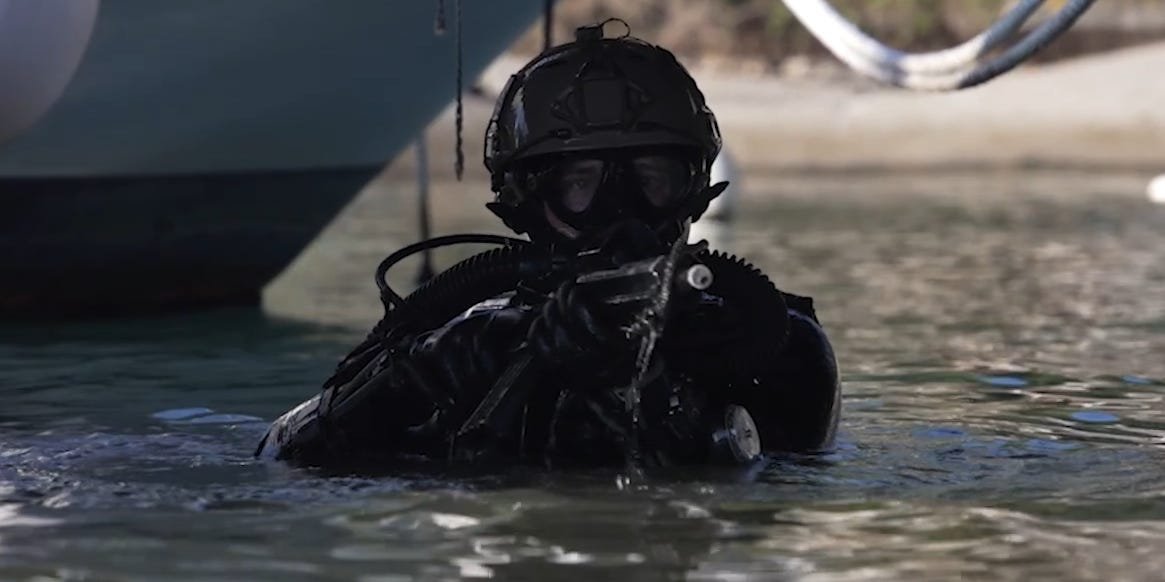
- NATO pit elite divers against new sensors to protect undersea cables from sabotage.
- Foreign adversaries have increasingly targeted undersea cables and underwater infrastructure.
- The training marks another shift in how NATO countries are preparing for future warfare.
NATO sent special operations divers to test new systems designed to help shield critical underwater infrastructure from damage and sabotage, growing problems.
Underwater cables and pipelines providing internet connectivity and energy have been damaged in a string of alarming incidents in recent years, with accusations of sabotage being thrown around about several just in the past couple of months.
These incidents highlight the vulnerability of these lines, but the NATO alliance is looking for answers.
Last fall, elite special operations divers from within the NATO alliance practiced bypassing underwater electronic detection sensors as part of an effort to boost protection for critical underwater infrastructure. NATO shared footage this week of the November training event — Exercise Bold Machina 2024 in La Spezia, Italy — as well as commentary from leadership.
The 13-nation event was the first of its kind, said US Navy Capt. Kurt Muhler, the maritime development director at the NATO Special Operations Headquarters, and was designed to test new sensors that could be used to defend against underwater sabotage attempts. This exercise, which Defense News first reported on, also tested allied special operations divers and their abilities to operate in increasingly transparent battlespaces.
Divers on offensive operations may not always be able to rely on dark, opaque waters to conceal their movements, Muhler, who has held SEAL team leadership positions, said, citing increased advancements in underwater detection system technologies.
Screenshot/NATO
“It’s not knowing if somebody knows, or if you’re being detected,” Muhler told Defense News last fall. “It is understanding that there is a system that has the capability to detect you, but that you know nothing about it and don’t know exactly what the capability is.”
Undersea cables, pipelines, and other critical underwater infrastructure are at risk
The joint exercise in Italy came as damage to critical underwater infrastructure has become increasingly worrisome to Western officials who are scrambling to deter more damage to cables from vessels often quietly linked to Russian and Chinese governments.
Several underwater cables have been damaged in the past two months, including one telecommunications line linking Finland and Germany and another connecting Finland and Estonia.
Finnish officials said that they found a 60-mile seabed trail suggesting a tanker linked to Russia might be responsible for cutting cables. And around the same time, cables linking Germany and Finland and Sweden and Estonia were damaged with a Chinese vessel detected nearby when the damage occurred.
Such damage has spurred British defense officials to create a new joint operation with 10 European countries throughout the Baltic Sea area, using artificial intelligence to monitor potential threats from ships.
Screenshot/NATO
Undersea cables are critical components of international telecommunication infrastructure and the global economy — around 745,000 miles of cables span global seabeds and help transmit 95% of international data, including around $10 trillion in financial transactions daily.
NATO officials highlighted growing threats to cables from Russia last year, noting surveillance activity from Russian units specializing in undersea sabotage. But the barrier to entry for sabotage isn’t particularly high. Russia has submarine units known to specialize in underwater sabotage, but cables have also been damaged by commercial vessels simply dragging their anchors along the sea floor.
And the concerns about the risk of underwater cable and infrastructure damage are not limited to European waters. Damage just last week to cables off the coast of Taiwan left that island’s officials suspecting intentional damage from China.
“The underwater domain is hard both to protect and hard to attack,” said Alberto Tremori, a NATO Centre for Maritime Research and Experimentation scientist who helped oversee the November NATO exercise. “It’s not easy to protect because it’s a complex environment, it’s a vast environment.”
