
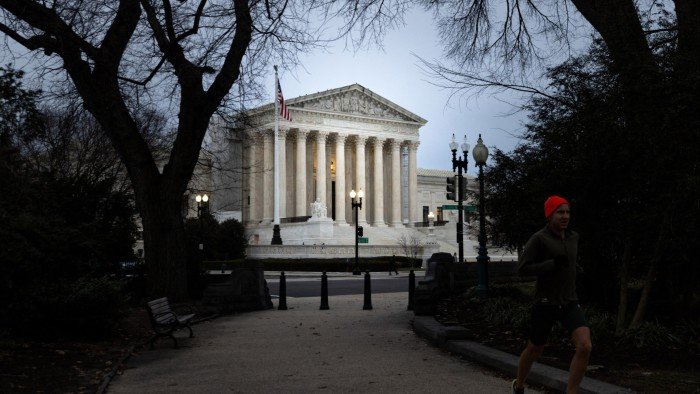
The US Supreme Court is poised to consider the legality of “forum shopping”, the tactic of seeking out sympathetic judges deployed by the financial services industry and other big businesses in their challenges to federal regulations.
The particular case, due to be heard in mid-January, is focused on RJ Reynolds Tobacco’s challenge to the Food and Drug Administration’s ban of flavoured e-cigarettes. Lawyers and analysts say it could force the top court to confront an issue that has helped to undermine respect for the US judicial system in recent years and prompted reform efforts.
“It’s not unethical for the parties to try to file in the most favourable forum,” said Paul Grimm, a Duke University law professor and former district judge. But if the public had “the perception that the judiciary is acting not consistently with facts and law in deciding cases, but rather that the judges are political in nature . . . it degrades their faith in the impartiality of the courts, and that undermines the rule of law”.
Unlike most European countries, the American legal system allows a fair amount of leeway on where lawsuits can be heard. Plaintiffs and defendants routinely jockey over whether state or federal judges should hear a case and whether the matter belongs in a particular court within either system.
Historically, business groups have criticised plaintiffs’ lawyers for seeking out friendly judges and juries for large damages claims, and liberal public interest groups often filed their challenges to the first Trump administration in states and circuit courts with more Democratic appointees.
But in recent years, powerful industry groups have done some of the most visible manoeuvring by finding ways to challenge government regulations in courts that have a larger share of conservative judges, particularly the Fifth Circuit, which covers Texas and nearby states.
While the US Securities and Exchange Commission contemplated new disclosure rules for private equity and hedge funds, some of the industry’s most powerful members set up a lobbying group in Texas. When the regulation passed, they used that group’s location to file a challenge to it before the Fifth Circuit rather than in Washington, where such challenges have traditionally been brought.
The financial industry used a similar tactic to take on the SEC’s rules on short selling and new requirements for participants in the Treasury market.
“It does work both ways. That doesn’t make it right or optically palatable,” said Scott Dodson, professor at the University of California Law, San Francisco.
The share of Americans who say they have confidence in the courts has plummeted 24 percentage points in the past four years to a record low of 35 per cent, according to pollsters Gallup. The decline crosses party lines and is steeper than for other national institutions.
In the vaping case, the relevant venue rules would normally send a lawsuit filed by a manufacturer against the FDA to either the Washington-based DC Circuit or the Fourth Circuit, which hears cases from North Carolina, where RJR is based. But RJR teamed up with retailers who sell vapes in Texas to bring the lawsuit, allowing it to file in the Fifth Circuit.
“The Fifth Circuit is less a forum that opposes regulation than it is a place where industry lobbies go for favourable rulings, whether to nix consumer protection rules, anti-discrimination measures or pro-investor practice,” said Christine Chen Zinner, senior policy counsel at Americans for Financial Reform, an investor group. “This circuit is full of politicians in robes, not principled judges.”
The US Chamber of Commerce, which has previously opposed efforts by class action attorneys to seek out friendly judges when they sue companies, has filed an amicus brief in support of allowing the vape sellers to sue the FDA where they are located.
“Suits against the United States are different,” said Jennifer Dickey, a lead chamber attorney. “For private parties, there’s a real burden, financial and otherwise, to facing a lawsuit far from where you’re based or where the action arose. For the United States, that burden is minimal.”
The last time the Supreme Court took up a venue case, in 2017, it tightened the rules for patent infringement cases, which had the effect of cracking down on a then-common trend of bringing them to friendly judges in eastern Texas. But legal scholars noted that the unanimous ruling was grounded specifically in the wording of patent law. Several said they expected the justices to issue a similarly narrow opinion this time.
The Judicial Conference of the US, which advises federal judges on best practices, issued new guidance on case assignments in March that appeared aimed at cracking down on plaintiffs who shop for particular judges. But the recommendations were advisory, and some of the courts that have drawn the most criticism opted not to change their practices, lawyers said.
The issue may ultimately be decided in Congress. Both Republicans and Democrats on Capitol Hill have introduced a series of bills aimed at quashing the practice, which has accelerated in the past decade as the political landscape has grown increasingly polarised. Though none have passed, some may be revived when a new Congress reconvenes.
“Forum shopping allows corporations to pick friendly courts . . . making it harder for Americans’ voices to be heard,” Democratic House member Zoe Lofgren told the Financial Times. “The practice erodes trust in the system and tilts the playing field in favour of the powerful.”
She has teamed up with Republican Ken Buck to sponsor a bill to prevent venue shopping in bankruptcy cases and plans to reintroduce it. Buck has retired, but Lofgren’s office said she was considering working with another GOP member.
