

By Will Dunham and Jasper Ward
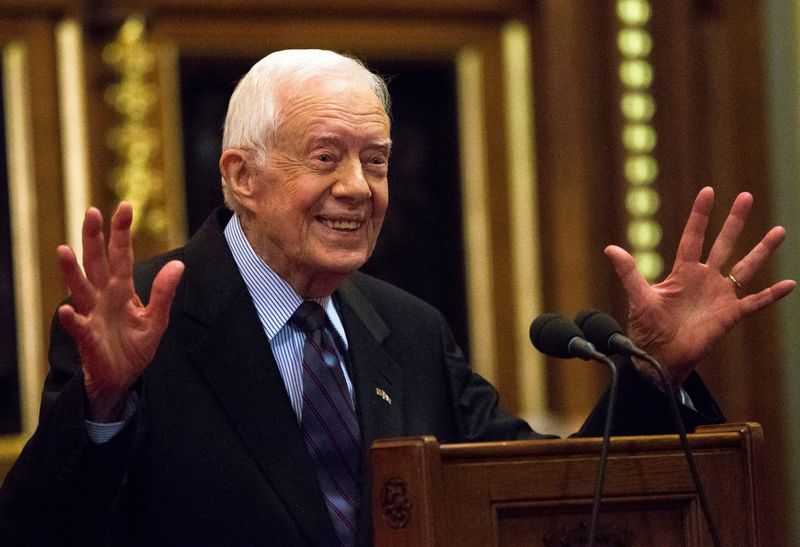
WASHINGTON (Reuters) -Jimmy Carter, the earnest Georgia peanut farmer who as U.S. president struggled with a bad economy and the Iran hostage crisis but brokered peace between Israel and Egypt and later received the Nobel Peace Prize for his humanitarian work, died at his home in Plains, Georgia, on Sunday, the Carter Center said. He was 100.
“My father was a hero, not only to me but to everyone who believes in peace, human rights, and unselfish love,” said Chip Carter, the former president’s son. “My brothers, sister, and I shared him with the rest of the world through these common beliefs. The world is our family because of the way he brought people together, and we thank you for honoring his memory by continuing to live these shared beliefs.”
A Democrat, he served as president from January 1977 to January 1981 after defeating incumbent Republican President Gerald Ford (NYSE:) in the 1976 U.S. election. Carter was swept from office four years later in an electoral landslide as voters embraced Republican challenger Ronald Reagan, the former actor and California governor.
Carter lived longer after his term in office than any other U.S. president. Along the way, he earned a reputation as a better former president than he was a president – a status he readily acknowledged.
His one-term presidency was marked by the highs of the 1978 Camp David accords between Israel and Egypt, bringing some stability to the Middle East. But it was dogged by an economy in recession, persistent unpopularity and the embarrassment of the Iran hostage crisis that consumed his final 444 days in office.
In recent years, Carter had experienced several health issues including melanoma that spread to his liver and brain. Carter decided to receive hospice care in February 2023 instead of undergoing additional medical intervention. His wife, Rosalynn Carter, died on Nov. 19, 2023, at age 96. He looked frail when he attended her memorial service and funeral in a wheelchair.
Carter left office profoundly unpopular but worked energetically for decades on humanitarian causes. He was awarded the Nobel Peace Prize in 2002 in recognition of his “untiring effort to find peaceful solutions to international conflicts, to advance democracy and human rights, and to promote economic and social development.”
Carter had been a centrist as governor of Georgia with populist tendencies when he moved into the White House as the 39th U.S. president. He was a Washington outsider at a time when America was still reeling from the Watergate scandal that led Republican Richard Nixon to resign as president in 1974 and elevated Ford from vice president.
“I’m Jimmy Carter and I’m running for president. I will never lie to you,” Carter promised with an ear-to-ear smile.
Asked to assess his presidency, Carter said in a 1991 documentary: “The biggest failure we had was a political failure. I never was able to convince the American people that I was a forceful and strong leader.”
Despite his difficulties in office, Carter had few rivals for accomplishments as a former president. He gained global acclaim as a tireless human rights advocate, a voice for the disenfranchised and a leader in the fight against hunger and poverty, winning the respect that eluded him in the White House.
Carter won the Nobel Peace Prize in 2002 for his efforts to promote human rights and resolve conflicts around the world, from Ethiopia and Eritrea to Bosnia and Haiti. His Carter Center in Atlanta sent international election-monitoring delegations to polls around the world.
A Southern Baptist Sunday school teacher since his teens, Carter brought a strong sense of morality to the presidency, speaking openly about his religious faith. He also sought to take some pomp out of an increasingly imperial presidency – walking, rather than riding in a limousine, in his 1977 inauguration parade.
The Middle East was the focus of Carter’s (NYSE:) foreign policy. The 1979 Egypt-Israel peace treaty, based on the 1978 Camp David accords, ended a state of war between the two neighbors.
Carter brought Egyptian President Anwar Sadat and Israeli Prime Minister Menachem Begin to the Camp David presidential retreat in Maryland for talks. Later, as the accords seemed to be unraveling, Carter saved the day by flying to Cairo and Jerusalem for personal shuttle diplomacy.
The treaty provided for Israeli withdrawal from Egypt’s Sinai Peninsula and establishment of diplomatic relations. Begin and Sadat each won a Nobel Peace Prize in 1978.
By the 1980 election, the overriding issues were double-digit inflation, interest rates that exceeded 20% and soaring gas prices, as well as the Iran hostage crisis that brought humiliation to America. These issues marred Carter’s presidency and undermined his chances of winning a second term.
HOSTAGE CRISIS
On Nov. 4, 1979, revolutionaries devoted to Iran’s Ayatollah Ruhollah Khomeini had stormed the U.S. Embassy in Tehran, seized the Americans present and demanded the return of the ousted shah Mohammad Reza Pahlavi, who was backed by the United States and was being treated in a U.S. hospital.
The American public initially rallied behind Carter. But his support faded in April 1980 when a commando raid failed to rescue the hostages, with eight U.S. soldiers killed in an aircraft accident in the Iranian desert.
Carter’s final ignominy was that Iran held the 52 hostages until minutes after Reagan took his oath of office on Jan. 20, 1981, to replace Carter, then released the planes carrying them to freedom.
In another crisis, Carter protested the former Soviet Union’s 1979 invasion of Afghanistan by boycotting the 1980 Olympics in Moscow. He also asked the U.S. Senate to defer consideration of a major nuclear arms accord with Moscow.
Unswayed, the Soviets remained in Afghanistan for a decade.
Carter won narrow Senate approval in 1978 of a treaty to transfer the Panama Canal to the control of Panama despite critics who argued the waterway was vital to American security. He also completed negotiations on full U.S. ties with China.
Carter created two new U.S. Cabinet departments – education and energy. Amid high gas prices, he said America’s “energy crisis” was “the moral equivalent of war” and urged the country to embrace conservation. “Ours is the most wasteful nation on earth,” he told Americans in 1977.
In 1979, Carter delivered what became known as his “malaise” speech to the nation, although he never used that word.
“After listening to the American people I have been reminded again that all the legislation in the world can’t fix what’s wrong with America,” he said in his televised address.
“The threat is nearly invisible in ordinary ways. It is a crisis of confidence. It is a crisis that strikes at the very heart and soul and spirit of our national will. The erosion of our confidence in the future is threatening to destroy the social and the political fabric of America.”
As president, the strait-laced Carter was embarrassed by the behavior of his hard-drinking younger brother, Billy Carter, who had boasted: “I got a red neck, white socks, and Blue Ribbon beer.”
‘THERE YOU GO AGAIN’
Jimmy Carter withstood a challenge from Massachusetts Senator Edward Kennedy for the 1980 Democratic presidential nomination but was politically diminished heading into his general election battle against a vigorous Republican adversary.
Reagan, the conservative who projected an image of strength, kept Carter off balance during their debates before the November 1980 election.
Reagan dismissively told Carter, “There you go again,” when the Republican challenger felt the president had misrepresented Reagan’s views during one debate.
Carter lost the 1980 election to Reagan, who won 44 of the 50 states and amassed an Electoral College landslide.
James Earl Carter Jr. was born on Oct. 1, 1924, in Plains, Georgia, one of four children of a farmer and shopkeeper. He graduated from the U.S. Naval Academy in 1946, served in the nuclear submarine program and left to manage the family peanut farming business.
He married his wife, Rosalynn, in 1946, a union he called “the most important thing in my life.” They had three sons and a daughter.
Carter became a millionaire, a Georgia state legislator and Georgia’s governor from 1971 to 1975. He mounted an underdog bid for the 1976 Democratic presidential nomination, and out-hustled his rivals for the right to face Ford in the general election.
With Walter Mondale as his vice presidential running mate, Carter was given a boost by a major Ford gaffe during one of their debates. Ford said that “there is no Soviet domination of Eastern Europe and there never will be under a Ford administration,” despite decades of just such domination.
Carter edged Ford in the election, even though Ford actually won more states – 27 to Carter’s 23.
Not all of Carter’s post-presidential work was appreciated. Former President George W. Bush and his father, former President George H.W. Bush, both Republicans, were said to have been displeased by Carter’s freelance diplomacy in Iraq and elsewhere.
In 2004, Carter called the Iraq war launched in 2003 by the younger Bush one of the most “gross and damaging mistakes our nation ever made.” He called George W. Bush’s administration “the worst in history” and said Vice President Dick Cheney was “a disaster for our country.”
In 2019, Carter questioned Republican Donald Trump’s legitimacy as president, saying “he was put into office because the Russians interfered on his behalf.” Trump responded by calling Carter “a terrible president.”
Carter also made trips to communist North Korea. A 1994 visit defused a nuclear crisis, as President Kim Il Sung agreed to freeze his nuclear program in exchange for resumed dialogue with the United States. That led to a deal in which North Korea, in return for aid, promised not to restart its nuclear reactor or reprocess the plant’s spent fuel.
But Carter irked Democratic President Bill Clinton’s administration by announcing the deal with North Korea’s leader without first checking with Washington.
In 2010, Carter won the release of an American sentenced to eight years hard labor for illegally entering North Korea.
Carter wrote more than two dozen books, ranging from a presidential memoir to a children’s book and poetry, as well as works about religious faith and diplomacy. His book “Faith: A Journey for All,” was published in 2018.
(Reporting and writing by Will Dunham; Editing by Bill Trott and Diane Craft)
