
Unlock the Editor’s Digest for free
Roula Khalaf, Editor of the FT, selects her favourite stories in this weekly newsletter.
Chinese carmaker BYD has said it has fired a subcontractor working on the construction of its electric vehicle factory in Brazil after local labour officials said they had rescued 163 workers from “slavery”-like conditions.
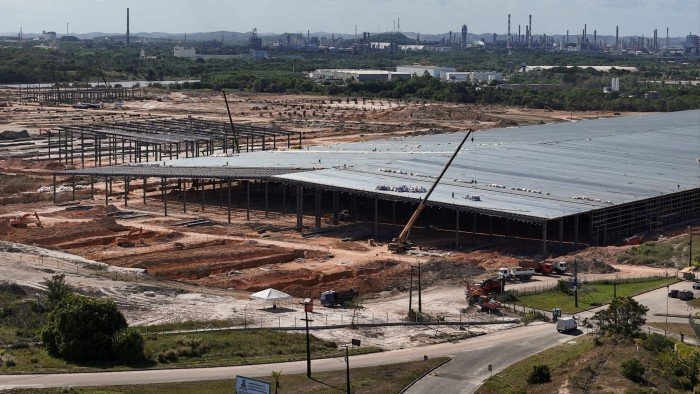
BYD, the Warren Buffett-backed rival to Tesla that is China’s biggest EV group, is revamping an old Ford factory in north-eastern Bahia state as part of rapid global expansion plans.
According to Brazilian officials, workers with Jinjiang Construction, BYD’s Chinese subcontractor, faced “extremely degrading” conditions at their on-site dormitories, including overcrowding, beds without mattresses and inadequate provision of bathrooms.
Brazilian officials also alleged that unsafe working conditions and long hours had resulted in accidents at the site. They claimed to have found evidence of forced labour, with workers’ passports confiscated and 60 per cent of their wages withheld.
BYD said it had terminated a contract with Jinjiang, while a spokesperson for the carmaker shared the subcontractor’s denials of any wrongdoing on social media.
The inspections at the plant in Camaçari were carried out by a multi-agency task force involving the labour ministry, the public labour prosecution office, the federal public defender and police forces.
Liane Durão, a labour inspector, said Jinjiang appeared to have brought construction workers into Brazil in an irregular manner by saying they were hired to provide specialised technical assistance.
“As we discovered a very serious situation, we are still continuing the investigation into the other contractors,” she added.
BYD’s local Brazilian office said the company had “zero tolerance for any disrespect of Brazilian law and human dignity”.
“Consequently, the company has decided to immediately terminate its contract with the contractor for a portion of the construction work and is evaluating other appropriate measures,” BYD added. Other subcontractors were continuing work on the site.
In a Chinese-language statement on social media platform Weibo, Jinjiang said claims that its employees were “enslaved” or “rescued” were “completely inconsistent with the facts”.
Jinjiang, which is based in Sichuan, south-west China, added that cultural differences, translation and interpretation errors had led to “inaccuracies” in the official Brazilian statements.
Li Yunfei, BYD’s public relations head, shared the post and said “certain foreign forces” had smeared Chinese brands and slandered China to “undermine the China-Brazil friendship”.
BYD did not respond to further questions about the alleged worker abuse.
Chinese high-tech manufacturers are increasingly building factories on foreign soil. HSBC estimates annual overseas EV sales by Chinese companies will grow to 4mn by 2030 from 424,000 in 2023, with about half of those cars expected to be produced outside China.
BYD is the key driver for that growth. Its billionaire founder Wang Chuanfu wants overseas sales to reach 1mn as early as 2025. Factories are also being built in Turkey, Hungary and Thailand.
The carmaker has been operating in Brazil for about a decade and produces bus chassis, batteries and solar panels there.
The company confirmed plans to begin making EVs in Latin America’s largest economy following a meeting between Wang and President Luiz Inácio Lula da Silva in China last year.
The investment was trumpeted by the leftwing Lula administration as an early success of its ambition for a “green” revival of the country’s industry.
Additional reporting by Nian Liu in Beijing
