
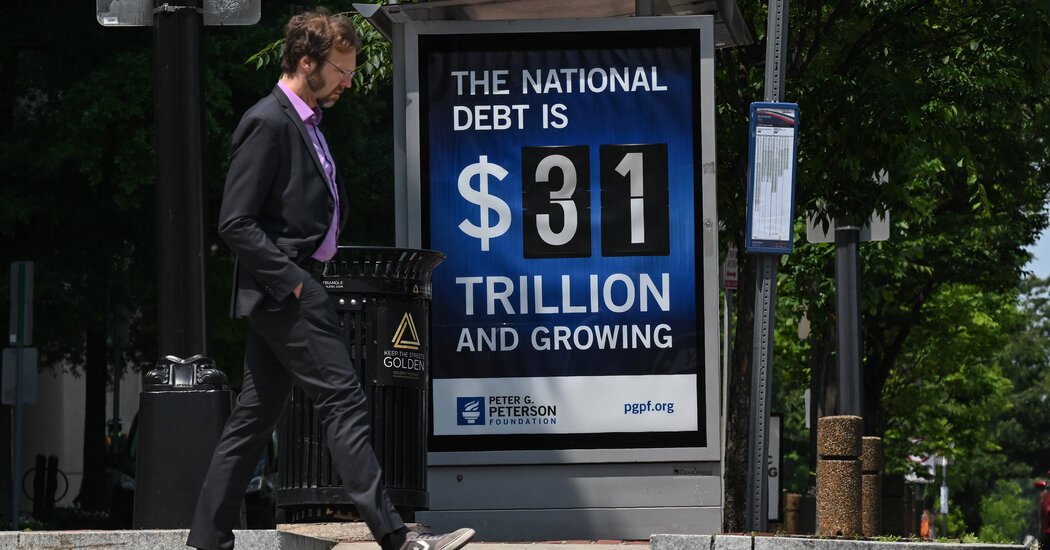
The last time the United States came perilously close to defaulting on its debt, a Democratic president and a Republican speaker of the House cut a deal to raise the nation’s borrowing limit and tightly restrain some federal spending growth for years to come. The deal averted default, but it hindered what was already a slow recovery from the Great Recession.
The debt deal that President Biden and Speaker Kevin McCarthy have agreed to in principle is less restrictive than the one President Barack Obama and Speaker John Boehner cut in 2011, centered on just two years of cuts and caps in spending. The economy that will absorb those cuts is in much better shape. As a result, economists say the agreement is unlikely to inflict the sort of lasting damage to the recovery that was caused by the 2011 debt ceiling deal — and, paradoxically, the newfound spending restraint might even help it.
“For months, I had worried about a major economic fallout from the negotiations, but the macro impact appears to be negligible at best,” said Ben Harris, a former deputy Treasury secretary for economic policy who left his post earlier this year.
“The most important impact is the stability that comes with having a deal,” Mr. Harris said. “Markets can function knowing that we don’t have a cataclysmic debt ceiling crisis looming.”
Mr. Biden expressed confidence earlier this month that any deal would not spark an economic downturn. That was in part because growth persisted over the past two years even as pandemic aid spending expired and total federal spending fell from elevated Covid levels, helping to reduce the annual deficit by $1.7 trillion last year.
Asked at a news conference at the Group of 7 summit in Japan this month if spending cuts in a budget deal would cause a recession, Mr. Biden replied: “I know they won’t. I know they won’t. Matter of fact, the fact that we were able to cut government spending by $1.7 trillion, that didn’t cause a recession. That caused growth.”
The agreement in principle still must pass the House and Senate, where it is facing opposition from the most liberal and conservative members of Congress. It goes well beyond spending limits, also including new work requirements for food stamps and other government aid and an effort to speed permitting for some energy projects.
But its centerpiece is limits on spending. Negotiators agreed to slight cuts to discretionary spending — outside of defense and veterans’ care — from this year to next, after factoring in some accounting adjustments. Military and veterans’ spending would increase this year to the amount requested in Mr. Biden’s budget for the 2024 fiscal year. All those programs would grow by 1 percent in the 2025 fiscal year — which is less than they were projected to.
A New York Times analysis of the proposal suggests it would reduce federal spending by about $55 billion next year, compared with Congressional Budget Office forecasts, and by another $81 billion in 2025.
The first back-of-the-envelope analysis of the deal’s economic impacts came from Mark Zandi, a Moody’s Analytics economist. He had previously estimated that a prolonged default could kill seven million jobs in the U.S. economy — and that a deep round of proposed Republican spending cuts would kill 2.6 million jobs.
His analysis of the emerging deal was far more modest: The economy would have 120,000 fewer jobs by the end of 2024 than it would without a deal, he estimates, and the unemployment rate would be about 0.1 percent higher.
Mr. Zandi wrote on Twitter on Friday that it was “Not the greatest timing for fiscal restraint as the economy is fragile and recession risks are high.” But, he said, “it is manageable.”
Other economists say the economy could actually use a mild dose of fiscal austerity right now. That is because the biggest economic problem is persistent inflation, which is being driven in part by strong consumer spending. Removing some federal spending from the economy could aid the Federal Reserve, which has been trying to get price growth under control by raising interest rates.
“From a macroeconomic perspective, this deal is a small help,” said Jason Furman, a Harvard economist who was a deputy director of Mr. Obama’s National Economic Council in 2011. “The economy still needs cooling off, and this takes pressure off interest rates in accomplishing that cooling off.”
“I think the Fed will welcome the help,” he said.
Economists generally consider increased government spending — if it is not offset by increased tax revenues — to be a short-term boost for the economy. That’s because the government is borrowing money to pay salaries, buy equipment, cover health care and provide other services that ultimately support consumer spending and economic growth. That can particularly help lift the economy at times when consumer demand is low, such as the immediate aftermath of a recession.
That was the case in 2011, when Republicans took control of the House and forced a showdown with Mr. Obama on raising the borrowing limit. The nation was slowly climbing out of the hole created by the 2008 financial crisis. The unemployment rate was 9 percent. The Federal Reserve had cut interest rates to near zero to try to stimulate growth, but many liberal economists were calling for the federal government to spend more to help bolster demand and accelerate job growth.
The budget deal between Republicans and Mr. Obama — which was hammered out by Mr. Biden, who was then the vice president — did the opposite. It reduced federal discretionary spending by 4 percent in the first year after the deal compared with baseline projections. In the second year, it reduced spending by 5.5 percent compared with forecasts.
Many economists have since blamed those cuts, along with too little stimulus spending at the recession’s outset, for prolonging the pain.
The deal announced on Saturday contains smaller cuts. But the even bigger difference today is economic conditions. The unemployment rate is 3.4 percent. Prices are growing by more than 4 percent a year, well above the Fed’s target rate of 2 percent. Fed officials are trying to cool economic activity by making it more expensive to borrow money.
Michael Feroli, a JPMorgan Chase analyst, wrote this week that the right way to assess the emerging deal was in terms of “how much less work the Fed needs to do in restraining aggregate demand because fiscal belt-tightening is now doing that job.” Mr. Feroli estimated the agreement could function as the equivalent of a quarter-point increase in interest rates, in terms of helping to restrain inflation.
While the deal will only modestly affect the nation’s future deficit levels, Republicans have argued that it will help the economy by reducing the accumulation of debt. “We’re trying to bend the cost curve of the government for the American people,” Representative Patrick T. McHenry of North Carolina, one of the Republican negotiators, said this week.
Still, the spending reductions from the deal will affect nondefense discretionary programs, like Head Start preschool, and the people they serve. New work requirements could choke off food and other assistance to vulnerable Americans.
Many progressive Democrats warned this week that those effects will amount to their own sort of economic damage.
“After inflation eats its share, flat funding will result in fewer households accessing rental assistance, fewer kids in Head Start and fewer services for seniors,” said Lindsay Owens, the executive director of the liberal Groundwork Collaborative in Washington.
Catie Edmondson contributed reporting.
