
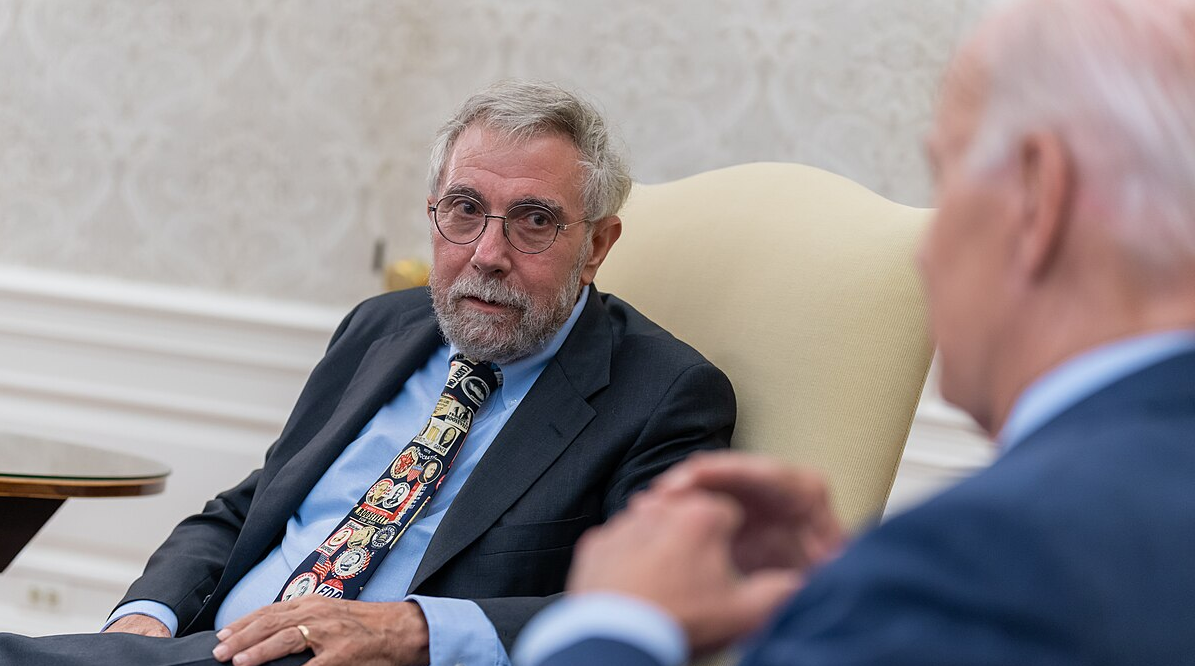
Over the years, I’ve done a number of posts reacting to Paul Krugman’s columns and blog posts. Now that Krugman is retiring from his NYT column (but not from academia), I thought I’d share a few observations about his career as a pundit. What made Krugman such an influential economic pundit, perhaps the most influential?
Some pundits are especially good at showing how a seemingly simple problem might actually be quite complex. I’ve seen blog posts by people like Tyler Cowen and Scott Alexander that discuss an issue about which I can only think of 2 or 3 relevant factors. They somehow come up with 10 or 12 important perspectives, most of which I’d never considered. My mind tends to move along a narrow track.
Other pundits are especially good at showing that a seemingly complex problem actually has a fairly simple underlying cause. They are good at getting to the heart of an issue that seems very messy at first glance. Paul Krugman is one of the most talented at that sort of analysis. (He also has excellent writing skills.)
Many of my readers have views closer to mine than Krugman on questions such as size of government, deregulation, and fiscal stimulus. They are often surprised to find that I have a very high opinion of Krugman as an economist, despite important policy differences in some areas.
Although my policy views are closer to those of people like Tyler Cowen, my analytical approach is often closer to Krugman’s. Indeed, some would argue that I oversimplify things. Thus I argued that the Great Recession of 2008 was caused by overly tight money that depressed NGDP, and the other things we observed (such as financial distress) were mostly symptoms of that decline in aggregate demand. In a recent post, I argued that the Great Depression was more complicated than many people assume, but even in that case I believe the underlying cause was pretty simple: the hoarding of gold by central banks and the hoarding of currency by the public. The increased demand for those two media of account caused NGDP to fall in half between late 1929 and early 1933. Because of sticky wages, the sharply lower NGDP greatly reduced employment and output.
I’ve argued that Krugman’s 1998 Brookings paper entitled “It’s Baaack . . .” was the last example of an innovative paper that fundamentally changed how we think about money/macro. Of course there are lots of excellent research papers being done all the time, but we now seem to be running out of truly transformative ideas, or at least transformative ideas that are broadly accepted.
In that paper, Krugman developed a new way of thinking about the zero lower bound problem, also known as the “liquidity trap”, which occurs when nominal interest rates fall to zero. I won’t do an in depth discussion here; interested readers can look at my (fairly long) paper on the Princeton School of Macroeconomics. Most importantly, Krugman showed that underlying a liquidity trap is a deeper problem of an “expectations trap”, the challenge of shaping expectations of the future path of monetary policy. In my Princeton School paper, I used the analogy of the Coase Theorem to explain this insight. Coase had showed that underlying the issue of external cost, there’s a deeper problem associated with transactions costs. Coase is another economist that was good at seeing beyond all the surface complexity, and getting to the essence of a problem.
Congratulations to Paul Krugman on a distinguished career as a NYT columnist.
