
This article is part of the FT’s Financial Literacy and Inclusion Campaign joint seasonal appeal with Magic Breakfast
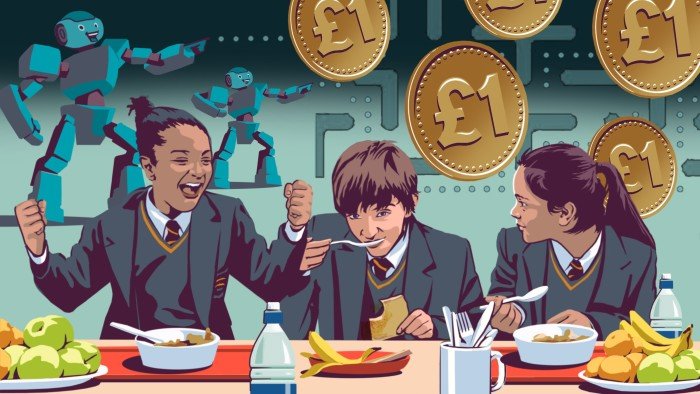
It is just after 8am in south Manchester and outside it is cold and slushy. Inside, a queue is forming at the school canteen, at the front of which are some Year 11 boys being served hot chocolate, toasted bagels, baked beans and buttered crumpets.
One tells me he is in early as he has a computer science exam later and he needs food.
“I can’t concentrate if I’m hungry,” he says, adding that this exam is important, as he wants to be a software developer.
Since January, Loreto High School has been offering free breakfasts in partnership with Magic Breakfast, a charity that aims to close the disadvantage gap, encouraging children in deprived areas to turn up to school on time and perform better when then get there — by giving them something healthy to eat in the morning.
Feed the future

Support the Financial Literacy and Inclusion Campaign’s joint seasonal appeal with Magic Breakfast
I ask some Year 7 girls sitting at a crowded table what they like about the breakfast. “I get to see my friends,” says one. Another says: “It’s free.” At her primary school, toast cost 20p so she didn’t have any.
Child poverty is getting worse in the UK — 25 per cent of children were living below the poverty line in 2022-23, up from 23.8 per cent the previous year, the biggest rise in 30 years. At Loreto, 52 per cent of the children are eligible for pupil premium funding, which means more than half the school population is trying to survive on a family income below £16,190 a year.
What would you have at home for breakfast, I ask the students.
“Probably nothing,” says one boy. “Yeah,” agrees another. “I can’t be bothered at home.”
Teachers report that when breakfast is provided, students are more likely to focus on the lesson and behave better too. There is also anecdotal evidence of healthier eating throughout the day, as a decent breakfast seems to make students shun the pizza queue at lunch.
Having spent the past seven years teaching in secondary schools in deprived areas in the UK, this doesn’t surprise me. I have often felt I could pick out the breakfasted from the unbreakfasted based on levels of concentration and behaviour. Equally, I’m struck by a correlation between those who perform badly and those who can be seen downing a can of Monster energy drink and stuffing a few crisps into their mouths before the first lesson starts.
Free breakfasts for all primary school children was an election promise made by the Labour government; now Magic Breakfast has been offering advice on the tricky logistics of delivering millions of bowls of bran flakes and pieces of toast every day all over the country. Soon a pilot will begin in up to 750 schools.

I ask the Loreto students if the government should extend the plan to secondary schools. “Breakfast is a basic human right,” says one boy as he takes a large bite of bagel. A Year 8 girl agrees. “Because of inflation, everything is so expensive and families can’t afford to buy breakfast,” she says. I ask if she can tell me what inflation is.
“It’s when the government raises prices,” she begins confidently enough. “It’s because of the global crisis. The government needs more money and is meant to give the money to charities, but it doesn’t. I think it keeps the money.”
That student has unwittingly provided the perfect segue to the other charity supported by this newspaper’s joint seasonal appeal with Magic Breakfast: the FT’s Financial Literacy and Inclusion Campaign (FLIC).
I became a trustee of FLIC when it launched in 2021 because I was uncomfortably aware of how little teenagers know about money. This isn’t through any lack of interest — in fact, money, particularly how to make it, is the single most alluring topic to nearly everyone I’ve ever taught. Yet building financial literacy is hard — partly because there is little on finance in the curriculum and partly because many teachers in a lot of schools are themselves hazy on the topic and don’t have the confidence to teach it.
I’ve often been drafted in at the last moment to do an assembly on something financial because no one else wanted to do it. I’ve scrabbled around through useless, out-of-date resources, ending up with something that barely passed muster.
Three years in, FLIC has developed an entire financial curriculum, offering free 50-minute lessons on its website, arranged by year group. These lessons cover inflation, budgeting, tax and banking — and each comes with notes for nervous teachers to help them deliver them.
Today I’m watching Chantelle Clarke, head of content at FLIC, give a lesson to a Year 9 maths class on a topic I know almost nothing about — online gaming. By contrast, the 30 teenagers who have filed into the room are mostly expert, at least in how to play the games. Less so, it turns out, in how to avoid being ripped off by them.
The class is shown a news story about a 12-year-old who had racked up a £1,000 bill on his parents’ credit cards through online gaming. A silence falls.
I have taught Year 9 maths. I know the full range of student facial expressions, including suspicion, frustration, boredom and just longing to be elsewhere. But in this room every student is sitting forward on their seat, eyes wide.
How could this happen, they are asked. And: did anything criminal take place? The first question is easy: “You buy skins and loot boxes and stuff,” as one boy puts it. But was it criminal? No, they mostly reply. Because you’re only a child. Some say it was criminal of the parents because they should be looking after their credit cards better. Only a few of the students know the correct answer — yes. At 12 a child is above the age of criminal responsibility.
I briefly think of my son, who at 16 used my credit card to play online poker, and wish his elite school had taught him at a younger age that this was fraud: he might then have thought twice before helping himself to my card.
We then watch a hair-raising video of all the ways in which games use behavioural economics to persuade gamers — who are often children — to part with their (parents’) cash. One is through loot boxes, often considered a form of online gambling — in which you pay real money for something that may or may not have value. Another way is to price in an imaginary currency with obscure exchange rates so that the user doesn’t feel as if they are spending real money.
The students are then given a swift lesson in ratio and shown how to convert currency from a Fifa video game into pounds. Heads are down and calculators out.
At the end of the class, most of them say they understood the real value of what they were buying and are confident that they could control their spending on gaming. Hooray. I can’t think of many 50-minute lessons I’ve given in an entire teaching career with such a cut-and-dried result.
The morning was making me feel upbeat. Hunger can be alleviated. Managing money is a set of skills that can be taught. The overall atmosphere of Loreto was so positive — it had the special bustle of effective schools where real learning is happening and staff and students seem happy enough to be there.
But as the class was packing up, I asked one boy whom I’d watched confidently changing his in-game points into pounds whether his behaviour would change now that he knew how much he was spending. “Not really,” he said. “I just like buying stuff.” So filling a child’s belly with bran flakes seems doable. But creating a new financially savvy generation may take a bit more work.
Lucy Kellaway is an FT contributing editor and co-founder of Now Teach
Find out about our latest stories first — follow FTWeekend on Instagram and X, and subscribe to our podcast Life and Art wherever you listen
