
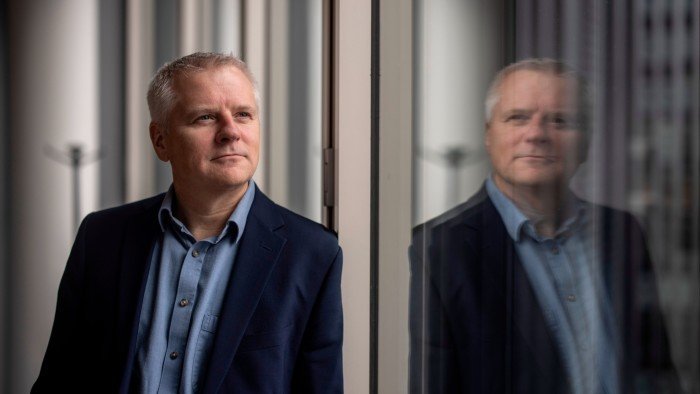
Making professional investment decisions on the basis of calls on markets, sectors or investment styles is a mug’s game. That is the suggestion of Craig Baker, global chief investment officer at insurer and institutional investor Willis Towers Watson (WTW), which oversees the recently merged £5bn investment trust Alliance Witan (ALW).
“It’s pointless to call views on one market versus another, or different sectors or industries. Stock selection is the only way over the long term,” Baker says.
Baker has been well known to Alliance Trust investors as lead portfolio manager since 2017, when WTW took over management of the then struggling trust’s portfolio and turned it around using a team of external specialist managers. So the merger with Witan — like Alliance, a large global generalist trust, well over 100 years old and run on a multi-manager basis — has been this year’s big event in the investment trust world.
Why is he so “anti-macro”? “The problem with big top-down market bets is that there isn’t much breadth to the decisions,” he explains. “The outcomes can be quite binary, so over the long term there can be long periods where you do either incredibly well or incredibly badly, depending on whether or not your bet paid off.”
Such bets are inherently prey to uncertainty. Wars, Covid-19, the threat of cyber attack, the global migrant crisis and, more recently, the potential for trade wars under US president-elect Donald Trump, have made the world a less predictable place. And top-down calls on market segments, whether different styles, company sizes or specific sectors, are equally challenging.
The WTW view is essentially that bottom-up, high-conviction stockpicking is a better option than making big market bets. “Over the long term, managers running highly concentrated portfolios and not taking much notice of the benchmark, outperform closet index trackers by more than 1 per cent a year,” Baker points out, “so investing with that kind of manager makes a lot of sense.”
That is hardly a groundbreaking approach: a number of investment houses, including JPMorgan, Fidelity and Baillie Gifford, take a similar view, though some managers are more mindful of the benchmark index than others.
But the problem for any individual manager is consistency. High-conviction stockpickers are not reliable over time, because their investment style and focus are bound to do better in certain environments than in others.
Thus, WTW research shows that of the funds that were top-quartile over 2003-05, only about 30 per cent remained top-quartile between 2006 and 2008. More recently, such consistency has been almost non-existent, with just 3 per cent of top-quartile funds in 2021-23 still at the top after that period.
The solution, as any portfolio manager will tell you, is to select a mix of different manager styles and strengths, and then rebalance to prevent bias emerging towards those that are currently more successful.
Investors do not necessarily need to do this themselves. Multi-managers take on the heavy lifting of manager selection and rebalancing for them. Both Alliance Trust and Witan were operating this way before this year’s merger, and there are other funds, both open- and closed-ended, that do the same.
However, Witan had been notably less successful than Alliance Trust in the run-up to the merger. A January 2024 research note from broker Investec shows a net asset value (Nav) return of 50 per cent for Witan since 2017 (when WTW took over management of Alliance), against Alliance Trust’s 86 per cent.
Baker puts the shortfall down to Witan’s greater focus on the UK market, which has had a tough time over much of the past decade, and its exposure to alternative assets such as private equity and real estate, which were hard hit post-Covid. “Alliance Trust was more focused on stock selection above all,” he adds.
As Laith Khalaf, head of investment analysis at broker AJ Bell, observes, this approach has paid off. “The fund has kept pace with the global stock market over a period which has been extremely challenging for active managers.” AJ Bell’s research suggests that over the past 10 years just 19 per cent of funds in the global sector outperformed a passive alternative, he adds.
How does ALW’s portfolio-building work in practice? “We’re looking globally for the managers we think are great, and then of those we have a subset of those we think are suited to running a concentrated portfolio,” Baker explains. From that bench of high-quality candidates, he selects a diverse blend of between eight and 12 specialist sub-managers, each of which are mandated to pick and run around 20 stocks.
The merger has had little impact in this respect. Of the sub-managers previously running chunks of Witan’s portfolio, two (Veritas and GQG) already featured in the Alliance Trust stable; a third, Jennison, has been added to the line-up. The rest have been let go.
There is, of course, a risk in a portfolio totalling around 200 stocks that several sub-managers may independently select the same stock. Baker is unconcerned by this. He says that around 80-90 per cent are owned by only one manager, some by two; very occasionally a stock has been owned by as many as four, but even in such a case it would only amount to a maximum 4 or 5 per cent of the portfolio.
“If several managers do select the same stock, I’m quite comfortable, because they’ve all come at it from different angles and all have come to the conclusion that it’s interesting.”
James Carthew, head of investment companies at QuotedData, says Alliance has long been his go-to suggestion for global equity trusts, and ALW remains his favourite post-merger.
“The only thing it could not be expected to contend with is the mania for the Magnificent Seven megacap stocks that have dominated indices over the past couple of years,” he adds. “If you want to make judgments about growth versus value, bet on AI, or prefer a trust that gives you exposure to multiple asset classes — there are other options.”
One significant benefit of the merger is the fact that while both trusts were able to provide a multi-manager strategy at a relatively competitive price beforehand (0.77 per cent for Witan and 0.62 per cent for Alliance), economies of scale mean fees have fallen to less than 0.6 per cent for ALW investors.
“It’s no mean feat for ALW to be able to offer a global trust enveloping the expertise of both WTW and the underlying regional fund managers for under 0.6 per cent a year, though it still won’t be quite as cheap as kindred behemoths F&C and Scottish Mortgage,” comments Khalaf.
He also likes Monks and Securities Trust of Scotland in the global sector, though he stresses that these are not generalist choices.
However, Ben Yearsley, director at Fairview Investing, is less convinced by the global multi-manager approach followed by ALW and F&C. “By the time you have so many teams and people involved, it becomes homogenised,” he argues.
“Interestingly, there’s little between Alliance and F&C in performance terms — a couple of percentage points since 2017. Both have virtually tracked the MSCI world index since then as well, so you might as well buy a tracker fund.”
He favours Brunner Investment Trust, another fund run by a single manager, in the global space. “Manager Julian Bishop is very impressive; it’s a nice mix of core, value and growth, and overweight in the UK compared to the benchmark.”
Ultimately, assuming you favour active management, your choice of core global holding may well depend on how far you accept Baker’s argument against top-down investing. If you think macro views should play a role in portfolio construction, Alliance Witan is probably not for you; if not, it may be one to consider.
The author has holdings in Alliance Witan and Scottish Mortgage Investment Trust.
