
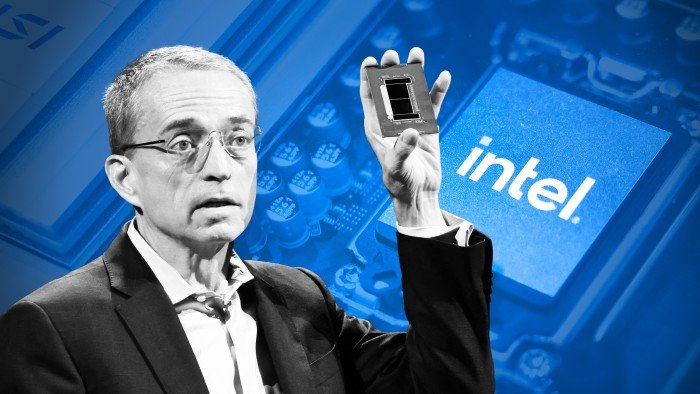
The abrupt departure of Intel’s chief executive removes the biggest obstacle to a radical reshaping of the iconic Silicon Valley company, including scaling back its chip manufacturing business in spite of multibillion-dollar incentives from the US government.
Pat Gelsinger, an engineer who spent the first 30 years of his career at Intel, returned in 2021 with a bold mandate to restore its chipmaking prowess at the same time as taking on its faster-growing rivals Nvidia and AMD in designing PC and data centre chips.
Key to his plan was agreeing to accept some $8bn from Washington in Chips Act funding. That deal, which was finalised just last week, made Intel the top example of President Joe Biden’s efforts to reduce US dependence on Asian tech suppliers as trade tensions with China ratchet higher.
On Wednesday, interim co-chief executive David Zinsner reassured investors that the company’s existing strategy is intact. But industry insiders believe Gelsinger’s hasty exit could be a prelude to Intel doing what was once unthinkable: moving away from manufacturing its own chips altogether, potentially dealing a serious blow to US attempts to rebuild its domestic semiconductor manufacturing sector.
Intel chair Frank Yeary’s comments immediately after Gelsinger’s departure on Monday that the company must “first and foremost . . . put our product group at the centre of all we do” were seen by many as a clear signal that Intel was preparing for such a drastic move.
“On paper, if Intel’s product business was fabless, their margins and products would look much better,” said Ben Bajarin, analyst at Creative Strategies. Citi analysts this week reiterated that Intel exiting the business would be “in the best interest of Intel shareholders”.
Getting Intel’s foundry to profitability is likely to cost tens of billions of dollars in the near term. That side of the business posted a $7bn operating loss in 2023.
The company’s challenges had been brewing for years. It failed to capture the mobile computing wave that followed the iPhone’s debut in 2007 and then missed the artificial intelligence revolution that has propelled Nvidia’s market value to more than $3tn.
In the process, it lost its chipmaking edge to TSMC, the contract supplier that produces leading-edge chips for the likes of Apple and Nvidia. Intel’s troubles have sent its shares plummeting, crashing more than 50 per cent since the start of the year. It now has a market capitalisation of less than $100bn.
While Intel’s board initially seemed content to let Gelsinger press on with his five-year turnaround plan, the scale of its financial and technical challenges rose to the fore this summer and brought the prospect of a takeover from rivals such as Qualcomm.
Signs of internal conflict first emerged in August, after Intel announced it would slash its staff and investment plans. After a crunch board meeting in September, Intel said it would delay the construction of two new chip plants in Europe, as well as moving to establish its manufacturing business as an independent subsidiary.
Any move to separate its businesses further will not be easy. Rival AMD went through a protracted process when it divested its manufacturing business in 2008.
Intel has a narrow window to pivot to contracting rival foundry TSMC to produce its PC and data centre chips that are planned to go into production in 2026.
The company is due to cash its first cheque from the US government within weeks. However, doing so would make it harder to get out of the chip manufacturing business due to provisions in its Chips Act contracts.
According to the terms of the deal, disclosed by Intel in an SEC filing, a change of control of Intel’s foundry business would require a buyer to sign up to Intel’s investment commitments or risk the Department of Commerce demanding that Intel return the money.
In a statement, the commerce department said the Chips Act grants were designed around “rigorous due diligence and milestone-based awards”, and that “evolutions and transitions in the industry are to be expected”.
Backing away from spending commitments on manufacturing, and a potential sale of part or all of Intel’s chip factories, would spell trouble for the Chips Act, passed in 2022.
Intel is the government’s one hope for a homegrown chip manufacturing champion, as the only American company capable of making advanced chips.
The Chips Act already faces an uncertain future under president-elect Donald Trump, who will now inherit the question of what, if anything, the US government can do to help Intel.
Even if Intel’s US Chips Act contractual complications could be overcome, analysts have been scratching their heads over who might want to buy a manufacturing business with such huge capital expenditure demands.
“You have to be able to afford [the manufacturing business] and you have to be able to know what to do with it,” said Patrick Moorhead at Moor Insights & Strategy.
TSMC and Samsung “would have to get through some serious regulatory scrutiny”, he said. Otherwise, it would need “some massive investment group who could do high-risk investments”, such as SoftBank, he said. Others speculate a Middle Eastern sovereign wealth fund may make a move.
Industry insiders say a divestment of the foundry business at a time of already heavily constrained chip manufacturing capacity, much of it controlled by TSMC, will bring its own risks for Intel, which still needs to ensure a supply of its own chips.
Gelsinger had been betting that the launch of Intel’s “18A” manufacturing process — a bold attempt to take on market-leader TSMC on making the most cutting-edge chips — would revive its foundry business. This is set to launch in 2025, with early customers signed on, including Microsoft and Amazon.
The next couple of weeks were going to be “incredibly pivotal” for Intel to articulate to investors what their plan for the company was, said Daniel Newman, chief executive of The Futurum Group.
Intel’s board moved so fast over the Thanksgiving weekend to hasten Gelsinger’s departure that it had not even lined up a permanent successor.
On Thursday it announced two new board members, Eric Meurice, a former chief executive of Dutch chipmaker ASML, and Steve Sanghi, interim chief executive of Microchip Technology.
“I’ve never seen anything like it,” said Newman. “Nothing about this situation seemed thoughtful or planned.”
