
This article is an on-site version of our Inside Politics newsletter. Subscribers can sign up here to get the newsletter delivered every weekday. If you’re not a subscriber, you can still receive the newsletter free for 30 days
Good morning. Keir Starmer has appointed Heidi Alexander as transport secretary following Louise Haigh’s resignation last week.
Alexander quit her safe seat in 2018 to become deputy mayor for transport in London, before returning to parliament as the MP for her native constituency of Swindon South in 2024. She is the most qualified candidate Starmer could have picked from the parliamentary party as Labour’s ambitious plans to renationalise the railways and revive buses outside of London get under way.
Her promotion aligns with Starmer’s Lords appointment to the department back in July: he brought in Peter Hendy, formerly head of Transport for London, as rail minister. “Make British railways run as well as TfL” is a good high-level aim. But there are many barriers in the way of it and some wishful thinking. Some thoughts on that in today’s newsletter.
Inside Politics is edited by Georgina Quach. Read the previous edition of the newsletter here. Please send gossip, thoughts and feedback to insidepolitics@ft.com
Rail against the world
Renationalising England’s railways will result in better outcomes, fewer cancelled trains, happier commuters and more economic activity. That’s the thesis behind Labour’s plans for the railways (examined in this excellent piece). Why, then, does this lovely chart not show any particular difference between state-run and privately run railways?

Results from the national rail passenger survey by Transport Focus, the independent watchdog, broadly suggest passenger satisfaction. But similarly those surveys do not show any real difference between nationalised railways and privately run ones.
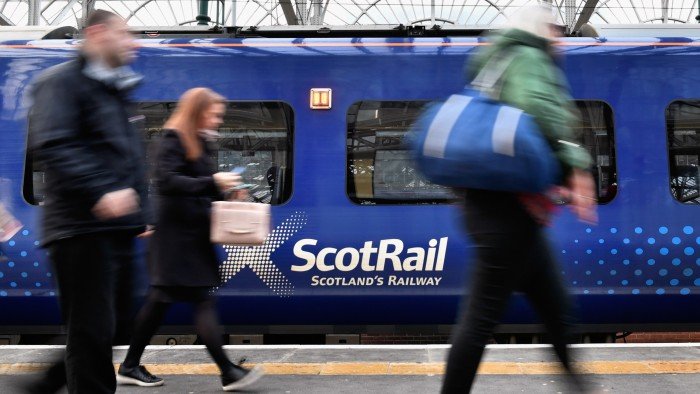
The best performers in terms of overall passenger satisfaction were, in no particular order: Merseyrail (public-private hybrid), TfL Rail/Elizabeth Line (public), c2c (owned by Trenitalia, the primary train operator of Italy), ScotRail (public) and Great Northern (private). Bringing up the rear, again in no particular order, are a motley crew of rail operators, some private, some public.
Now, one problem here, as supporters of renationalisation will reasonably point out, is that with the exception of TfL and the two devolved legislatures, every other nationalised railway in the UK is run by the operator of last resort. They are state-run because they were already in some difficulty. LNER, Northern, TransPennine Express and Southeastern were not getting good results when they were privately run. In some ways, assessing the performance of England’s nationalised railways is a bit like going “this bankruptcy specialist can’t be very good at his job: all of his clients have cash flow difficulties!”
Within London, there was consistently a big difference in passenger satisfaction between the capital’s commuter railways run by TfL, and the commuter railways run by private operators.
But outside of London, we only have two real comparison points: ScotRail run by the Scottish government (as of 2022), which also had performed well in Transport Focus’ surveys and has a great record on our chart above, and Transport for Wales, which comes out poorly.
All stories are about management, other than the ones that are about commodities. The optimistic read of Labour’s plans is that the story of the UK’s railways ultimately concerns management: that while there were excellent case studies of well-run private railways in the UK, rail privatisation failed to diffuse good management practices across the network. Chiltern Railways performed excellently, but those lessons never transmitted themselves to Southeastern or Northern. A nationalised railway will be better set up to spread excellence and best practice across the railways. In support of this view of the world, look at how much more effective the London Overground is compared with the private railway it replaced.
The pessimistic read, and I’m afraid it is one I share, is that the story of the UK’s railways is ultimately a commodities story. Some railways are just harder to run well, owing to more complicated routes, a less benign legacy of capital investment before privatisation, or some other factor to do with the material conditions of the actual railways in question. In support of this theory, note that ScotRail’s difficulty as a privatised operator was that it struggled to wipe its own face financially (a problem it still has as a nationalised railway). Shunting Northern into the state’s hands in 2020 has yet to significantly improve outcomes.
Labour is about to embark on what is, I think, a worthwhile experiment in whether us pessimists are right or not. But the big risk it is taking is that if nationalisation doesn’t improve the quality of England’s railways, the transport department will have no one to blame or to cost-share with.
Now try this
On Tim Hayward’s recommendation, I had an early dinner at OMA yesterday, and it really is as lovely as his review makes it sound. (Also it’s a nice walk from the South Bank and on to the Barbican, which made it ideal for our purposes.)
Top stories today
-
Calling on start-ups | The UK government is set to unveil plans for a new defence industrial council with business, in a bid to deepen Whitehall collaboration with technology companies and smaller start-ups, as well as the sector’s giants.
-
No magic number | Cabinet minister Pat McFadden has denied that Keir Starmer’s plan to issue new targets for his government next week is a “reset”, and defended the UK prime minister’s decision not to include a cap on inward migration.
-
Fear of Musk-ing out | Elon Musk has stepped up his attacks on the UK and Keir Starmer’s government, branding the country “a police state”. But he enjoys a warmer relationship with former prime ministers Boris Johnson and Tony Blair, who have both attempted to strengthen ties with the world’s richest man, now one of US president-elect Donald Trump’s closest advisers.
-
‘Local growth doesn’t [magically] levitate’ | Jennifer Williams’ long read assesses whether England’s new mayors can help fix its left-behind regions. Challenges standing in the way of mayoral administrations, some of which are still in their infancy, include capacity issues and a wider local government system that has been starved of funding for years.
Recommended newsletters for you
White House Watch — Your essential guide to what the 2024 election means for Washington and the world. Sign up here
FT Opinion — Insights and judgments from top commentators. Sign up here
