The incoming administration’s cabinet appointments are a bizarre disaster. So why are the president-elect’s approval ratings going up?
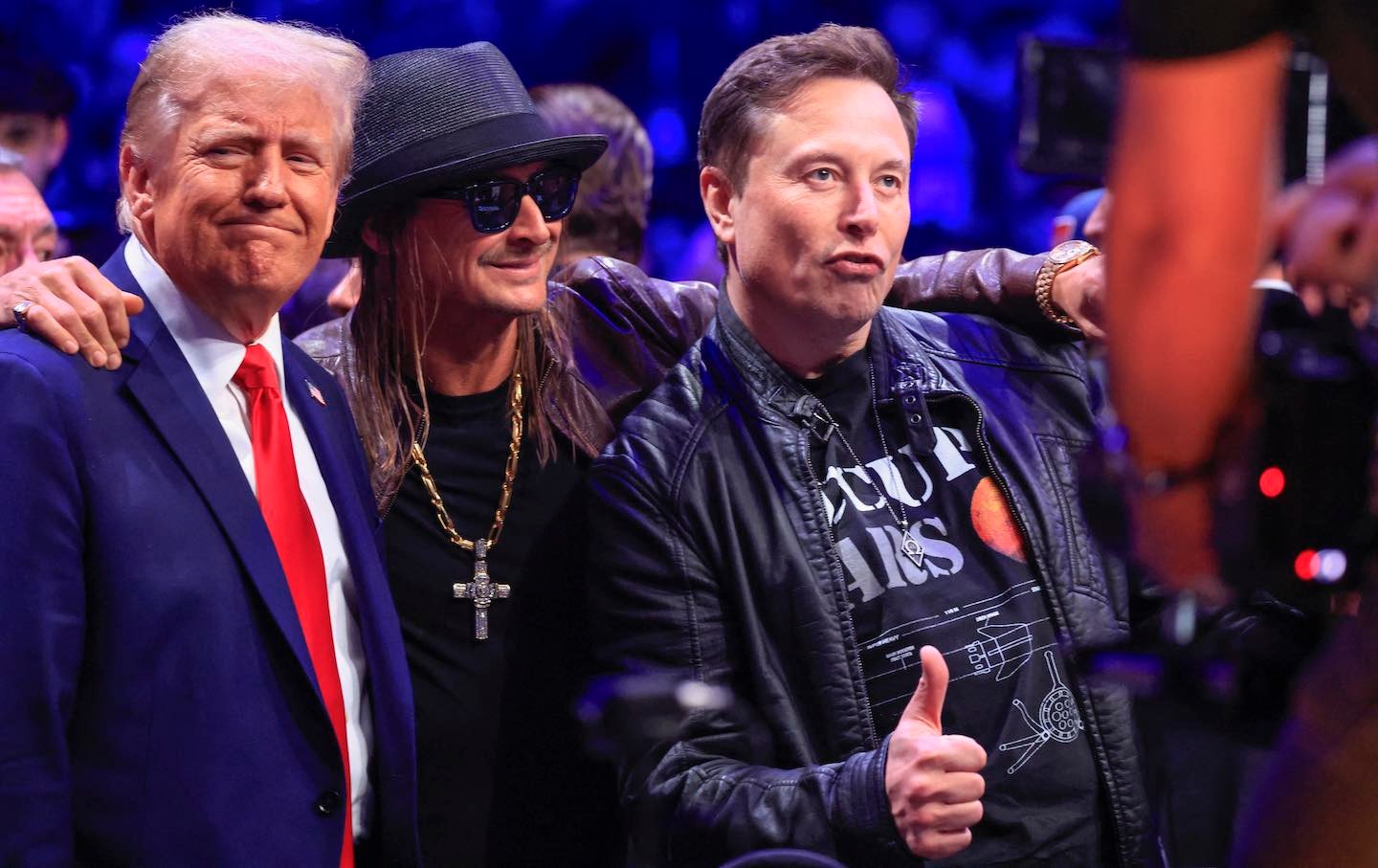
President-elect Donald Trump, Kid Rock, and Tesla and SpaceX CEO Elon Musk pose for a photo as they attend UFC 309 at Madison Square Garden in New York, on November 16, 2024.
(Kena Betancur / AFP)
The November air is still thick with postmortems of the 2024 election, but there’s already another mystery of public opinion that deserves at least as much scrutiny as the dismal outcome of presidential balloting. Americans beholding the squalid, bottom-feeding composition of the Trump cabinet in waiting—a grim panoply of grifters, self-dealing hacks, and sexual assaulters—report that they like what they see. The net approval rating for the Trump transition is 18 percent, according to a CNN poll—compared to just 1 percent during the transition into the first Trump White House. Fifty-three percent of respondents say they’re optimistic or excited about the prospects for a second term—a photographic negative of the initial dawn of the Trump era, where that same majority said that it scared or concerned them.
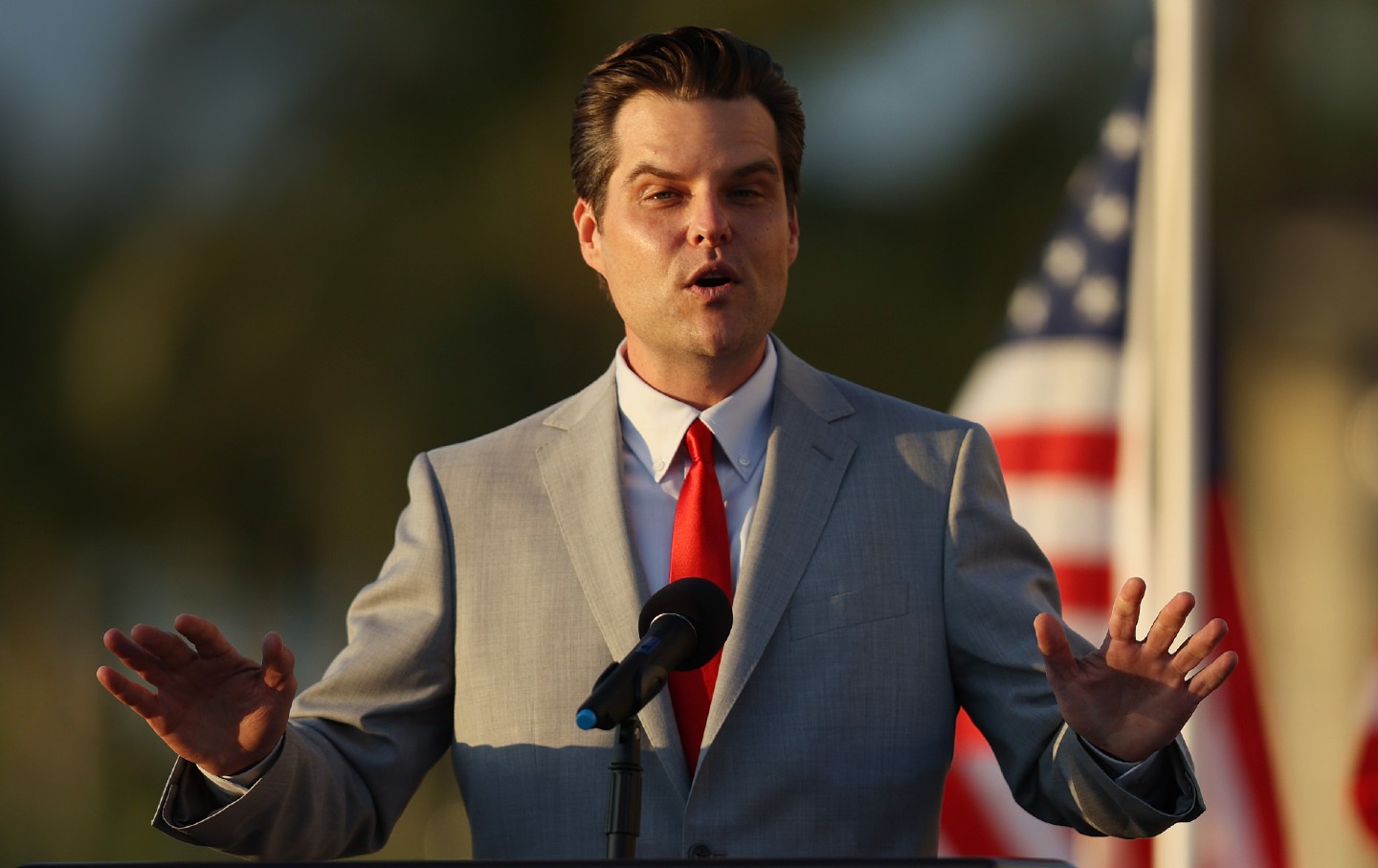
These findings come in the wake of a series of objectively awful cabinet appointments and botched and corrupt follow-throughs, from the transparently doomed nomination of Matt Gaetz as attorney general to the sexual assault charges against defense secretary nominee Pete Hegseth, to newly surfaced allegations that longtime Trump legal fixer Boris Epshteyn has been selling access to the president-elect to aspiring cabinet nominees for $100,000 a pop. This is to say nothing, of course, of the woeful unpreparedness of cabinet nominees for the consequential posts they’re assuming.
Linda McMahon is up to serve as education secretary after being dismissed from a Connecticut education post for lying about her nonexistent college degree in, yes, education. Robert F. Kennedy Jr. is poised to captain the Department of Health and Human Services, after denying the efficacy of vaccines so robustly that he played no small role in the death of 83 Samoans, most of them children, from measles. (There’s also his dimwitted pledge to ban fluoridation, as part of an apparent crusade against basic healthcare provision for kids.) Dr. Mehmet Oz, who’d administer Medicare and Medicaid, remains a mountebank and snake-oil shill who has sought to privatize both programs.
Then there’s the extra-governmental Department of Government Efficiency, which has Elon Musk and Vivek Ramaswamy—tech bros without portfolio who are equal parts clueless and ethically conflicted—claiming a mandate to hack away at one-third of the federal budget and 75 percent of the government workforce. Looking out at this new model army of boodlers and craven sycophants and professing optimism and excitement is something like promoting Deadpool v. Wolverine for a best-picture Oscar nomination.
Yet, once the shock of the CNN finding wears off, it’s worth pondering the deeper causes behind a public embrace of government by corruption. The reliably excitable pundit team of Jim Van De Hei and Mike Allen at Axios theorize that Trump’s “bad-boys fixation” in cabinet picks is a hit with male supporters who rally to brash confrontation as a political virtue. Yet Trump still remains quite popular among white women voters—and characters like Musk, Oz, and Ramaswamy are hardly swaggering studies in traditional machismo.
No, what seems to lie behind the pronounced appeal of Trump’s cabinet team is the same force that fuels Trump’s own popularity: his frontal assault on the ideology of meritocracy. Throughout the 2016 primary cycle, Trump whaled away at the pieties of credentialed Beltway expertise, insisting that the whole political and business establishment was rigged against any semblance of the public interest. If the foundations of public life were mobbed up, he argued, the trick is to have a mobbed-up insider using his influence on behalf of forgotten ordinary Americans. The pitch was essentially a dumbed-down version of Franklin Roosevelt’s pledge to govern as a traitor to his moneyed class—only where FDR proclaimed that he welcomed their hatred, Trump has proceeded to cultivate cronyism, using the powers of the state to reward personal fealty and punish what he views as ungrateful betrayals of his beneficence.
Current Issue
This view of rank favoritism as the central political dynamic in America is a deliberate trashing of the model of impartial and impersonal governance handed down in the liberal tradition from the goo-goos and Mugwumps of the late 19th century. Appalled by the self-dealing excesses of Gilded Age governance, these crusading reformers promoted civil service reforms and the abolition of the party bosses’ spoils system, while also extolling extensions of voter sovereignty via measures like ballot initiatives and the popular election of senators.
But behind many of these innovations was a covert bid for a more high-minded brand of class rule, in which experts and educated elites would lay claim to the public weal on grounds of general enlightenment; the vision that would later be identified as meritocratic, following the criticism of civil-service rule by British socialist Michael Young. This Progressive model of reform gained broader popular traction during the New Deal, when FDR and his brain trust engineered a new battery of government programs to redistribute resources and work opportunities to workers left behind in the Great Depression.
Today, however, on the far side of this meritocratic social contract, Trump and his cronies have driven home the claim that all government operations are definitionally self-dealing ones, and that the meritocracy has always been a farce. Theirs is a vision of government by and for the mobbed-up that John Ganz has dubbed the gangster Gemeinschaft. And the reason it commands wide popular assent is that it accords with how many Americans experience our actually existing political economy—as a rigged system devised to ensure that insiders clean up at the expense of everybody else.
In the face of the Trumpian assault on meritocracy, Democratic Party elites continue to mistakenly cling to the core precepts of meritocratic rule. In a recent interview with MSNBC, Bill Clinton—in every respect a model meritocrat in the Michael Young sense, having been recruited from the rural working class to become a grateful propagandist for the knowledge elite—underlined the threat Trump represents to credentialed and enlightened governance. “In demonizing all establishments,” he explained to Jonathan Capehart, “and all people who wear a tie, like you and me, to work, we are breaking down the legitimacy not only of people who may be too sanctimonious and too set in their ways in the past, but also of people who actually know things that are very important for us today, and very important for our continued growth and prosperity and harmony.”
This is the commencement-day version of a far uglier sentiment that Democratic partisans have endorsed after Harris’s defeat, forecasting bad income, health, and social outcomes for the misguided heartland rubes who threw in with the MAGA movement; they have fucked around and found out, so the path forward is to mount a Democratic version of Trumpian payback governance, and let white working-class voters twist in the wind. To aid that cause, Democratic-leaning wonks are massing research data to reinforce a cherished meritocratic talking point: that economically prosperous, healthier, and better educated stretches of the country turned out disproportionately for the Harris-Walz ticket, leaving the benighted proles of the heartland in the MAGA camp.
But this isn’t proposing a viable solution for the scattered and demoralized Democrats; it’s merely restating the problem. Casting white working-class voters as ingrates at best and ill-informed marks at worst is not going to broaden the Democrats’ appeal to this pivotal vanishing constituency; nor does it do anything to redress Trump’s historic gains among Black and Hispanic voters. Socioeconomic petulance is never a viable strategy to win elections; instead, Democrats need to recover the working-class base that rescued them in the Roosevelt years from the myopic vision of elite governance bequeathed to them by the Progressive movement.
There’s no mystic messaging strategy or savvy payback tactic that will get this done in a single campaign; instead, the party needs to take a long and hard look at its own massive and deliberate retreat from a vital working-class politics in its elite-driven repudiation of the Bernie Sanders movement. And it needs to take at least as much time in a clear-eyed assessment of how the party’s own elite consulting class enriches itself in prosecuting this flight from plain talk about class inequality in the sanctums of Democratic power. A party movement that lives by the meritocracy can very easily die by it. Just ask the Mugwumps.
We cannot back down
We now confront a second Trump presidency.
There’s not a moment to lose. We must harness our fears, our grief, and yes, our anger, to resist the dangerous policies Donald Trump will unleash on our country. We rededicate ourselves to our role as journalists and writers of principle and conscience.
Today, we also steel ourselves for the fight ahead. It will demand a fearless spirit, an informed mind, wise analysis, and humane resistance. We face the enactment of Project 2025, a far-right supreme court, political authoritarianism, increasing inequality and record homelessness, a looming climate crisis, and conflicts abroad. The Nation will expose and propose, nurture investigative reporting, and stand together as a community to keep hope and possibility alive. The Nation’s work will continue—as it has in good and not-so-good times—to develop alternative ideas and visions, to deepen our mission of truth-telling and deep reporting, and to further solidarity in a nation divided.
Armed with a remarkable 160 years of bold, independent journalism, our mandate today remains the same as when abolitionists first founded The Nation—to uphold the principles of democracy and freedom, serve as a beacon through the darkest days of resistance, and to envision and struggle for a brighter future.
The day is dark, the forces arrayed are tenacious, but as the late Nation editorial board member Toni Morrison wrote “No! This is precisely the time when artists go to work. There is no time for despair, no place for self-pity, no need for silence, no room for fear. We speak, we write, we do language. That is how civilizations heal.”
I urge you to stand with The Nation and donate today.
Onwards,
Katrina vanden Heuvel
Editorial Director and Publisher, The Nation
More from The Nation
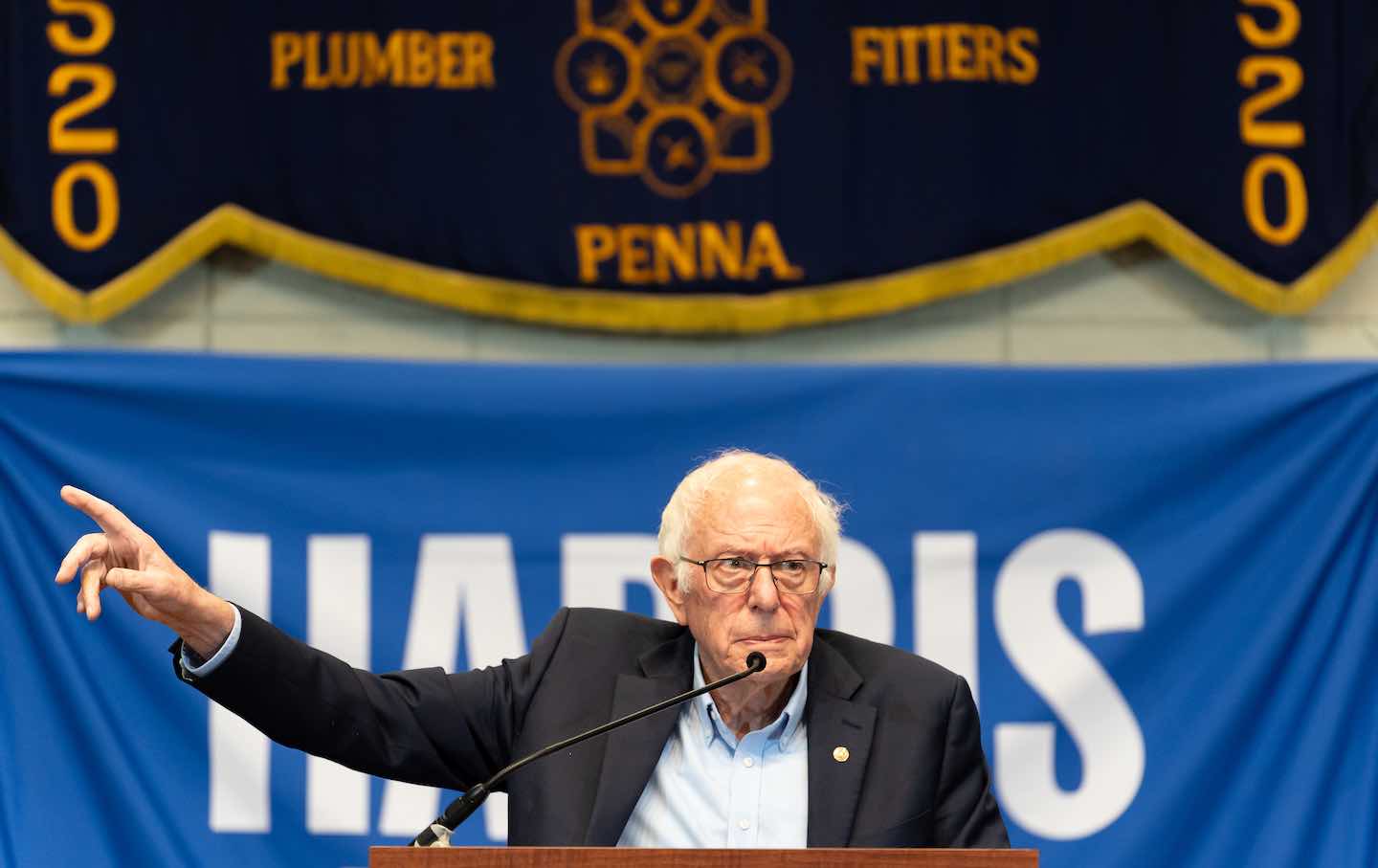
The senator says in this exclusive interview that challengers to status quo politics can run in Democratic primaries or as independents.

The election showed what has been clear for some time: Chinese communities are becoming a new center of conservative power.
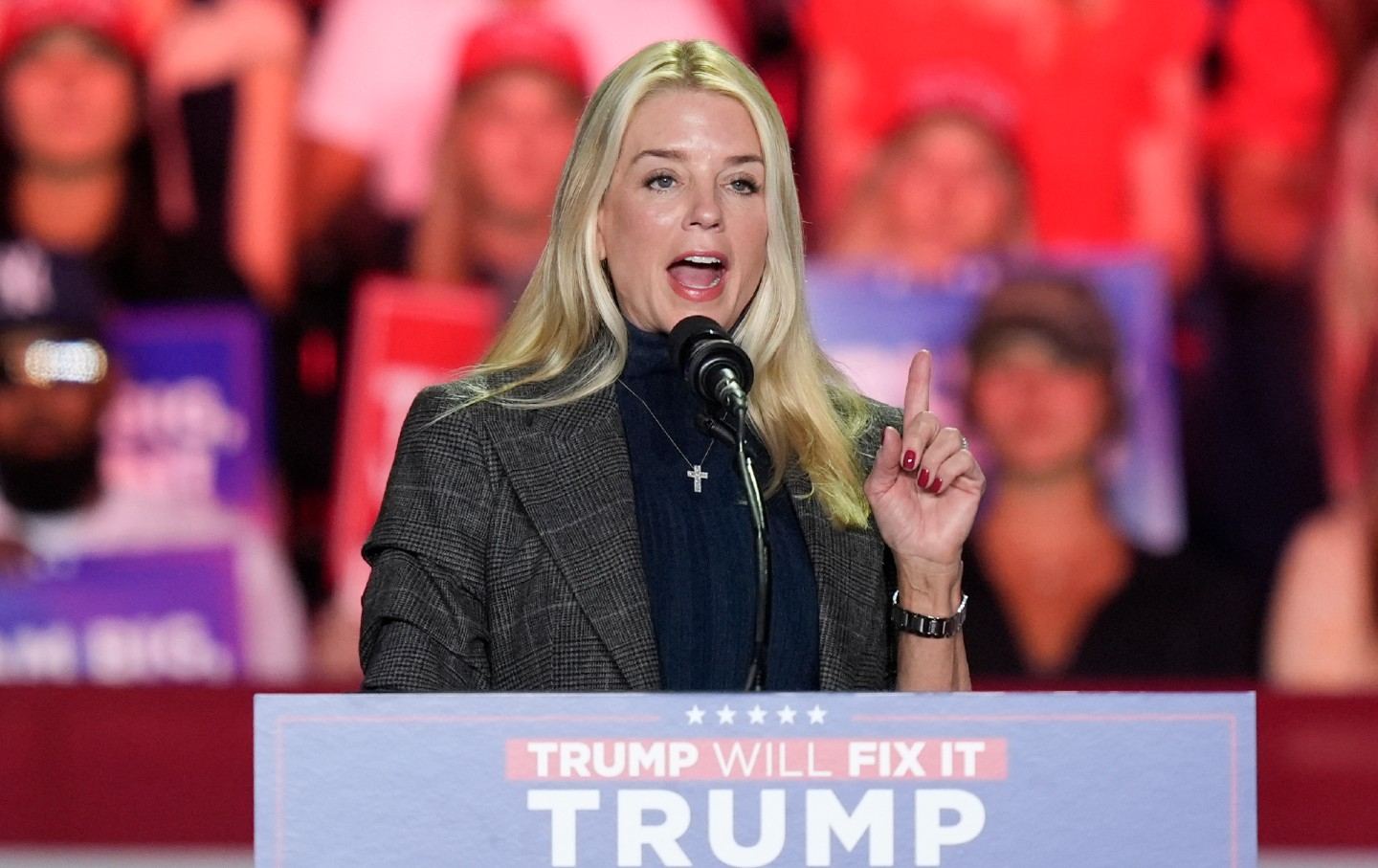
While Bondi is a Trump loyalist who will do real damage, she won’t be as dangerous as one of the Federalist Society ideologues who might have gotten the post.