
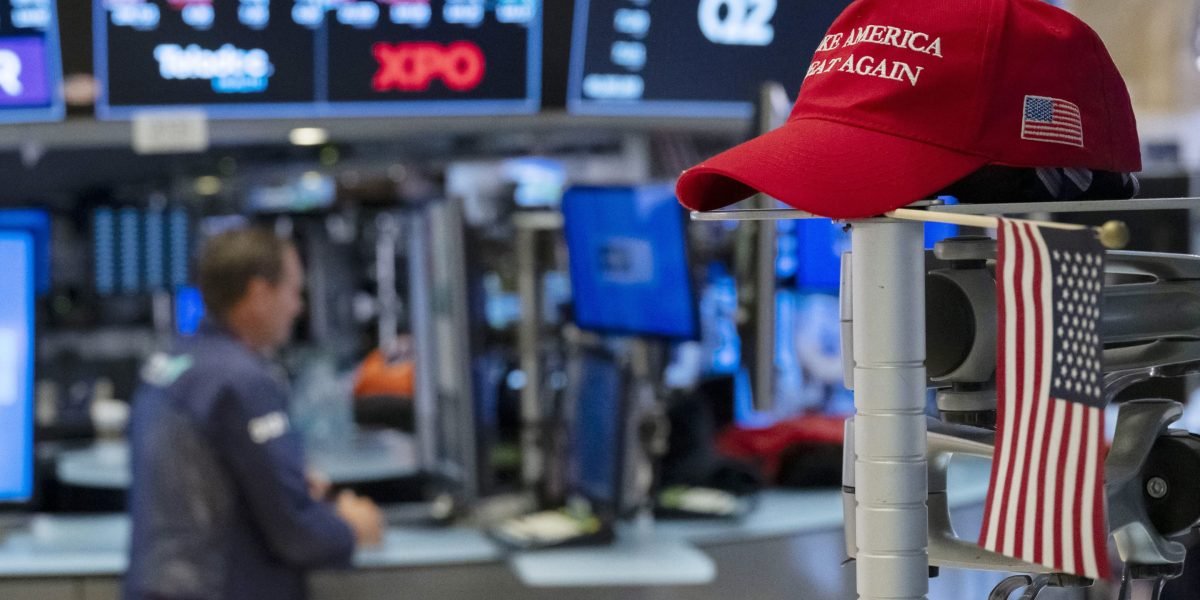

If Wall Street learned one thing during Donald Trump’s first term as president, it’s that the stock market is a way he keeps score. At various points he took credit for equities rallies, urged Americans to buy the dip, and even considered firing Federal Reserve Chairman Jerome Powell, who he blamed for a selloff.
Now he’s preparing for another stint in the White House, and the market is once again a key focus. The problem is he’s also bringing a series of economic policy proposals that many strategists say raise the risk of increasing inflation and slowing growth.
So for investors who’ve enjoyed the S&P 500 Index’s more than 50% jump since the start of 2023, the best hope for keeping the market rolling into 2025 and beyond may be Trump’s fear of doing anything to damage a rally.
“Trump considers the stock market performance as an important part of his scorecard,” said Eric Sterner, chief investment officer at Apollon Wealth Management. “He regularly started his speeches as president in his first term with the question, ‘How’s your 401K doing?’ when the markets were riding high. So he clearly does not want to create any policies that threaten the current bull market.”
The S&P 500 Index took off after Trump’s win on Nov. 5, putting up its best post-Election Day session ever. A whopping $56 billion flowed into US equity funds in the week through Nov. 13, the most since March, according to strategists at Bank of America Corp. using data from EPFR Global. And the S&P 500, technology-heavy Nasdaq 100 Index and Dow Jones Industrial Average have all hit multiple records since Election Day, despite last week’s pullback.
What makes the reaction notable is Trump’s campaign promises weren’t what you’d normally consider investor-friendly. They include: hefty tariffs that will potentially strain relations with key trade partners like China; mass deportations of low-wage undocumented workers; tax cuts targeted at corporations and wealthy Americans, which are expected to increase the national debt and widen the budget deficit; and a general protectionist approach aimed at bringing manufacturing back to America, where costs are higher than they are overseas.
None of these risks is a secret, they’ve all been widely discussed in investing circles. So where’s the enthusiasm coming from? Simple. Wall Street doesn’t believe Trump will tolerate a declining stock market, even if it’s caused by one of his own proposals.
President Pivot
“If some of these policies start to impact his popularity, start to impact the stock market in a way that he perceives as being negative, I think that he’ll pivot,” Emily Leveille, portfolio manager at Thornburg Investment Management, said in an interview.
Or, as Barclays strategists put it in a note to clients on Thursday: “We think the president-elect should be taken seriously, but not literally.”
The possibility of tariffs is what investors are most closely watching, since Trump regularly used them in his first term as negotiating tools, threatening to put them on and then just as quickly reversing course when markets sold off in response. Along the way, he whipsawed stocks as trade talks with China and Mexico dragged on and often played out on social media.
This time, Trump has proposed a 10% to 20% tariff on imports from all countries. Even at the lower end, that could lead to a 10% pullback in US equities and a mid-single digit decline in S&P 500 profits, according to a team of strategists at UBS. The universal tariff combined with a proposed 60% or higher levy on goods from China would shave 3.2% off S&P 500 companies’ earnings in 2025, according to Barclays strategists.
“Threatening tariffs to gain advantage in trade negotiations is one thing, but imposing them is another,” said Mark Malek, chief investment officer at Siebert, adding that Trump’s sensitivity to equity markets should, in theory, temper his approach.
Wall Street leaders like Jamie Dimon seem to agree, with the JPMorgan Chase & Co. chief executive telling the APEC CEO Summit in Peru on Thursday that he thinks the president-elect will want to avoid triggering a stock market selloff with his tariffs.
Nonetheless, investors are getting out in front of the risk, selling shares of companies that are expected to suffer from the levies. The Nasdaq Golden Dragon China Index, which holds firms that are listed in the US but do business in China, is down 8.9% since Election Day. Coca-Cola Co. and PepsiCo Inc. have lost around 5.5% apiece over the same period. And Hasbro Inc. has dropped 7.1%.
Not 2016 Anymore
Of course, historical analogies may not matter because conditions when Trump first took office in 2017 were so different from what they are now. Back then, the S&P 500 was coming off a 9.5% gain in 2016 and a slight dip in 2015. This time, the index has been on a two-year tear, leaping 53% since the end of 2022. In 2024 alone, it has notched more than 50 records.
Interest rates were also much lower in 2017, with the fed funds rate between 0.5% to 0.75% compared with a range 4.5% to 4.75% today. And Trump may not be getting much assistance from the Fed after Powell said on Thursday that there was no need to hurry with more rate cuts after reductions at the September and October meetings.
The high equity valuations and tight financial conditions could limit Trump’s ability to stimulate the economy and stock market like he did in his first term, when he passed a $1.3 trillion spending billthat increased expenditures on domestic programs as well as a $1.5 trillion tax cut.
“President Trump will not be able to replicate the fiscal stimulus from his previous term,” Marko Papic, chief geopolitical strategist at BCA Research, wrote in a note to clients last week. “Trump 2.0 will curb immigration and be forced to curb fiscal policy, the twin pillars of American outperformance relative to the rest of the world.”
The risks of this are mainly showing up more in the bond market, at least for now, as traders are betting on a selloff in Treasuries in the wake of Trump’s win. How much the market will tolerate is a key question, according to Ed Yardeni, president and chief investment strategist at Yardeni Research.
“If bond yields go up substantially here on fears of inflation and larger deficits, obviously the stock market’s getting it wrong,” he said.
And the final risk, counter-intuitively, is if Trump is too sensitive to what markets are doing. Meddling can also be destabilizing, which typically isn’t beneficial for equity prices, according to Siebert’s Malek.
“Markets, as we all know, can be temperamental,” he said. “If Trump is too reactive to daily market moves as he was during some passages of his first term, he along with many others, may find themselves getting whipsawed.”
