
The Royal Swedish Academy of Sciences awarded the Nobel Memorial Prize in Economic Sciences to three economists. The recipients are Turkish-born Daron Acemoglu and British-born Simon Johnson, both of the Massachusetts Institute of Technology, and British-born James A. Robinson, an economist and political scientist at the University of Chicago. They received the award “for studies of how institutions are formed and affect prosperity.”
This field has a long and noble history in economics. The Nobelists’ contribution is to lay out empirical data on the specific economic institutions that helped or hindered economic growth and then to examine the factors that led to those institutions. They point out, as Adam Smith did, that property rights and the rule of law are key. Governments respect these two pillars, they argue, because the political elites share the benefits of economic growth with the “masses” rather than extract the masses’ wealth.
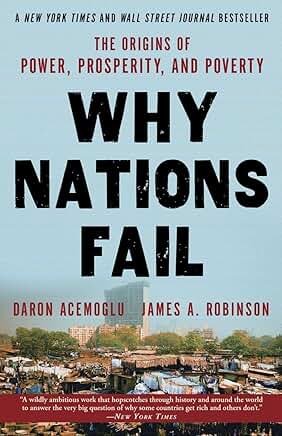
In their 2012 book, “Why Nations Fail,” Messrs. Acemoglu and Robinson divide countries into two types: extractive and inclusive. In extractive countries, a small elite extracts wealth from the masses, whereas in inclusive countries, political power is shared. When governments are extractive, people have little incentive to produce. But the opposite is true when governments are inclusive, as people have property rights and can accumulate wealth.
Why do political elites sometimes favor property rights and the rule of law and sometimes oppose them? The three Nobelists’ research examines European colonization of other continents. They show that where there was a relative absence of diseases, such as malaria, there were more colonizers. These colonizers were too numerous to get rich by exploiting the natives, so they created wealth-building institutions. But where colonizer mortality was high, the colonizers who survived simply extracted wealth from the natives. This explains why Canada and the U.S. did relatively well as colonies and many countries in Africa and Latin America did poorly.
As I noted in my 2013 review of “Why Nations Fail,” Adam Smith observed that natural resources were less plentiful in the future Canada and the U.S. than in Latin America. But the economic institutions that Spain’s government set up in Latin America were less geared toward the free market and property rights than those that the British set up in the northern part of North America. It’s a pity that Messrs. Acemoglu and Robinson didn’t cite Smith’s insight. Nor did they cite economist Mancur Olson’s 1982 book, “The Rise and Decline of Nations,” which anticipates the Nobelists’ hypothesis.
You might think that Messrs. Acemoglu and Robinson would be strong believers in economic freedom. Their work is consistent with the findings in the Fraser Institute’s annual Economic Freedom of the World report, which finds a strong positive correlation between economic freedom and real gross domestic product per capita. While the two authors do favor private property rights, Mr. Acemoglu advocates a high minimum wage that adjusts for inflation. He also favors strong antitrust laws.
Behind Mr. Acemoglu’s belief in antitrust is his mistaken interpretation of the era of the so-called robber barons. In “Why Nations Fail,” Messrs. Acemoglu and Robinson claim that the robber barons “aimed at consolidating monopolies and preventing any potential competitor from entering the market or doing business on an equal footing.” Ironically, they single out Cornelius Vanderbilt as a notorious robber baron. But as a young man, Vanderbilt helped his employer, Thomas Gibbons, break Aaron Ogden’s interstate monopoly on ferry travel. The Supreme Court ruled against the monopoly in Gibbons v. Ogden (1824). As historian Burton W. Folsom Jr. noted in his 1991 book, “The Myth of the Robber Barons,” the breakdown of the monopoly increased steamboat traffic.
It’s good to see a Nobel Prize awarded to economists who understand the importance of private property and the rule of law. Unfortunately, Mr. Acemoglu’s understanding is incomplete. He recently signed a statement supporting the Brazilian government’s move to rein in freedom of speech for Brazilians who want to communicate using X. Only time will tell whether Mr. Acemoglu will favor further undercutting of the rule of law. Let’s hope he doesn’t.
Mr. Henderson is a research fellow with Stanford University’s Hoover Institution and editor of the Concise Encyclopedia of Economics.
