
Sir James Dyson, the billionaire inventor of high-tech vacuum cleaners, has become an outspoken critic in recent weeks of Britain’s plan to reintroduce inheritance tax for farms. He should know: his farming empire alone could result in about £122mn in death duties.
The entrepreneur — who sparked controversy by supporting Brexit then moving his eponymous technology company’s headquarters from Wiltshire to low-tax Singapore in 2019 — has developed one of the UK’s largest farming businesses, owning some of the country’s most productive agricultural areas.
The 77-year-old tycoon — who says he has a mission to “protect and nurture” British farmland — has been able to expand his agricultural business over the past decade free of the threat of death duties. The company says it has invested a total of £140mn to upgrade its farms.
Dyson Farming owns at least 36,000 acres, the group says, across Lincolnshire, Oxfordshire, Gloucestershire and Somerset. It recorded profits of £5.2mn in 2023, up 10 per cent from the previous year, according to the company’s accounts. The group is now one of the top five UK producers of wheat grains, malting barley, oil seeds, peas and potatoes.

Chancellor Rachel Reeves proposed changes in last month’s Budget to measures that soften the impact of death duties: agricultural property relief (APR) and business property relief (BPR), which were designed to ensure the survival of family and farm businesses after the owner’s death.
“You can find cases of people who have specifically said they purchased land for the purpose of acquiring this tax break,” said Arun Advani of the Centre for the Analysis of Taxation. “There are lots and lots of problems with the way we tax the transfer of assets between generations in the UK. This Budget closes some of the gap.”
From April 2026 farm business owners will have to pay IHT at a rate of 20 per cent of the value of their estate, beyond a £1mn cap. With £612mn in net assets in its annual accounts, the changes could translate into about £122mn in duties for Dyson Farming, according to Financial Times’ estimates.
In a column in The Times published earlier this month, Dyson, who has three children and six grandchildren, lashed out at the decision, accusing the new Labour government of destroying the “fabric of our economy.” “No business can survive Reeves’ 20 per cent tax grab. It will be the death of entrepreneurship,” he said.


The revision has also sparked a wider outcry among farmers and landowners across the country, who have warned that the changes will force small rural businesses to sell their assets and undermine the country’s food security.
But the intervention into the controversy by Dyson — whom the Sunday Times estimates has a fortune of £20bn — has renewed scrutiny on the scale of his farming business.
It was “wrong to assume that my investment in farming is to avoid inheritance tax”, Dyson wrote in a letter to The Times in 2019. “There are far simpler and less risky ways of achieving it than buying farmland.”
A spokesperson for Dyson said that the changes to IHT introduced in the Budget would “severely undermine” efforts to improve the UK’s food security.
“The Dysons’ motivation has been to bring new thinking and new technology to promote sustainable agriculture, to produce high quality food for the British market and to improve UK food security,” they said.
The Budget “damages family businesses of all types and threatens the livelihoods of the many millions who work for them”, the spokesperson added.

Dyson’s spokesperson said that the billionaire had consistently been among Britain’s top 10 taxpayers, “contributing more than £500mn to the Exchequer in the last five years alone”.
According to the Land Registry, privately owned Dyson Farming owns 185 separately listed properties, with the bulk of the purchases coming between 2013 and 2016. In some locations, such as around Carrington in Lincolnshire, he has strategically assembled large tracts of land by buying up neighbouring properties.
Carrington and Nocton, Dyson Farming’s two major farming hubs where the head office is located, make up two-thirds of all farmland owned by the entrepreneur.
“Lincolnshire produces a third of the UK’s fresh food and has very good soil, very big fields, a good rural agricultural community, and good skills,” Dan Cross, managing director of Dyson Farming, said in an interview. “If you want to be scale farming, [it’s] a great place to start.”
He added that the company had no plans to significantly increase its landholding from current levels.
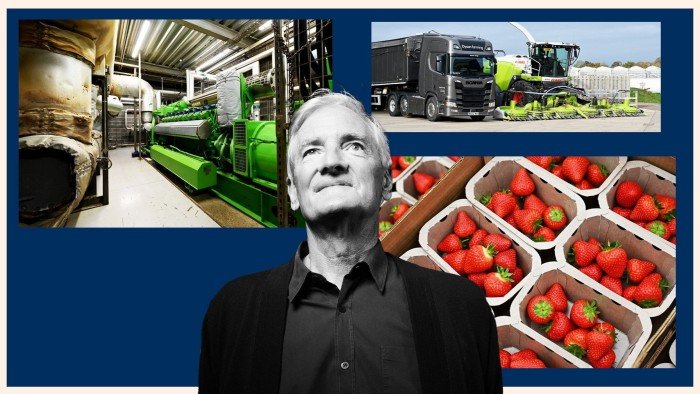
A big part of Dyson Farming’s technology investments has been poured into a 26-acre glasshouse in Carrington, which houses 1.25mn strawberry plants that produce 1,250 tonnes of fruit a year. The berries are harvested by a mix of human pickers and robots, whose UV light kills dangerous fungi and can pick fruit without taking any breaks.


Equipment and development are a core area of growth at Dyson Farming, which plans to invest £28mn in 2025 and up to £35mn in 2026.
Dyson is currently eligible for APR or BPR on most of the value of his businesses, including his farming group, Dyson Farming, and the Dyson Group, which qualifies as an unlisted public company.
As of April 2026, when the reforms come into place, his estate will be liable to 20 per cent inheritance tax on the majority of the value of the group, leaving out the £1mn allowance, which is minimal to the overall value of his estate.
“IHT applies to individuals and trusts but not to corporates,” says Joseph Adunse, a tax partner with Moore Kingston Smith. “But in this case, as the farmland is owned by a corporate and an individual owns the corporate, then IHT will be payable by the individual’s estate.”
The company declined to comment on its potential tax liabilities as a result of the government’s overhaul.

Dyson — who visits his farms about six times a year, according to Cross — owns his farmland through Dyson Farming Limited, which is part of the Weybourne Group, according to Weybourne’s website. This is in turn owned by Weybourne Holdings Pte Limited, a company incorporated in Singapore. The billionaire has moved his personal residency back to the UK after relocating to Singapore in 2019.
“As his ownership is of a company located in Singapore, if he left the UK for more than 10 years, he would cease to be liable to UK IHT on the shares he holds in the Singaporean holding company so would escape UK IHT altogether,” said one tax adviser.
The ability to leave the country for 10 years and then be outside the UK inheritance tax net will become a feature of the tax system from April 2025, when the government changes the rules. Currently, a British-born person is liable for inheritance tax regardless of where they live if they retain a UK-domicile. From April 2025, the concept of domicile will be scrapped in tax and replaced with a residence-based test.
High-net-worth individuals have been scrambling for alternative succession strategies after last month’s government decision, said St James’s Place wealth management consultant Iain McLeod.
“The conversations have been, ‘should we accelerate the gifting of our farm to our children now, rather than holding on to it until death?’” he said.
Rupert Jackson, head of agriculture and landed estates at wealth manager Brabners Personal, said that the changes will incentivise people to spread their assets across family members through divided ownership.
Landowners can also gift their estate to relatives during their lifetime, which makes the land exempt from IHT as long as the donor does not die within seven years of making the gift, Jackson added.
In any case, Advani at the Centre for the Analysis of Taxation, said transfers between spouses, gifts and trust funds were more efficient ways to avoid paying inheritance tax compared to APR and BPR. “They’re not the biggest holes in inheritance tax.”
Visuals by Steve Bernard in London
