
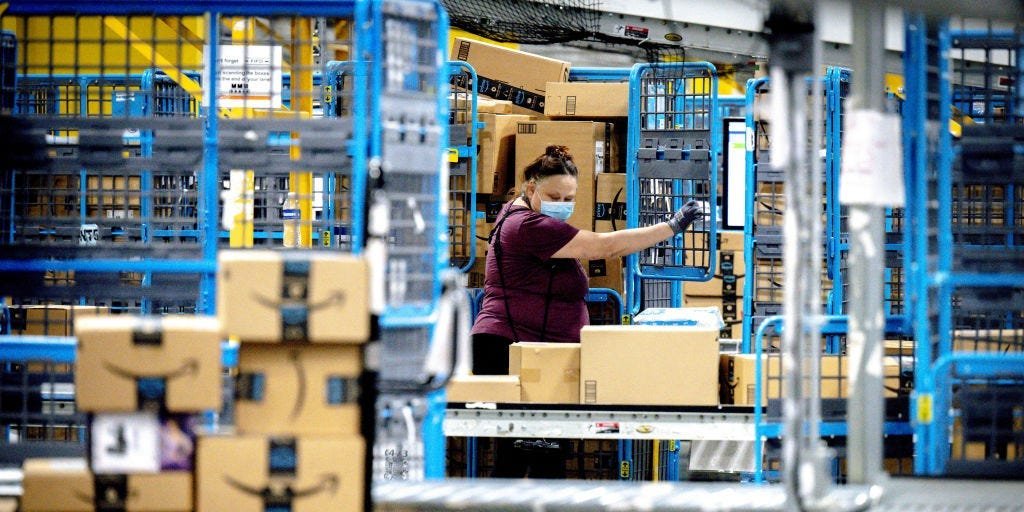
- Oxfam said in a new report that Amazon and Walmart use excessive surveillance in their warehouses.
- The “concerning” practice puts warehouse employees’ health and well-being in jeopardy, the report says.
- “Excessive surveillance is not simply disconcerting for workers; it also erodes worker rights,” says the report.

Amazon and Walmart both use over-the-top surveillance in their warehouses — and the “concerning” practice not only undermines the rights of the megacorporations’ massive amount of employees, but puts their health and well-being in jeopardy, international anti-poverty organization Oxfam said in a new report.
The 52-page report, “At Work and Under Watch: Surveillance and Suffering at Amazon and Walmart Warehouses,” was released Wednesday and highlights survey data it says was collected from 1,484 Amazon warehouse employees and 444 Walmart warehouse workers across the United States.
Amazon currently has 750,000 operations employees working in warehouses throughout the country, the company said. Walmart employs roughly 1.6 million associates in the US, according to a recent Securities and Exchange Commission filing. Tens of thousands of those workers are employed across Walmart’s more than 200 US distribution centers.
Oxfam’s report quotes several unidentified warehouse workers for the retail giants describing harsh labor conditions, including one Amazon worker who likened their experiences on the warehouse floor to “slavery.”
“Amazon has been a pioneer in the area of worker surveillance and management in its warehouses, and Walmart, long known for adopting repressive practices to monitor workers, is also entering a new phase of accelerated technology deployment across its facilities,” the report says.
Data from two recent surveys, funded in part by Oxfam — the National Survey of Amazon Warehouse Workers and the National Survey of Walmart Warehouse Workers — is included in the report. The results show that a substantial amount of Amazon and Walmart warehouse employees surveyed reported being closely watched by technology while in the workplace.
“As the data shows, although key differences exist, workers at both Amazon and Walmart are experiencing concerning levels of surveillance,” the report says. “Crucially, excessive surveillance is not simply disconcerting for workers; it also erodes worker rights.”
Soren Larson/Reuters
Amazon and Walmart slammed Oxfam’s report
Amazon has disputed claims that it uses technology to monitor its warehouse workers, while Walmart said the report fails to accurately depict the company’s use of technology.
“While we respect Oxfam and its mission, we have strong disagreements with the characterizations and conclusions made throughout this paper — many based on flawed methodology and hyperbolic anecdotes,” Amazon spokesperson Maureen Lynch Vogel told Business Insider in a statement. “In reality, Amazon has made notable safety gains and enriched the communities in which we operate, providing safe, good paying jobs with health benefits and educational opportunities.”
Vogel went on to attack the research itself.
“Traditionally, researchers work to disprove pre-existing beliefs and biases, but the organizations involved in this paper did the opposite — they started with biases and sought to prove them — which is disappointing,” Vogel said. “We’re not perfect, but we’re making measurable progress and our employees’ health, safety, and well-being will always be our top priority.”
A Walmart spokesperson told BI in a statement: “Oxfam’s claims are based on incomplete and misleading information. This report inaccurately represents Walmart’s use of technology and Walmart’s publicly available disclosures around data privacy and worker safety.”
According to the data outlined in the Oxfam report, 77% of Amazon warehouse workers surveyed and 62% of Walmart warehouse employees who participated reported that “technology can tell” if they are “actively engaged” in their work almost or most of the time.
Similarly, 72% of Amazon warehouse employees who participated and 67% of Walmart warehouse employees surveyed reported that “how fast” they work is measured by company technology always or most of the time, the data in the report shows.
In a seven-page response to Oxfam viewed by BI, Tessie Petion, the head of ESG Engagement at Amazon, wrote that Oxfam’s report “illustrates a misunderstanding of what the technology in our facilities does and doesn’t do.”
“We do use technology in our facilities to help ensure the safety and security of our employees — it would be irresponsible if we did not take this approach. We also secure our inventory. Our facilities house hundreds of thousands of products that will be shipped to customers around the world, and the technology in our facilities helps guide the flow of goods through the sites,” Petion wrote.
Petion continued, “This is similar to technology used throughout the industry. We do not use the camera technology in our warehouses to monitor employees. Employees who have questions about how our technology works, or concerns about the data it collects, are always encouraged to speak to their manager who can explain it to them in greater detail.”
Suzanne Kreiter/The Boston Globe via Getty Images
More than half of Amazon and Walmart employees surveyed find it tough to get to the bathroom
According to data in Oxfam’s report, roughly three-quarters of both Amazon and Walmart warehouse workers surveyed reported feeling pressure to work faster at least some of the time.
“Being monitored this minutely takes a physical and mental toll as workers need to make decisions about taking breaks, eating, going to the bathroom, or even drinking water with their pace or performance metrics in mind,” the report says.
Some 54% of Amazon respondents and 57% of Walmart respondents reported that their production rate makes it hard for them to use the bathroom at least some of the time, data included in the report said.
“The conditions there are absolutely horrific,” one Amazon warehouse worker in Alabama was quoted as saying in the report. “I likened it to slavery, because they care more about quotas and meeting production rates than actually caring about us as human beings inside there. I feel more like a number.”
Petion, in her response to Oxfam, called the assertion that workers don’t get sufficient breaks “wrong.”
“In addition to their regularly scheduled breaks, employees are free to take informal breaks throughout their shifts to use the restroom, get water, or talk to a manager or HR,” Petion wrote. “If there’s ever a concern about a manager misusing productivity guidance or asking employees to prioritize productivity over safety, we immediately investigate and take appropriate action.”
The data shows a move towards a ‘really dystopian workplace,’ Oxfam director says
Irit Tamir, the director of Oxfam America’s private sector department, told BI that the research outlined in the report shows a move towards a “really dystopian workplace where people feel like they’re constantly being monitored and watched.”
“They are feeling oppressed by this cognitive tax on workers who fear this constant surveillance and punishment” for taking breaks, Tamir said. “And as a result, you know, I think these warehouse floors have become incubators of injury sustained by automation and surveillance, and workplace cultures of intimidation.”
The Oxfam report says that at Amazon, warehouse workers “are assigned handheld devices or scanners that record, count, and measure every item they move during their day.”
“These systems measure down to the second the amount of time a worker spends not actively sorting, packing, or performing work — what is called ‘time off task,'” the report says. Those scanners, according to the report, “play a key role in the surveillance machine” because it says it can lead to automated penalties for workers who fail to meet production targets.
“In addition, hundreds of security cameras are constantly monitoring the warehouse floor, ready to notify a manager when a worker is away from their station for too long,” the report says.
corporate.walmart.com
When it comes to Walmart, the report says that “little is known about the technology the company is currently using to monitor workers across its warehouses,” but states that workers it surveyed reported being “watched constantly.”
The report says that the data from the Walmart warehouse worker survey analyzed in the report is the “first of its kind to offer insights into the extent of worker monitoring at Walmart’s warehousing facilities, and it captures vital information about the company’s current practices.”
One Walmart worker quoted in the Oxfam report alleged that the company’s warehouse robots “are treated better than human beings.”
In a statement, Abby Maxman, the president and CEO of Oxfam America, accused Amazon and Walmart of “making record profits on the backs of warehouse workers by exploiting them through oppressive surveillance practices.”
Oxfam is calling upon both Walmart and Amazon to commit to “ceasing or significantly reforming their use of worker surveillance technologies to enforce unreasonable and/or unsafe quotas.”
“These are the two biggest private employers in the United States,” Tamir told BI of Amazon and Walmart. “So we are talking impact across millions of workers.”
