
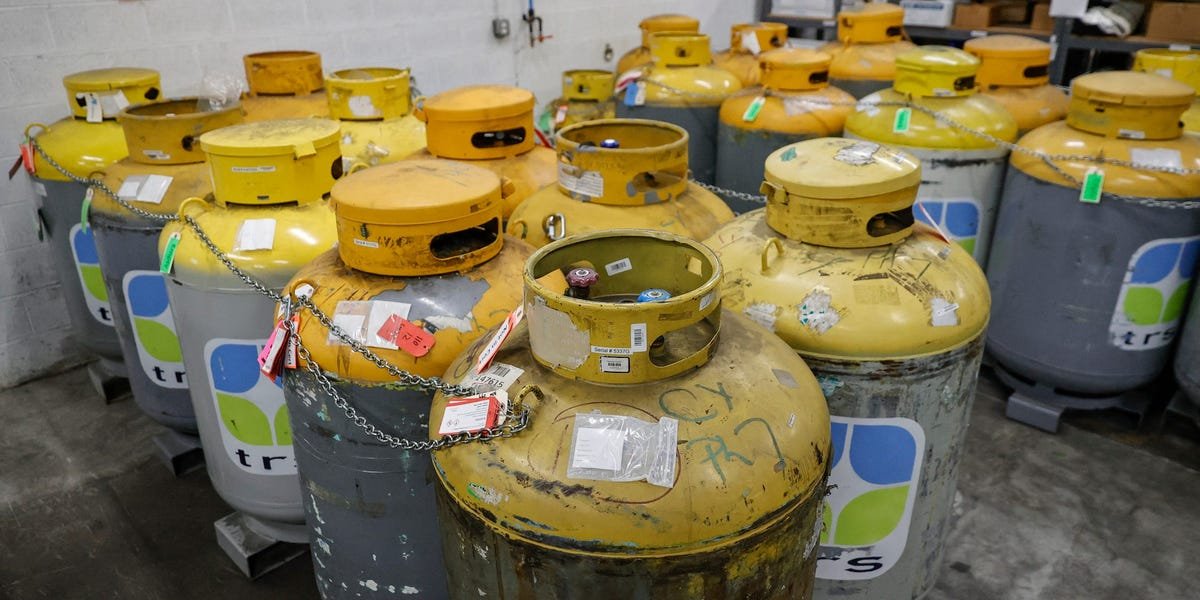
Plenty of legitimate business drives the climate crisis — any industry that runs on fossil fuels or cow burps is helping raise our planet’s temperature, endangering lives and economies for decades to come. But there’s also a blooming black market in greenhouse gases.
The shadowy trade had a moment in the sun on Monday, when the Department of Justice brought charges against a San Diego man, saying that he smuggled hydrofluorocarbons (HFCs) into the country.
HFCs are commonly used in refrigerators and air conditioners, but they’re also potent greenhouse gases. In the atmosphere, their warming effect can be hundreds to thousands of times as powerful as that of carbon dioxide. That’s why their import is strictly regulated.
Adrees Latif/Reuters
The indictment alleges that Michael Hart bought the chemicals in Mexico, hid them in his truck under a tarp as he drove back to the US, posted them on OfferUp and Facebook Marketplace, and sold them for profit.
“This is the first time the Department of Justice is prosecuting someone for illegally importing greenhouse gases,” US Attorney Tara McGrath said in a statement. “It will not be the last.”
There’s been a thriving black market for climate-altering refrigerant chemicals since the 1990s, at times as lucrative as selling cocaine. As time runs out to avoid catastrophic levels of climate change, Hart’s case is just the first in the government’s new concerted effort to end this illegal business once and for all.
New chemicals have brought new problems
Unlike in the Hart case, greenhouse gases often come in on shipping containers, intentionally labeled as something else, experts told Business Insider.
Carlo Allegri/Reuters
This smuggling method has persisted over two decades and three generations of refrigerants, starting with chlorofluorocarbons (CFCs). Those chemicals famously made a hole in the ozone layer, until the 1987 Montreal Protocol, when 24 countries agreed to phase them out. The following generation of refrigerants, hydrochlorofluorocarbons (HCFCs), have now been replaced with HFCs.
“They’re all produced in the same factories. They’re all used in the same types of products. They’re all distributed to the same channels,” David Doniger, a senior federal strategist at the Natural Resources Defense Council who has championed efforts to stop production of each of these chemicals, told Business Insider.
Unlike their predecessors, HFCs don’t create holes in the ozone layer, but they’re still considered super pollutants for their aggressive heat-trapping capacity. That’s why countries are now phasing them out, too.
Reuters
Ditching HFCs could help avoid up to 0.5°C of global warming by 2100, according to the EPA. That may sound small, but remember that world leaders aim to limit warming to 1.5 degrees since 2 degrees would be far more catastrophic to human health and political and economic stability. That half-a-degree matters.
Smuggling puts this goal in jeopardy, Avipsa Mahapatra, a climate campaign lead with the Environmental Investigation Agency, told Business Insider.
A new anti-smuggling task force is cracking down
KAMIL KRZACZYNSKI/AFP via Getty Images
In 2021, the EPA, Department of Homeland Security, Department of Defense, Department of Justice, and other government agencies created an interdepartmental task force aimed at stopping the illegal importation of HFCs.
In 2022 alone, the task force seized enough illegal HFCs to emit 889,000 metric tons of carbon dioxide — the equivalent of powering 173,000 homes with electricity for a year.
“That just gives us a tip of the iceberg,” Mahapatra said.
Since both the task force is relatively new, it’s difficult to say how much HFCs smugglers are bringing into the US.
In addition to Hart’s case, this month the DOJ announced charges that a woman attempted to smuggle four 24-pound HFC cylinders. The indictment alleges she was paid $100 for taking them across the border from Mexico.
The two recent US-Mexico border cases could be, in part, because Mexico’s HFC phase-out timeline is slower than that of the US and there’s a greater stockpile of the chemicals there. That creates a new route in addition to shipping container smuggling.
“It appears that a black market has arisen due to the regulatory scheme in the treaty which provides for differing phase out schedules for the United States and Mexico,” a spokesperson from the US Attorney’s Office Southern District of California, which is prosecuting both cases, told Business Insider in an email.
This landscape “creates a significant price differential due to the restrictions on supply in the United States that do not exist in Mexico,” the statement added. “We will continue to prosecute these cases.”
“Ultimately, illegal trade in HFCs is fueled by the ongoing consumer demand,” Mahapatra said. Sometimes appliance servicers might purchase them to fill up a customer’s air conditioner refrigerant, for example.
The EPA has allowed some importers to continue bringing in HFCs legally, and there are no requirements for consumers to give up existing appliances just because they run on HFCs.
The next generation of refrigerants
KAMIL KRZACZYNSKI/AFP via Getty Images
The black market “comes with the territory” of regulation, Doniger said. The same thing happened in the 1990s, when the US was phasing out CFCs.
A 1996 New York Times story said CFC smuggling was “more profitable than cocaine.” A $42 canister of Freon could sell for as much as $550.
By 2002, the US had convicted 114 people of illegally importing the chemicals. One refrigerant company was fined over $37 million for importing more than 4,000 tons of CFCs.
At the height of the CFC black market, many cars still used those refrigerants for their air conditioners. With fewer pre-1993 vehicles on the road, the demand for these refrigerants has dropped.
Eventually, something similar could happen with HFCs. Some of the proposed alternatives for refrigerants include ammonia, propane, isobutane, CO2, and hydrofluoroolefins (HFOs), many of which are currently used in refrigerators and air conditioners in Europe.
“We think that the real solution is to find systemic changes,” Mahapatra said. “We cannot keep using these super pollutants in our refrigerators, in our air conditioners, in our cars.”
