
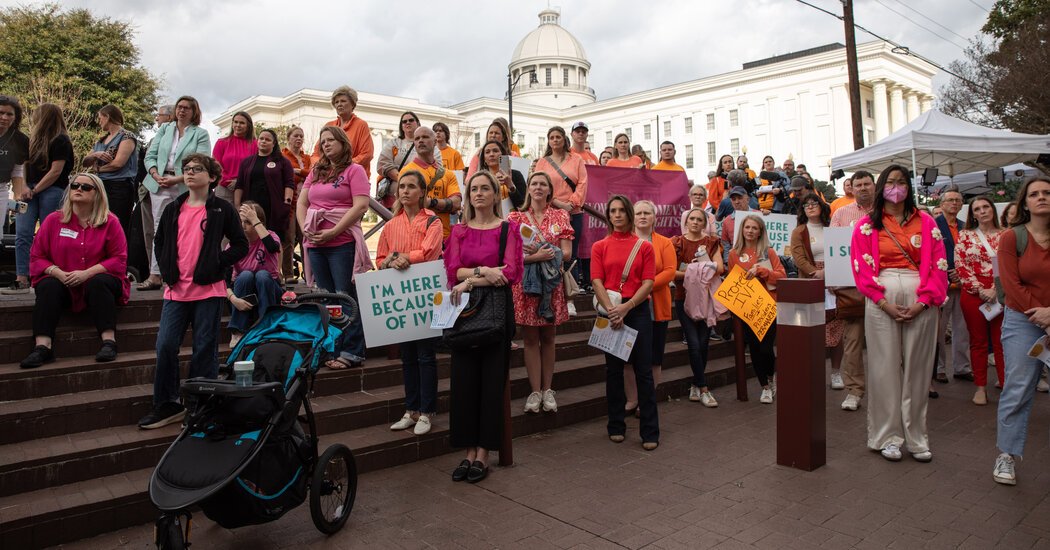
The Alabama legislature on Wednesday is expected to approve legislation intended to make it possible for fertility clinics in the state to reopen without the specter of crippling lawsuits.
But the measure, hastily written and expected to pass by a substantial bipartisan margin, does not address the legal question that led to clinic closings and set off a stormy, politically fraught national debate: Whether embryos that have been frozen and stored for possible future implantation have the legal status of human beings.
The Alabama Supreme Court made such a finding last month, in the context of a claim against a Mobile clinic brought by three couples whose frozen embryos were inadvertently destroyed. The court ruled that under Alabama law, those embryos should be regarded as people, and that the couples were entitled to punitive damages for the wrongful death of a child.
Legal experts said the bill, which Governor Kay Ivey has signaled she will sign, would be the first in the country to create a legal moat around embryos, blocking lawsuits or prosecutions if they are damaged or destroyed.
But though the measure could bring enormous relief to infertility patients whose treatments had been abruptly suspended, it will do so in exchange for limiting their ability to sue when mishaps to embryos do occur. Such constraints in a field of medicine with limited regulatory oversight could make the new law vulnerable to court challenges, the experts said.
Here are answers to some key questions:
What does the measure do?
It creates two tiers of legal immunity. If embryos are damaged or destroyed, direct providers of fertility services, including doctors and clinics, cannot be sued or criminally prosecuted.
Others who handle frozen embryos, including shippers, cryobanks and manufacturers of devices such as storage tanks, have more limited protections, but those are still significant. Patients can sue them for damaged or destroyed embryos, but the only compensation they may receive is reimbursement for the costs associated with the I.V.F. cycle that was impacted.
Does the law benefit patients beyond making it possible for clinics to reopen?
It may have some benefits. The legal shield that protects providers of fertility services also includes individuals “receiving services,” which appears to extend to patients going through I.V.F.
Alabama patients would have “a cone around them as they do I.V.F. and how they treat their embryos,” including donating frozen embryos to medical research, discarding them or choosing not to be implanted with those that have genetic anomalies, said Barbara Collura, the president of Resolve, a national group that represents infertility patients.
Those shields can be hugely significant given the state supreme court’s recent ruling, the first to state that life begins at conception; not just in utero, but also outside the womb, in a fertility lab.
“Until now, no state has ever declared embryos to be humans. And once you declare them to be humans, a lot more damages become available,” said Benjamin McMichael, an associate professor at the University of Alabama School of Law who specializes in health care and tort law. “So this is the first time we’ve ever needed a bill like this because we’ve always treated embryos at most as property.”
Does the measure prevent a patient from suing a fertility provider for negligence?
The statute does not address quotidian medical malpractice claims. If an infertility patient has a dangerous ectopic pregnancy because a doctor mistakenly implanted an embryo in her fallopian tube, she can still sue for negligence, Mr. McMichael said. But among her damages, he said, she can’t claim the destroyed embryo.
“The bill doesn’t establish liability or provide a vehicle for injured parties to hold other people liable,” he said. “It only confers immunity.”
Other legal experts said that the lines drawn by the legislature were subject to dispute. Judith Daar, the dean of the Northern Kentucky University Salmon P. Chase College of Law and an expert in reproductive law, offered the example of an embryologist who switches or otherwise mishandles embryos.
“This bill says there is no recovery for patients for reproductive negligence,” she said. “I don’t think that was intended, but certainly the plain language of the statute would yield that kind of result.”
Until now, she said, patients have not always won such cases, “but here they don’t even have the option to pursue a claim.”
The measure is very much a physician protection bill, she added. “I’m not judging that but it doesn’t really address patient needs and in fact seems to deprive them of rights,” she said.
To the extent that the threat of legal consequences can modulate behavior, she said, “this bill certainly gives providers more license to be less concerned about being careful, because there’s no liability at stake.”
Are the wrongful death cases that led to the Alabama Supreme Court ruling now moot?
No, those cases can proceed. The new legislation exempts any embryo-related lawsuits currently being litigated. If, however, patients haven’t yet filed a claim based on the destruction of their embryos, they are barred from bringing it once the bill is enacted.
Does this legislation do anything to resolve the personhood controversy?
No. It entirely sidesteps the question of whether a frozen embryo is a person. That ruling, at least in the context of a wrongful death claim, still stands in Alabama. Rather than confronting the issue, which has set off a political firestorm around the country, legislators “are trying to thread the needle through the liability side of it and coming up with some very complex and counterintuitive measures,” Ms. Daar said.
Ms. Collura of Resolve said she hopes that the measure will solve an immediate problem, even though it leaves the larger issue hanging. “Is it going to get clinics open? Yes. Does it create other unintended consequences? Yes.”
Emily Cochrane contributed reporting.
