
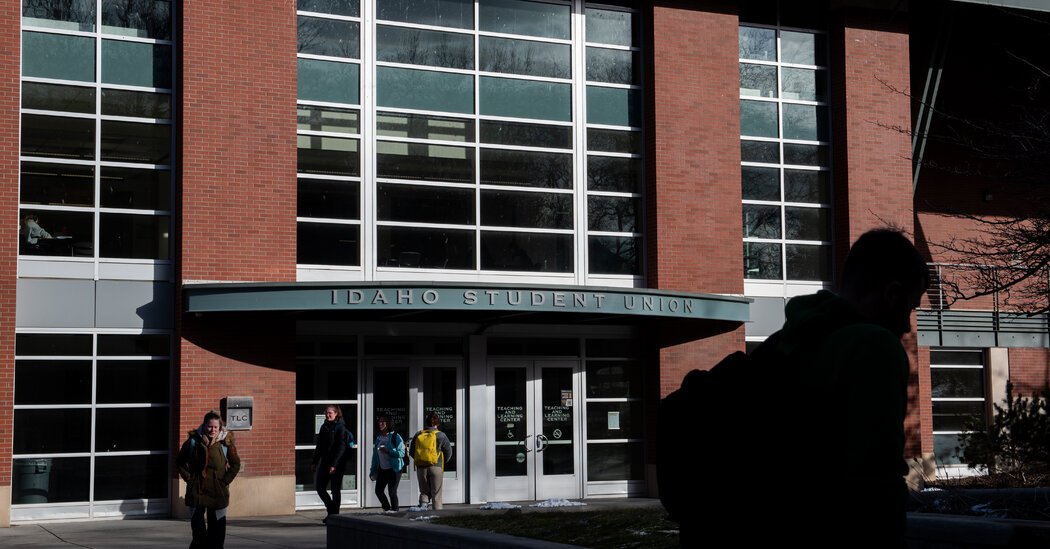
Depending on whom you ask, the University of Idaho’s plan to take over the University of Phoenix, a for-profit online school, is either a sweet deal or a potential disaster.
C. Scott Green, the president of University of Idaho, said he viewed the agreement with a price tag of $550 million as a hedge against what is known as the “demographic cliff,” an expected drop in the number of college-age students.
But critics of the university’s plan, like U.S. senators including Elizabeth Warren, nonprofits and a union, have questioned why the state’s top public university would team up with the University of Phoenix, known historically for its low graduation rates and misleading claims, so much so that it was recently ridiculed on “Saturday Night Live.”
The University of Idaho is just the latest publicly funded state school to consider partnering with a for-profit institution as a way to develop online enrollment. Arrangements at Arizona State, Purdue and, most recently, the University of Arizona have delivered varying results as higher education faces an existential crisis.
“There are going to be lots of universities that don’t survive,” Mr. Green, an alumnus of the University of Idaho and of Harvard Business School, said in an interview.
Mr. Green, who inherited a deficit when he became president in 2019, set out to run the university as a business. He cut spending, laid off employees and merged programs. He has also worked to entice students to the campus in Moscow, a city in a remote area of the state called the Palouse, which is distinctive for its vast rolling hills covered in wheat. He even published a book on navigating the university through crisis.
College enrollment across the country is expected to peak by next year and then fall precipitously as a result of lower birthrates after the economic downturn, according to research by Nathan D. Grawe, a professor at Carleton College.
Undergraduate enrollment at Idaho has inched up recently, to around 7,400 last fall, an increase of 3.4 percent since 2022. But the future is cloudy, especially for a state with one of the country’s lowest rates of students enrolling in college immediately after high school.
Mr. Green says the University of Phoenix can deliver enrollment and revenue. But it comes with its own complicated legacy.
Founded in 1976, the University of Phoenix grew rapidly, and by 2010, it enrolled more than 450,000 students, mostly online. It aggressively promoted its brand, even acquiring naming rights to an N.F.L. stadium.
Because its enrollment skews toward lower-income students and veterans, its operations have been fueled by billions of dollars in federally backed loans and grants. But along with its growth came allegations of deceptive representation. Thousands of students said they had enrolled and amassed debt, but never gotten degrees.
In 2019, the University of Phoenix reached a $191 million federal settlement following allegations that, from 2012 to 2016, it promoted nonexistent deals with companies such as Microsoft and Twitter that would help students get jobs. The Federal Trade Commission said it would reimburse 147,000 students as a result of those claims.
Alphi Black, an Army veteran from Los Angeles, is trying to have her student loans forgiven after having enrolled at the University of Phoenix following what she said were misleading sales pitches. After earning her degree in 2018, she came to view it as a handicap.
Prospective employers “kind of laughed,” she said. “They said, ‘It’s not a real school.’”
Other University of Phoenix graduates, though, say their degrees have been valuable. In December, more than 200 of them wrote to Miguel Cardona, the education secretary, in support of Idaho’s acquisition.
“We are often dismayed at the level of focus and vitriol directed at our alma mater. It seems certain officials believe we should have pursued our degrees at a different institution,” the letter to Mr. Cardona said.
Jake Searle, a former Army pilot who lives in Kuna, Idaho, was one of the graduates who signed the letter. A working father who found it difficult to attend a traditional campus, Mr. Searle, now 41, obtained two University of Phoenix degrees, including an M.B.A. in 2019.
“The University of Phoenix was the first out of the gate,” said Mr. Searle, who now works in petroleum marketing. “They were the ones that designed and developed the online platform that I would argue every other program has adopted.”
The University of Phoenix has transformed itself, according to Andrea Smiley, a spokeswoman for the school. It has closed low-performing programs and has seen higher graduation rates since 2016, when it was acquired for $1.1 billion by a group of investors, including funds associated with Apollo Global Management. Apollo Global is led by the billionaire Marc Rowan, who directed the recent donor revolt at the University of Pennsylvania that resulted in the resignation of its president, M. Elizabeth Magill.
“The University of Phoenix is proud of who we are today and the value we offer our students and alumni,” Ms. Smiley said in an email, citing “improving student outcomes, positive external reviews by our accreditor, the satisfaction of our students with our career-focused education, and our fiscal health.”
Emphasizing the value of its enrollment, which the university says it has intentionally shrunk to a more manageable 85,000 students, and its net income of about $75 million, the University of Phoenix has been shopping itself around.
It has not been a smooth process. Last year, the University of Arkansas’s board of trustees rejected a proposal, despite the chancellor’s push for a $500 million agreement.
“Why would you lie down with a dog? You’re going to get fleas,” said C.C. Gibson III, an Arkansas lawyer and former member of the university’s board, citing Phoenix’s reputational problems.
In Idaho, the plan has roiled state politics. While Gov. Brad Little has endorsed it, Raúl Labrador, the state’s attorney general, is suing to block it. Mr. Labrador is questioning the secrecy surrounding the Idaho State Board of Education vote last year that approved the complex arrangement, in which the University of Phoenix would technically be acquired by a newly created nonprofit organization.
Members of the Idaho Legislature are questioning the deal, bolstered by a legal opinion from a lawyer with the state government who says the board lacked authority to approve it. The controversy was fanned when Idaho Education News disclosed that the University of Idaho had paid the law firm Hogan Lovells, where Mr. Green was formerly the chief operating officer, more than $7 million for advice on the deal.
“From everything I can see, and from what I know about corporate acquisitions and restructurings, this deal carries substantial risk,” said Rod Lewis, a former general counsel for a major technology company who also once headed the board that oversees the state’s public universities.
In a recent opinion piece describing his reservations, Mr. Lewis asked whether the state could be on the hook for a $685 million bond issue that is being planned to finance the deal.
There is also the sense that the University of Idaho may be late to the party. Arizona State University and Purdue already sponsor major online programs, said Byron Jones, the former chief financial officer for the University of Phoenix.
“The online market itself is kind of flattening out because of the saturation rates,” Mr. Jones said.
At the University of Arizona, a budget crisis has raised questions about its acquisition of the for-profit Ashford University in 2020. Robert Shireman, a former deputy under secretary at the U.S. Education Department, points to the program, currently operating at a loss, as a cautionary sign that public universities face “innumerable hazards and complications” when teaming up with for-profit schools.
Still, the enrollment cliff is not going away.
Even though Idaho isn’t among the states expected to be hit the hardest, Mr. Green said that other universities were already trying to poach his prospective students. At a recent recruitment event at a high school in Idaho Falls, universities from as far away as Tennessee showed up, he said.
“Our competitors are already here,” Mr. Green said. “I mean, it was unbelievable. So, you know, people are going to come for our students, because they’re going to be desperate.”
